

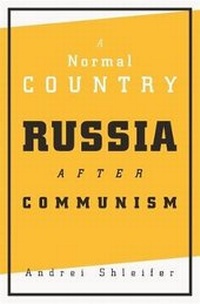
A Normal Country
Russia after Communism
Published on 31. March 2005
Book
Hardback
218 pages
978-0-674-01582-1 (ISBN)
Description
Russia's historic transition from communism in the 1990s sparked intense, often ideological debates. This book offers a firsthand glimpse into the intellectual challenges that Russia's turbulent transition generated. It deals with many of the most important reforms, from Gorbachev's half-hearted "perestroika," to the mass privatization program, to the efforts to build legal and regulatory institutions of a market economy. The essays in this book attempt to identify the driving forces of Russia's rapidly changing economic and social reality.
To understand Yeltsin's reforms, the book argues, it is essential to grasp their twin goals of destroying the remnants of the communist order and building the institutions of a market economy. Time after time, reforms were shaped to assure that communism, with its overwhelming control of the economy and society, the planning ministries, and pervasive centralization, cannot come back to Russia. Many of the successes, as well as the pathologies, of the Russian economy during the 1990s must be understood from this perspective. Despite many setbacks, Yeltsin succeeded in his life's mission. By the end of the twentieth century, both a market economy and a democracy were developed in Russia. Each was both vulnerable and flawed, but the escape from communism was certain. A decade after communism, Russia became a normal country.
To understand Yeltsin's reforms, the book argues, it is essential to grasp their twin goals of destroying the remnants of the communist order and building the institutions of a market economy. Time after time, reforms were shaped to assure that communism, with its overwhelming control of the economy and society, the planning ministries, and pervasive centralization, cannot come back to Russia. Many of the successes, as well as the pathologies, of the Russian economy during the 1990s must be understood from this perspective. Despite many setbacks, Yeltsin succeeded in his life's mission. By the end of the twentieth century, both a market economy and a democracy were developed in Russia. Each was both vulnerable and flawed, but the escape from communism was certain. A decade after communism, Russia became a normal country.
Reviews / Votes
A Normal Country will have a substantial effect on the scholarly perception of Russia's postcommunist economic transformation. -- Anders Aslund, Carnegie Endowment for International Peace Andrei Shleifer's A Normal Country brings together in one volume his influential and controversial set of arguments about Russia's postcommunist transformation. As an advisor to the Russian government in the 1990s, Shleifer helped to make history. This book now helps to frame the debate about that history - essential reading for any student of transitional economies. -- Michael McFaul, Stanford UniversityMore details
Language
English
Place of publication
Cambridge, Mass
United States
Target group
Professional and scholarly
Illustrations
22 line illustrations, 16 tables
Dimensions
Height: 235 mm
Width: 156 mm
ISBN-13
978-0-674-01582-1 (9780674015821)
Copyright in bibliographic data and cover images is held by Nielsen Book Services Limited or by the publishers or by their respective licensors: all rights reserved.
Schweitzer Classification
Person
Andrei Shleifer is Professor of Economics at Harvard University.
Content
1. Russia after Communism 2. The Transition to a Market Economy: Pitfalls of Partial Reform 3. Privatizing Russia 4. How Does Privatization Work? Evidence from the Russian Shops 5. Origins of Bad Policies: Control, Corruption, and Confusion 6. The Invisible Hand and the Grabbing Hand 7. The Unofficial Economy in Transition 8. Toward a Theory of Legal Reform 9. Federalism with and without Political Centralization: China versus Russia 10. A Normal Country Notes References Index