

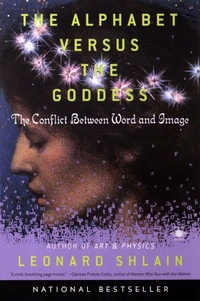
The Alphabet versus The Goddess
The Conflict Between Word and Image
Published on 1. September 1999
Book
Paperback/Softback
496 pages
978-0-14-019601-6 (ISBN)
Description
This groundbreaking book proposes that the rise of alphabetic literacy reconfigured the human brain and brought about profound changes in history, religion, and gender relations. Making remarkable connections across brain function, myth, and anthropology, Dr. Shlain shows why pre-literate cultures were principally informed by holistic, right-brain modes that venerated the Goddess, images, and feminine values. Writing drove cultures toward linear left-brain thinking and this shift upset the balance between men and women, initiating the decline of the feminine and ushering in patriarchal rule. Examining the cultures of the Israelites, Greeks, Christians, and Muslims, Shlain reinterprets ancient myths and parables in light of his theory. Provocative and inspiring, this book is a paradigm-shattering work that will transform your view of history and the mind.
More details
Language
English
Place of publication
New York
United States
Publishing group
Penguin Putnam Inc
Target group
College/higher education
Professional and scholarly
Dimensions
Height: 214 mm
Width: 141 mm
Thickness: 28 mm
Weight
449 gr
ISBN-13
978-0-14-019601-6 (9780140196016)
Copyright in bibliographic data and cover images is held by Nielsen Book Services Limited or by the publishers or by their respective licensors: all rights reserved.
Schweitzer Classification
Other editions
Additional editions
E-Book
09/1999
Penguin Books
€12.49
Available for download
Person
Leonard Shlain is the author of Art & Physics: Parallel Visions in Space, Time & Light, and The Alphabet Versus the Goddess: The Conflict Between Word and Image. He is the chief of laparoscopic surgery at California Medical Center in San Francisco.
Content
The Alphabet Versus the Goddess Preface
Acknowledgments
1. Image/Word
2. Hunters/Gatherers
3. Right Brain/Left Brain
4. Males: Death/Females: Life
5. Nonverbal/Verbal
6. Cuneiform/Marduk
7. Hieroglyphs/Isis
8. Aleph/Bet
9. Hebrews/Israelites
10. Abraham/Moses
11. Thera/Matzah
12. Adam/Eve
13. Cadmus/Alpha
14. Sappho/Ganymede
15. Dionysus/Apollo
16. Athens/Sparta
17. Lingam/Yoni
18. Birth/Death
19. Yin/Yang
20. Taoism/Confucianism
21. B.C./A.D.
22. Jesus/Christ
23. Death/Rebirth
24. Patriarchs/Heretics
25. Reason/Madness
26. Illiteracy/Celibacy, 500-1000
27. Muslin Veils/Muslim Words
28. Mystic/Scholastic, 1000-1300
29. Humanist/Egoist, 1300-1500
30. Protestant/Catholic
31. Faith/Hate
32. Sorcery/Science
33. Positive/Negative, 1648-1899
34. Id/Superego, 1900-1945
35. Page/Screen, 1945-2000
Epilogue
Notes
Bibliography
Index
Acknowledgments
1. Image/Word
2. Hunters/Gatherers
3. Right Brain/Left Brain
4. Males: Death/Females: Life
5. Nonverbal/Verbal
6. Cuneiform/Marduk
7. Hieroglyphs/Isis
8. Aleph/Bet
9. Hebrews/Israelites
10. Abraham/Moses
11. Thera/Matzah
12. Adam/Eve
13. Cadmus/Alpha
14. Sappho/Ganymede
15. Dionysus/Apollo
16. Athens/Sparta
17. Lingam/Yoni
18. Birth/Death
19. Yin/Yang
20. Taoism/Confucianism
21. B.C./A.D.
22. Jesus/Christ
23. Death/Rebirth
24. Patriarchs/Heretics
25. Reason/Madness
26. Illiteracy/Celibacy, 500-1000
27. Muslin Veils/Muslim Words
28. Mystic/Scholastic, 1000-1300
29. Humanist/Egoist, 1300-1500
30. Protestant/Catholic
31. Faith/Hate
32. Sorcery/Science
33. Positive/Negative, 1648-1899
34. Id/Superego, 1900-1945
35. Page/Screen, 1945-2000
Epilogue
Notes
Bibliography
Index