

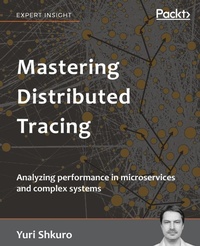
Mastering Distributed Tracing
Analyzing performance in microservices and complex systems
Published on 28. February 2019
Book
Paperback/Softback
444 pages
978-1-78862-846-4 (ISBN)
Description
Understand how to apply distributed tracing to microservices-based architectures
Key Features
A thorough conceptual introduction to distributed tracing
An exploration of the most important open standards in the space
A how-to guide for code instrumentation and operating a tracing infrastructure
Book DescriptionMastering Distributed Tracing will equip you to operate and enhance your own tracing infrastructure. Through practical exercises and code examples, you will learn how end-to-end tracing can be used as a powerful application performance management and comprehension tool.
The rise of Internet-scale companies, like Google and Amazon, ushered in a new era of distributed systems operating on thousands of nodes across multiple data centers. Microservices increased that complexity, often exponentially. It is harder to debug these systems, track down failures, detect bottlenecks, or even simply understand what is going on. Distributed tracing focuses on solving these problems for complex distributed systems. Today, tracing standards have developed and we have much faster systems, making instrumentation less intrusive and data more valuable.
Yuri Shkuro, the creator of Jaeger, a popular open-source distributed tracing system, delivers end-to-end coverage of the field in Mastering Distributed Tracing. Review the history and theoretical foundations of tracing; solve the data gathering problem through code instrumentation, with open standards like OpenTracing, W3C Trace Context, and OpenCensus; and discuss the benefits and applications of a distributed tracing infrastructure for understanding, and profiling, complex systems.
What you will learn
How to get started with using a distributed tracing system
How to get the most value out of end-to-end tracing
Learn about open standards in the space
Learn about code instrumentation and operating a tracing infrastructure
Learn where distributed tracing fits into microservices as a core function
Who this book is forAny developer interested in testing large systems will find this book very revealing and in places, surprising. Every microservice architect and developer should have an insight into distributed tracing, and the book will help them on their way. System administrators with some development skills will also benefit. No particular programming language skills are required, although an ability to read Java, while non-essential, will help with the core chapters.
Key Features
A thorough conceptual introduction to distributed tracing
An exploration of the most important open standards in the space
A how-to guide for code instrumentation and operating a tracing infrastructure
Book DescriptionMastering Distributed Tracing will equip you to operate and enhance your own tracing infrastructure. Through practical exercises and code examples, you will learn how end-to-end tracing can be used as a powerful application performance management and comprehension tool.
The rise of Internet-scale companies, like Google and Amazon, ushered in a new era of distributed systems operating on thousands of nodes across multiple data centers. Microservices increased that complexity, often exponentially. It is harder to debug these systems, track down failures, detect bottlenecks, or even simply understand what is going on. Distributed tracing focuses on solving these problems for complex distributed systems. Today, tracing standards have developed and we have much faster systems, making instrumentation less intrusive and data more valuable.
Yuri Shkuro, the creator of Jaeger, a popular open-source distributed tracing system, delivers end-to-end coverage of the field in Mastering Distributed Tracing. Review the history and theoretical foundations of tracing; solve the data gathering problem through code instrumentation, with open standards like OpenTracing, W3C Trace Context, and OpenCensus; and discuss the benefits and applications of a distributed tracing infrastructure for understanding, and profiling, complex systems.
What you will learn
How to get started with using a distributed tracing system
How to get the most value out of end-to-end tracing
Learn about open standards in the space
Learn about code instrumentation and operating a tracing infrastructure
Learn where distributed tracing fits into microservices as a core function
Who this book is forAny developer interested in testing large systems will find this book very revealing and in places, surprising. Every microservice architect and developer should have an insight into distributed tracing, and the book will help them on their way. System administrators with some development skills will also benefit. No particular programming language skills are required, although an ability to read Java, while non-essential, will help with the core chapters.
More details
Language
English
Place of publication
Birmingham
United Kingdom
Target group
Professional and scholarly
Dimensions
Height: 235 mm
Width: 191 mm
Thickness: 24 mm
Weight
823 gr
ISBN-13
978-1-78862-846-4 (9781788628464)
Copyright in bibliographic data and cover images is held by Nielsen Book Services Limited or by the publishers or by their respective licensors: all rights reserved.
Schweitzer Classification
Other editions
Additional editions
E-Book
06/2024
1st Edition
Packt Publishing Limited
€39.99
Available for download
Person
Dr. Yuri Shkuro holds a Ph.D. in Computer Science from University of Maryland, College Park, and a Master's degree in Computer Engineering from MEPhI (Moscow Engineering & Physics Institute), one of Russia's top three universities. Yuri is the author of many academic papers in the area of machine learning and neural networks, which have been cited in over 130 other publications. Yuri's impressive career includes 15 years on Wall Street, building trading and risk management systems for derivatives at top investment banks, Goldman Sacks, JPMorgan Chase, and Morgan Stanley, and over three years on Uber's Infrastructure & Observability team. His open-source credentials include being a co-founder and a member of the Specification Council of the OpenTracing project, and the creator and current tech lead of Jaeger, a distributed tracing system developed at Uber. Both projects are incubating at the Cloud Native Computing Foundation. Outside of his academic and professional career, Yuri was an editor and co-producer of several animated shorts directed by Lev Polyakov, including: * Only Love (2008), which screened at over 30 film festivals and won several awards * Piper the Goat and the Peace Pipe (2005), a winner at the Ottawa International Animation Festival
Content
Table of Contents
Why Distributed Tracing
Take Tracing for a HotROD ride
Distributed Tracing Fundamentals
Instrumentation Basics with OpenTracing
Instrumentation of Asynchronous Applications
Tracing Standards and Ecosystem
Tracing with Service Mesh
All About Sampling
Turning the Lights On
Distributed Context Propagation
Integration with Metrics and Logs
Gathering Insights with Data Mining
Implementing Tracing in Large Organizations
Under the Hood of a Distributed Tracing System
Why Distributed Tracing
Take Tracing for a HotROD ride
Distributed Tracing Fundamentals
Instrumentation Basics with OpenTracing
Instrumentation of Asynchronous Applications
Tracing Standards and Ecosystem
Tracing with Service Mesh
All About Sampling
Turning the Lights On
Distributed Context Propagation
Integration with Metrics and Logs
Gathering Insights with Data Mining
Implementing Tracing in Large Organizations
Under the Hood of a Distributed Tracing System