

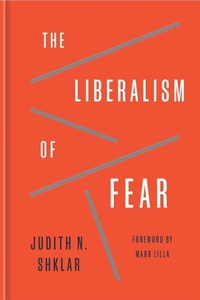
The Liberalism of Fear
Will be published approx. on 6. October 2026
Book
Hardback
88 pages
978-0-674-30663-9 (ISBN)
Description
Available for the first time in a stand-alone volume, the classic essay that envisions liberalism not as the triumphant endpoint of political progress, or even a cohesive ideology, but rather as a precarious guardrail against abuses of power.
After the collapse of the Soviet Union, many hailed the supposed triumph of liberal democracy as the "end of history." But Judith Shklar offers a sober and cautionary perspective. Far from an inevitable or permanent political order, liberalism was as fragile as it was essential: always threatened by the abusive political forces against which it offered imperfect but necessary defense. Shklar's vision of a bulwark in the face of cruelty, rather than a venerable ideology of freedom or individual autonomy, powerfully rejects conceptions of liberalism that were easy targets of critique from both left and right.
With its focus on the thin line dividing our political system from authoritarianism, The Liberalism of Fear is as relevant today as it was on its initial publication. Democratic institutions, from the courts to the ballot, are under attack from within, and marginalized groups are even more vulnerable to state-sanctioned violence. Now as before, our faith in the liberal order seems to be fueled above all by a fear of the alternatives. This is as it should be, according to Shklar: Properly conceived, liberalism is a means of survival, not the road to utopia.
A new foreword by Mark Lilla places this classic study in its historical context and solidifies its importance during a precarious moment. A perfect entryway into Shklar's large and influential body of work, The Liberalism of Fear is both an essential addition to any scholar's library and a powerful note of warning.
After the collapse of the Soviet Union, many hailed the supposed triumph of liberal democracy as the "end of history." But Judith Shklar offers a sober and cautionary perspective. Far from an inevitable or permanent political order, liberalism was as fragile as it was essential: always threatened by the abusive political forces against which it offered imperfect but necessary defense. Shklar's vision of a bulwark in the face of cruelty, rather than a venerable ideology of freedom or individual autonomy, powerfully rejects conceptions of liberalism that were easy targets of critique from both left and right.
With its focus on the thin line dividing our political system from authoritarianism, The Liberalism of Fear is as relevant today as it was on its initial publication. Democratic institutions, from the courts to the ballot, are under attack from within, and marginalized groups are even more vulnerable to state-sanctioned violence. Now as before, our faith in the liberal order seems to be fueled above all by a fear of the alternatives. This is as it should be, according to Shklar: Properly conceived, liberalism is a means of survival, not the road to utopia.
A new foreword by Mark Lilla places this classic study in its historical context and solidifies its importance during a precarious moment. A perfect entryway into Shklar's large and influential body of work, The Liberalism of Fear is both an essential addition to any scholar's library and a powerful note of warning.
Reviews / Votes
Judith Shklar's disabused vision of liberalism has survived more optimistic versions of the creed. It is high time for this classic essay to stand alone, in a frightening political moment and as so many are finding her wisdom a touchstone. -- Samuel Moyn, author of <i>Liberalism Against Itself</i> Shklar's legacy is an inspiring example of liberal thought at its arresting best, unflinchingly courageous and unmoved by the dreary and unmeaning harmonies conjured up by theories of justice and rights. -- John Gray, <i>Times Literary Supplement</i> Judith Shklar's essay about cruelty being the one vice that a liberal society must avoid and combat gains more relevance every day. As right- and left-wing populist movements rise and compassion fatigue overwhelms constitutional democracies, Shklar's wise words caution us to seek a more robust and humane liberalism. -- Seyla Benhabib, author of <i>The Rights of Others</i>More details
Language
English
Place of publication
Cambridge, Mass
United States
Target group
Professional and scholarly
Illustrations
1 photo
Dimensions
Height: 152 mm
Width: 102 mm
Thickness: 6 mm
Weight
130 gr
ISBN-13
978-0-674-30663-9 (9780674306639)
Copyright in bibliographic data and cover images is held by Nielsen Book Services Limited or by the publishers or by their respective licensors: all rights reserved.
Schweitzer Classification
Persons
Judith N. Shklar (1928-1992) was John Cowles Professor of Government at Harvard University and a MacArthur Fellow. Her many books include American Citizenship: The Quest for Inclusion, Ordinary Vices, and Legalism: Law, Morals, and Political Trials. Mark Lilla is Professor of the Humanities at Columbia University and a frequent contributor to the New York Review of Books and other publications worldwide. His books include Ignorance and Bliss: On Wanting Not to Know, The Once and Future Liberal: After Identity Politics, The Shipwrecked Mind: On Political Reaction, and The Stillborn God: Religion, Politics, and the Modern West.