

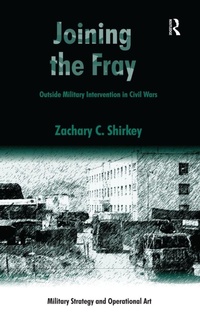
Joining the Fray
Outside Military Intervention in Civil Wars
1st Edition
Published on 21. November 2012
Book
Hardback
232 pages
978-1-4094-2892-3 (ISBN)
Description
National leaders often worry that civil wars might spread, but also seem to have little grasp on which civil wars will in fact draw in other states. An ability to understand which civil wars are most likely to draw in outside powers and when this is likely to happen has important policy implications as well as simply answering a scholarly question. Joining the Fray takes existing explanations about which outside states are likely to intervene militarily in civil wars and adds to them explanations about when states join and why. Building on his earlier volume, Is this a Private Fight or Can Anybody Join?, Zachary C. Shirkey looks at how the decision to join a civil war can be intuitively understood as follows: given that remaining neutral was wise when a war began something must change in order for a country to change its beliefs about the benefits of fighting and join the war. This book studies what these changes are, focusing in particular on revealed information and commitment problems.
Reviews / Votes
'Applying the insights of his first book on joining and interstate wars now to the domain of civil wars, Shirkey provides a detailed and convincing account of how revealed information and commitment problems affect intervention in civil wars. A must-read for anyone interested in understanding why civil conflicts sometimes spread and sometimes do not.' Page Fortna, Saltzman Institute of War and Peace Studies, Columbia University, USA 'Why and when do states intervene militarily in ongoing civil wars? Through careful theorizing that highlights the role of revealed information and commitment problems, and in-depth case studies that span nearly two centuries, Shirkey provides a new answer to a question of great importance for both theory and policy. Joining the Fray is required reading for students of civil war.' Jack S. Levy, Rutgers University, USA 'Despite their name, civil wars rarely are completely contained within a single state, a fact we often neglect. Shirkey does not. With clear logic and careful case-studies he shows that whether outsiders join is influenced by pre-existing factors, like geography, great power status and alliances, and by developments during the war, particularly surprises on the battlefield and expectations about how the winner might behave later. This is an important study.' Robert Jervis, Columbia University, USA '... Shirkey develops a theory whose main hypothesis contends that revealed information and commitment problems account for changes in interventionist attitudes ... The theory also acknowledges the role of alliances and institutional patterns of interaction, as well as elements of strategy delay. In doing so, the book becomes a significant and intellectually refreshing addition to the existing literature.' Journal of Peace ResearchMore details
Series
Language
English
Place of publication
London
United Kingdom
Publishing group
Taylor & Francis Ltd
Target group
College/higher education
Professional and scholarly
Dimensions
Height: 240 mm
Width: 161 mm
Thickness: 17 mm
Weight
517 gr
ISBN-13
978-1-4094-2892-3 (9781409428923)
Copyright in bibliographic data and cover images is held by Nielsen Book Services Limited or by the publishers or by their respective licensors: all rights reserved.
Schweitzer Classification
Other editions
Additional editions
Book
11/2016
1st Edition
Routledge
€78.40
Shipment within 10-20 days
E-Book
05/2016
Routledge
€72.49
Available for download
E-Book
05/2016
Routledge
€72.49
Available for download
Person
Zachary C. Shirkey, Hunter College, City University of New York, USA
Content
Contents: The puzzle and importance of military intervention in civil wars; Why states join civil wars: revealed information and commitment problems; The Hungarian revolution (1848-49): unexpected defeats and nagging commitment problems; The Lebanese civil war (1975-90): revealed information, commitment problems or pretexts?; The First and Second Congo wars (1996-2003): ethnic ties, refugee flows and commitment problems; The Afghan civil war (1978-2001): invasion versus military aid; Conclusions, extensions, implications for policy and avenues for future research; Bibliography; Index.