

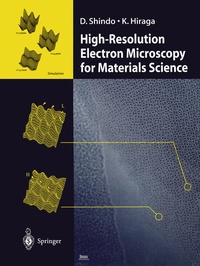
High-Resolution Electron Microscopy for Materials Science
Published on 1. September 1998
Book
Paperback/Softback
IX, 190 pages
978-4-431-70234-4 (ISBN)
Description
High-resolution electron microscopy (HREM) has become a most powerful method for investigating the internal structure of materials on an atomic scale of around 0.1 nm. The authors clearly explain both the theory and practice of HREM for materials science. In addition to a fundamental formulation of the imaging process of HREM, there is detailed explanation of image simulationindispensable for interpretation of high-resolution images. Essential information on appropriate imaging conditions for observing lattice images and structure images is presented, and methods for extracting structural information from these observations are clearly shown, including examples in advanced materials. Dislocations, interfaces, and surfaces are dealt with, and materials such as composite ceramics, high-Tc superconductors, and quasicrystals are also considered. Included are sections on the latest instruments and techniques, such as the imaging plate and quantitative HREM.
More details
Edition
Softcover reprint of the original 1st ed. 1998
Language
English
Place of publication
Tokyo
Japan
Target group
Professional and scholarly
Research
Illustrations
IX, 190 p.
Dimensions
Height: 280 mm
Width: 210 mm
Thickness: 12 mm
Weight
513 gr
ISBN-13
978-4-431-70234-4 (9784431702344)
DOI
10.1007/978-4-431-68422-0
Schweitzer Classification
Persons
Daisuke Shindo received his Dr. Eng. from Tohoku University in 1982. He is Professor Emeritus in Tohoku University and Team Leader in RIKEN Center for Emergent Matter Science. He is Fellow of the Japan Institute of Metals and Materials and Fellow of Korean Society of Microscopy. He has been involved in electron microscopy for more than 30 years. He is Author of books "High-Resolution Electron Microscopy for Materials Science" and "Analytical Electron Microscopy for Materials Science." He is currently interested in electromagnetic-field observation by electron holography, in particular, in electron holographic observation of collective motions of electrons.
Zentaro Akase received his Dr. Eng. from Kyushu University in 2001. He is Senior Assistant Professor in the Institute of Multidisciplinary Research for Advanced Materials, Tohoku University. His current research activities include the development of in-situ Lorentz microscopy with alternating magnetic fields and analysis of effects of dynamical electron diffraction on phase shift detected by electron holography. In-situ observation with electron holography is his main current research interest.
Content
1. Basis of High-Resolution Electron Microscopy.- 1.1 Principles of Transmission Electron Microscopy.- 1.2 Electron Scattering and Fourier Transform.- 1.3 Formation of High-Resolution Images.- 1.4 Computer Simulation of High-Resolution Images.- References.- 2. Practice of High-Resolution Electron Microscopy.- 2.1 Classification of High-Resolution Images.- 2.2 Practice in Observing High-Resolution Images.- References.- 3. Application of High-Resolution Electron Microscopy.- 3.1 High-Resolution Images of Various Defects.- 3.2 High-Resolution Images of Various Materials.- References.- 4. Peripheral Instruments and Techniques for High-Resolution Electron Microscopy.- 4.1 Image Processing.- 4.2 Quantitative Analysis.- 4.3 Electron Diffraction.- 4.4 Weak-Beam Method.- 4.5 Evaluation of the Performance of Electron Microscopes.- 4.6 Specimen Preparation Techniques.- References.- Appendixes.- Appendix A. Physical Constants, Conversion Factors and Electron Wavelength.- Appendix B. Geometry of Crystal Lattice.- Appendix C. Typical Structures in Materials and Their Electron Diffraction Patterns.- Appendix D. Properties of Fourier Transform.- Appendix E. Sign Conventions.