

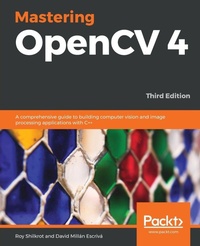
Mastering OpenCV 4
A comprehensive guide to building computer vision and image processing applications with C++
3rd Edition
Published on 27. December 2018
Book
Paperback/Softback
280 pages
978-1-78953-357-6 (ISBN)
Description
Work on practical computer vision projects covering advanced object detector techniques and modern deep learning and machine learning algorithms
Key Features
Learn about the new features that help unlock the full potential of OpenCV 4
Build face detection applications with a cascade classifier using face landmarks
Create an optical character recognition (OCR) model using deep learning and convolutional neural networks
Book DescriptionMastering OpenCV, now in its third edition, targets computer vision engineers taking their first steps toward mastering OpenCV. Keeping the mathematical formulations to a solid but bare minimum, the book delivers complete projects from ideation to running code, targeting current hot topics in computer vision such as face recognition, landmark detection and pose estimation, and number recognition with deep convolutional networks.
You'll learn from experienced OpenCV experts how to implement computer vision products and projects both in academia and industry in a comfortable package. You'll get acquainted with API functionality and gain insights into design choices in a complete computer vision project. You'll also go beyond the basics of computer vision to implement solutions for complex image processing projects.
By the end of the book, you will have created various working prototypes with the help of projects in the book and be well versed with the new features of OpenCV4.What you will learn
Build real-world computer vision problems with working OpenCV code samples
Uncover best practices in engineering and maintaining OpenCV projects
Explore algorithmic design approaches for complex computer vision tasks
Work with OpenCV's most updated API (v4.0.0) through projects
Understand 3D scene reconstruction and Structure from Motion (SfM)
Study camera calibration and overlay AR using the ArUco Module
Who this book is forThis book is for those who have a basic knowledge of OpenCV and are competent C++ programmers. You need to have an understanding of some of the more theoretical/mathematical concepts, as we move quite quickly throughout the book.
Key Features
Learn about the new features that help unlock the full potential of OpenCV 4
Build face detection applications with a cascade classifier using face landmarks
Create an optical character recognition (OCR) model using deep learning and convolutional neural networks
Book DescriptionMastering OpenCV, now in its third edition, targets computer vision engineers taking their first steps toward mastering OpenCV. Keeping the mathematical formulations to a solid but bare minimum, the book delivers complete projects from ideation to running code, targeting current hot topics in computer vision such as face recognition, landmark detection and pose estimation, and number recognition with deep convolutional networks.
You'll learn from experienced OpenCV experts how to implement computer vision products and projects both in academia and industry in a comfortable package. You'll get acquainted with API functionality and gain insights into design choices in a complete computer vision project. You'll also go beyond the basics of computer vision to implement solutions for complex image processing projects.
By the end of the book, you will have created various working prototypes with the help of projects in the book and be well versed with the new features of OpenCV4.What you will learn
Build real-world computer vision problems with working OpenCV code samples
Uncover best practices in engineering and maintaining OpenCV projects
Explore algorithmic design approaches for complex computer vision tasks
Work with OpenCV's most updated API (v4.0.0) through projects
Understand 3D scene reconstruction and Structure from Motion (SfM)
Study camera calibration and overlay AR using the ArUco Module
Who this book is forThis book is for those who have a basic knowledge of OpenCV and are competent C++ programmers. You need to have an understanding of some of the more theoretical/mathematical concepts, as we move quite quickly throughout the book.
More details
Edition
3rd Revised edition
Language
English
Place of publication
Birmingham
United Kingdom
Target group
Professional and scholarly
US School Grade: College Graduate Student
Edition type
Revised edition
Dimensions
Height: 235 mm
Width: 191 mm
Thickness: 16 mm
Weight
528 gr
ISBN-13
978-1-78953-357-6 (9781789533576)
Copyright in bibliographic data and cover images is held by Nielsen Book Services Limited or by the publishers or by their respective licensors: all rights reserved.
Schweitzer Classification
Other editions
Additional editions
Roy Shilkrot | David Millan Escriva
Mastering OpenCV 4
A comprehensive guide to building computer vision and image processing applications with C++
E-Book
09/2024
3rd Edition
Packt Publishing
€34.99
Available for download
Persons
Roy Shilkrot is an assistant professor of computer science at Stony Brook University, where he leads the Human Interaction group. Dr. Shilkrot's research is in computer vision, human-computer interfaces, and the cross-over between these two domains, funded by US federal, New York State, and industry grants. Dr. Shilkrot graduated from the Massachusetts Institute of Technology (MIT) with a PhD, and has authored more than 25 peer-reviewed papers published at premier computer science conferences, such as CHI and SIGGRAPH, as well as in leading academic journals such as ACM Transaction on Graphics (TOG) and ACM Transactions on Computer-Human Interaction (ToCHI). David Millan Escriva was 8 years old when he wrote his first program on an 8086 PC in Basic, which enabled the 2D plotting of basic equations. In 2005, he finished his studies in IT with honors, through the Universitat Politecnica de Valencia, in human-computer interaction supported by computer vision with OpenCV (v0.96). He has worked with Blender, an open source, 3D software project, and on its first commercial movie, Plumiferos, as a computer graphics software developer. David has more than 10 years' experience in IT, with experience in computer vision, computer graphics, pattern recognition, and machine learning, working on different projects, and at different start-ups, and companies. He currently works as a researcher in computer vision.
Content
Table of Contents
Cartoonifier and Skin Color Analysis on the RaspberryPi
Exploring Structure from Motion with the SfM Module
Face Landmark and Pose Estimation with the Face Module
Number Plate Recognition with Deep Convolutional Networks
Face Recognition with the DNN Module
Introduction to Web Computer Vision with OpenCv.js
Android Camera Calibration and AR using the ARUco Module
iOS Image Stitching with the Stitching Module
Finding the Best OpenCV Algorithm for the Job
Avoiding Common Pitfalls in OpenCV
Cartoonifier and Skin Color Analysis on the RaspberryPi
Exploring Structure from Motion with the SfM Module
Face Landmark and Pose Estimation with the Face Module
Number Plate Recognition with Deep Convolutional Networks
Face Recognition with the DNN Module
Introduction to Web Computer Vision with OpenCv.js
Android Camera Calibration and AR using the ARUco Module
iOS Image Stitching with the Stitching Module
Finding the Best OpenCV Algorithm for the Job
Avoiding Common Pitfalls in OpenCV