

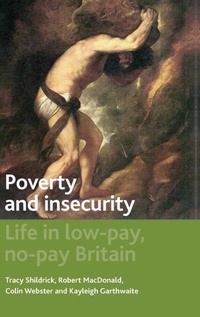
Poverty and Insecurity
Life in Low-Pay, No-Pay Britain
1st Edition
Published on 19. December 2012
Book
Hardback
264 pages
978-1-84742-911-7 (ISBN)
Description
Winner of the British Academy Peter Townsend Prize for 2013
How do men and women get by in times and places where opportunities for standard employment have drastically reduced? Are we witnessing the growth of a new class, the 'Precariat', where people exist without predictability or security in their lives? What effects do flexible and insecure forms of work have on material and psychological well-being?
This book is the first of its kind to examine the relationship between social exclusion, poverty and the labour market. It challenges long-standing and dominant myths about 'the workless' and 'the poor', by exploring close-up the lived realities of life in low-pay, no-pay Britain. Work may be 'the best route out of poverty' sometimes but for many people getting a job can be just a turn in the cycle of recurrent poverty - and of long-term churning between low-skilled 'poor work' and unemployment. Based on unique qualitative, life-history research with a 'hard-to-reach group' of younger and older people, men and women, the book shows how poverty and insecurity have now become the defining features of working life for many.
How do men and women get by in times and places where opportunities for standard employment have drastically reduced? Are we witnessing the growth of a new class, the 'Precariat', where people exist without predictability or security in their lives? What effects do flexible and insecure forms of work have on material and psychological well-being?
This book is the first of its kind to examine the relationship between social exclusion, poverty and the labour market. It challenges long-standing and dominant myths about 'the workless' and 'the poor', by exploring close-up the lived realities of life in low-pay, no-pay Britain. Work may be 'the best route out of poverty' sometimes but for many people getting a job can be just a turn in the cycle of recurrent poverty - and of long-term churning between low-skilled 'poor work' and unemployment. Based on unique qualitative, life-history research with a 'hard-to-reach group' of younger and older people, men and women, the book shows how poverty and insecurity have now become the defining features of working life for many.
Reviews / Votes
"Based on unique qualitative, life-history research with a `hard-to-reach group' of younger and older people, men and women, the book shows how poverty and insecurity have now become the defining features of working life for many. An illuminating read" - London School of Economics Review of Books "Its inestimable value is to give a much needed voice to the poor and in doing so begin to challenge the 'old libel' that informs much contemporary policy making." People, Place and Policy "This book is about one important part of the growing precariat, those who have fallen out of old working-class communities. It should make people sad and angry. It is a great corrective to the utilitarian bias exhibited by mainstream politicians. It should be widely read." Professor Guy Standing, author of The Precariat: The New Dangerous Class "The book achieves its aims of providing a thorough insight into life at the foot of the contemporary labour market in a way that is sensitive andempathetic ... This is a good quality publication produced by a research team who between them have done much to increase understanding of the
realities of working-class life." Dr David M. Smith, Canterbury Christ Church University
More details
Series
Edition
First Edition
Language
English
Place of publication
Bristol
United Kingdom
Publishing group
Bristol University Press
Target group
College/higher education
Illustrations
1 s/w Photographie bzw. Rasterbild, 4 s/w Abbildungen
1 Halftones, black and white; 4 Illustrations, black and white
Dimensions
Height: 240 mm
Width: 161 mm
Thickness: 19 mm
Weight
564 gr
ISBN-13
978-1-84742-911-7 (9781847429117)
Copyright in bibliographic data and cover images is held by Nielsen Book Services Limited or by the publishers or by their respective licensors: all rights reserved.
Schweitzer Classification
Other editions
Additional editions
Tracy Shildrick | Robert MacDonald | Colin Webster
Poverty and Insecurity
Life in Low-Pay, No-Pay Britain
Book
12/2012
1st Edition
Policy Press
€47.70
Shipment within 15-20 days
Persons
Tracy Shildrick is a Professor of Sociology at Teesside University. She has researched and written widely around issues to do with young people, poverty and worklessness.
Robert MacDonald is Professor of Sociology at Teesside University. He has long-standing research interests in the areas of youth transitions, social exclusion and unemployment.
Colin Webster is Professor of Criminology at Leeds Metropolitan University. He has long-standing research interests in ethnicity and crime and poverty and social exclusion.
Kayleigh Garthwaite is a researcher in the Geography Department at Durham University. Her research interests focus on health, welfare-to-work and identity
Robert MacDonald is Professor of Sociology at Teesside University. He has long-standing research interests in the areas of youth transitions, social exclusion and unemployment.
Colin Webster is Professor of Criminology at Leeds Metropolitan University. He has long-standing research interests in ethnicity and crime and poverty and social exclusion.
Kayleigh Garthwaite is a researcher in the Geography Department at Durham University. Her research interests focus on health, welfare-to-work and identity
Content
Introduction;
Precarious work, welfare and poverty;
Researching the low-pay, no-pay cycle;
The low-pay, no-pay cycle: the perspectives and practices of employers and 'welfare to work' agencies;
The low-pay, no-pay cycle: its pattern and people's commitment to work;
Searching for jobs: qualifications, support for the workless and the good and bad of informal social networks;
Poor work: insecurity and churning in deindustrialised labour markets;
'The ties that bind': ill-health and caring and their impact on the low-pay, no-pay cycle;
Poverty and social insecurity;
Conclusions.
Precarious work, welfare and poverty;
Researching the low-pay, no-pay cycle;
The low-pay, no-pay cycle: the perspectives and practices of employers and 'welfare to work' agencies;
The low-pay, no-pay cycle: its pattern and people's commitment to work;
Searching for jobs: qualifications, support for the workless and the good and bad of informal social networks;
Poor work: insecurity and churning in deindustrialised labour markets;
'The ties that bind': ill-health and caring and their impact on the low-pay, no-pay cycle;
Poverty and social insecurity;
Conclusions.