

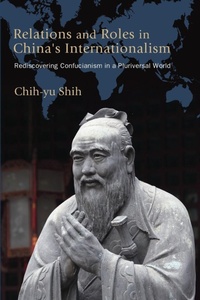
Relations and Roles in China's Internationalism
Rediscovering Confucianism in a Pluriversal World
Published on 2. February 2025
Book
Paperback/Softback
323 pages
978-1-4384-9888-1 (ISBN)
Description
Creative exploration of how the encounter between Confucianism and western (neo)liberalism necessarily leads to the unlearning of both.
Pluriversalism within International Relations and the literature on Chinese international relations each embrace ideas of relation and difference. While they similarly strive for recognition by Western academics, they do not seriously engage with each other. To the extent that either succeeds in winning recognition, it ironically reproduces Western centrism and the binary of the Western versus the non-Western. In Relations and Roles in China's Internationalism, author Chih-yu Shih demonstrates, through a critical translation exercise, that Confucian themes enable both the critique and realignment of liberal thought, allowing all of us, including the members of Confucianism and the neo-liberal order, to understand how we adapt to and coexist with each another. In the end, Confucianism not only informs the pluriversal necessity that all are bound to be related but also de-nationalizes China's internationalism.
Pluriversalism within International Relations and the literature on Chinese international relations each embrace ideas of relation and difference. While they similarly strive for recognition by Western academics, they do not seriously engage with each other. To the extent that either succeeds in winning recognition, it ironically reproduces Western centrism and the binary of the Western versus the non-Western. In Relations and Roles in China's Internationalism, author Chih-yu Shih demonstrates, through a critical translation exercise, that Confucian themes enable both the critique and realignment of liberal thought, allowing all of us, including the members of Confucianism and the neo-liberal order, to understand how we adapt to and coexist with each another. In the end, Confucianism not only informs the pluriversal necessity that all are bound to be related but also de-nationalizes China's internationalism.
Reviews / Votes
"Shih's discussion of relationality and roles from the classical Confucian perspective is a significant and indispensable step toward a full-fledged theorization of 'relationality' in international relations. Utilizing a rather de-nationalized and de-Sinicized notion of Confucian philosophy, Shih's work opens a meaningful path for the full theorization of non-Western IR." - Jungmin Seo, Yonsei University"Significantly advancing the 'relational turn' in International Relations (IR), this remarkable book offers a highly original understanding of the theoretical underpinnings of Chinese international policy. Richly textured with relevant historical examples to illuminate both philosophical and theoretical insights, Relations and Roles in China's Internationalism is an important piece of work that requires maximum exposure."-Mustapha Kamal Pasha, Aberystwyth University
More details
Series
Language
English
Place of publication
Albany, NY
United States
Target group
Professional and scholarly
US School Grade: College Graduate Student and over
Product notice
Paperback (trade)
Illustrations
3 Tables, black and white; 7 Figures
Dimensions
Height: 229 mm
Width: 152 mm
Thickness: 20 mm
Weight
528 gr
ISBN-13
978-1-4384-9888-1 (9781438498881)
Copyright in bibliographic data and cover images is held by Nielsen Book Services Limited or by the publishers or by their respective licensors: all rights reserved.
Schweitzer Classification
Other editions
Additional editions
Chih-Yu Shih
Relations and Roles in China's Internationalism
Rediscovering Confucianism in a Pluriversal World
E-Book
08/2024
1st Edition
State University of New York Press
from
€84.99
Available for download
Person
Chih-yu Shih is Visiting Chair Professor of Tongji University and Professor Emeritus of National Taiwan University. He is the author of Post-Chineseness: Cultural Politics and International Relations, also published by SUNY Press.
Content
Illustrations
Preface
Acknowledgments
Introduction: Translating Confucianism as a Pluriversal Engagement
Part One. Cosmology: Denationalizing Tianxia
1. De-Sinicizing Tianxia: The Invisible Hand of International Relations
2. Rivalry in Tianxia: Hegemony as Role Relations
Part Two. Relation: Practicing Confucian IR
3. Role and Relation in Confucian IR: Relating to Strangers in the States of Nature
4. Performing Anger: The Ethics of Foreign Policy Role Emotion
5. Patience with Nonsolutions: Emotion and Trust in Role Creation
6. Corrupting Friendship: Distance Sensibilities in International Gift Giving
7. Doomed to Expand: Exception and Exceptionalism as the Mechanisms of Relating
Part Three. Identity: (De)securitizing Chineseness
8. Western Belonging Aborted: The Ideological Background of the US-China Rivalry
9. Neither Balance nor Deterrence: Relational Security across the Taiwan Strait
10. Building Post-Western Regionalism: Moral Superiority or Post-Tianxia?
11. Experimenting with Twin Sovereignty: Implications for the Security Community
Conclusion: Unlearning Chinese Relational IR
Notes
Index
Preface
Acknowledgments
Introduction: Translating Confucianism as a Pluriversal Engagement
Part One. Cosmology: Denationalizing Tianxia
1. De-Sinicizing Tianxia: The Invisible Hand of International Relations
2. Rivalry in Tianxia: Hegemony as Role Relations
Part Two. Relation: Practicing Confucian IR
3. Role and Relation in Confucian IR: Relating to Strangers in the States of Nature
4. Performing Anger: The Ethics of Foreign Policy Role Emotion
5. Patience with Nonsolutions: Emotion and Trust in Role Creation
6. Corrupting Friendship: Distance Sensibilities in International Gift Giving
7. Doomed to Expand: Exception and Exceptionalism as the Mechanisms of Relating
Part Three. Identity: (De)securitizing Chineseness
8. Western Belonging Aborted: The Ideological Background of the US-China Rivalry
9. Neither Balance nor Deterrence: Relational Security across the Taiwan Strait
10. Building Post-Western Regionalism: Moral Superiority or Post-Tianxia?
11. Experimenting with Twin Sovereignty: Implications for the Security Community
Conclusion: Unlearning Chinese Relational IR
Notes
Index