

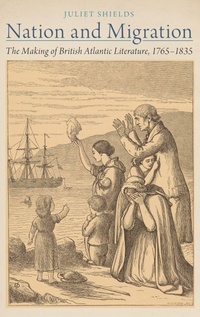
Nation and Migration
The Making of British Atlantic Literature, 1765-1835
Published on 28. January 2016
Book
Hardback
208 pages
978-0-19-027255-5 (ISBN)
Description
Nation and Migration provides a literary history for a nation that still considers itself a land of immigrants. Most studies of transatlantic literature focus primarily on what Stephen Spender has described as the "love-hate relations" between the United States and England, the imperial center of the British Atlantic world. In contrast, this book explores the significant contributions of Scotland, Ireland, and Wales to the development of a British Atlantic literature and culture. It argues that, by allowing England to stand in for the British archipelago, recent literary scholarship has oversimplified the processes through which the new United States differentiated itself culturally from Britain and underestimated the impact of migration on British nation formation during the late eighteenth and early nineteenth centuries.
Scottish, Irish, and Welsh migrants brought with them to the American colonies and early republic stories and traditions very different from those shared by English settlers. Americans looked to these stories for narratives of cultural and racial origins through which to legitimate their new nation. Writers situated in Britain's Celtic peripheries in turn drew on American discourses of rights and liberties to assert the cultural independence of Scotland, Ireland, and Wales from the English imperial center. The stories that late eighteenth- and early nineteenth-century Britons and Americans told about transatlantic migration and settlement, whether from the position of migrant or observer, reveal the tenuousness and fragility of Britain and the United States as relatively new national entities. These stories illustrate the dialectial relationship between nation and migration.
Scottish, Irish, and Welsh migrants brought with them to the American colonies and early republic stories and traditions very different from those shared by English settlers. Americans looked to these stories for narratives of cultural and racial origins through which to legitimate their new nation. Writers situated in Britain's Celtic peripheries in turn drew on American discourses of rights and liberties to assert the cultural independence of Scotland, Ireland, and Wales from the English imperial center. The stories that late eighteenth- and early nineteenth-century Britons and Americans told about transatlantic migration and settlement, whether from the position of migrant or observer, reveal the tenuousness and fragility of Britain and the United States as relatively new national entities. These stories illustrate the dialectial relationship between nation and migration.
Reviews / Votes
Overall, this book makes a valuable contribution to our recognition of how regionalism continued to be a force both in Britain and in North America during the early national period. ... Shield's charting of the unfolding of archipelagic British literatures "in dialectical relation to their American counterparts" (127) adds an important dimension to our understanding of the transatlantic cultural matrix at the turn of the nineteenth century. * Paul Giles, Modern Language Quarterly * Shields's approach-eschewing "the nation-state as a primary or natural unit of analysis while nonetheless acknowledging its long-standing role in organizing literary study" (139) -- and her focus on microgeographies result in a lucid study of Romantic-era literature that tests and displaces conventional geographical and genre boundaries. Nation and Migration is a welcome contribution to a field of study that keeps revealing important literary and critical spaces. * Michael Wiley, Modern Philology * Shields' innovative study builds on the definitive formulations and insights of New British History architect J.G.A. Pocock and the subsequent achievements of devolutionary, archipelagic criticism. But Shieldss central concern is the fields limitations. * Margaret Linley, European Romantic Review *More details
Language
English
Place of publication
New York
United States
Target group
College/higher education
Product notice
sewn/stitched
Cloth over boards
Dimensions
Height: 236 mm
Width: 155 mm
Thickness: 18 mm
Weight
408 gr
ISBN-13
978-0-19-027255-5 (9780190272555)
Copyright in bibliographic data and cover images is held by Nielsen Book Services Limited or by the publishers or by their respective licensors: all rights reserved.
Schweitzer Classification
Other editions
Additional editions
E-Book
01/2016
1st Edition
OUP eBook
€53.49
Available for download
E-Book
12/2015
1st Edition
OUP eBook
€53.49
Available for download
Person
Juliet Shields is Associate Professor of English at the University of Washington. She is the author of Sentimental Literature and Anglo-Scottish Identity, 1745-1820.
Content
Introduction: Decentering Transatlantic Literary Studies ; Chapter One: From English Empire to British Atlantic World ; Chapter Two: The Irish Uncanny and the American Gothic ; Chapter Three: Scots and Scott in the Early Republic ; Chapter Four: Wales and the American West ; Chapter Five: The Literary Sketch and British Atlantic Regionalism ; Conclusion: British Atlantic Worlds: Anglo-American, Colonial, and Archipelagic ; Bibliography