

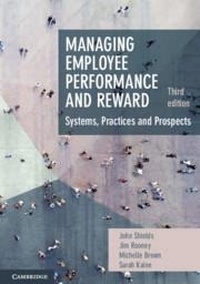
Managing Employee Performance and Reward
Systems, Practices and Prospects
3rd Edition
Published on 2. January 2020
Book
Paperback/Softback
452 pages
978-1-108-70104-4 (ISBN)
Description
The third edition of Managing Employee Performance and Reward: Systems, Practices and Prospects has been thoroughly revised and updated by a new four-member author team. The text introduces a new conceptual framework based on systems thinking and a dual model of strategic alignment and psychological engagement. Coverage of chapter topics provides a balance between research evidence and practice and, in this new edition, is enhanced with a more applied and technical approach. The text also includes chapters dedicated to conceptual framing, base pay and individual recognition and reward; 'reality check' breakout boxes with practical examples and current problems on each of strategic alignment, employee engagement, organisation justice and workforce diversity; and a new chapter exploring new horizons in performance and reward practice and research with a focus on the mega-trends of technological transformation under 'Industry 4.0', new economic forms and relationships arising from the 'gig' economy, and generational change.
More details
Edition
3rd Revised edition
Language
English
Place of publication
Cambridge
United Kingdom
Target group
College/higher education
Professional and scholarly
Edition type
Revised edition
Product notice
Paperback (trade)
Illustrations
Worked examples or Exercises; 68 Halftones, black and white; 39 Line drawings, black and white
Dimensions
Height: 249 mm
Width: 178 mm
Thickness: 32 mm
Weight
986 gr
ISBN-13
978-1-108-70104-4 (9781108701044)
Copyright in bibliographic data and cover images is held by Nielsen Book Services Limited or by the publishers or by their respective licensors: all rights reserved.
Schweitzer Classification
Other editions
New editions
John Shields | Michelle Brown | Sunghoon Kim
Managing Employee Performance and Reward
Strategies, Practices and Prospects
Book
11/2025
4th Edition
Cambridge University Press
€90.70
Shipment within 15-20 days
Additional editions
John Shields | Jim Rooney | Michelle Brown
Managing Employee Performance and Reward
Systems, Practices and Prospects
E-Book
02/2020
3rd Edition
Cambridge University Press
€76.49
Available for download
E-Book
01/2020
Cambridge University Press
€71.49
Available for download
Previous edition
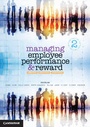
John Shields | Michelle Brown | Sarah Kaine
Managing Employee Performance and Reward
Concepts, Practices, Strategies
Book
10/2015
2nd Edition
Cambridge University Press
€64.36
Article exhausted; check for reprint
Persons
John Shields is Deputy Dean (Education) of the University of Sydney Business School and Professor of Human Resource Management and Organisational Studies in the Discipline of Work and Organisational Studies. Professor Shields holds a PhD in Economic History from the University of Sydney (1990). His principal areas of research and teaching include performance management, reward management, executive remuneration and corporate governance, and business and labour history. He is currently engaged in national and international collaborative research projects in the fields of strategic reward configuration, predictors of employee pay preferences, the impact of the director human and social capital on firm financial performance, and the relationship between employee emotional intelligence, cultural value orientation and workplace wellbeing. Jim Rooney has lectured on undergraduate and postgraduate accounting units in topics ranging from financial/management accounting through to corporate governance. Rooney has completed appointments as a Research Fellow at the Weatherhead Centre for International Relations at Harvard University as well as the Sustainability Transparency Accountability Research (STAR) Lab at Sydney University, working with senior academics at Harvard, Stanford and Sydney Universities. He also serves on the Editorial Working Party of the Labour History journal and the Executive of the Sydney branch of the Australian Society for the Study of Labour History. Over the past five years, Rooney has served in official capacities for the Genesis student entrepreneurial competition and on the technical committee of the Sydney University Economic Model. Prior to his full time appointment at the University of Sydney, Rooney has had twenty-five years business experience in general management, service operations, accounting, consulting and Information Technology roles, largely in the Financial Services industry. Michelle Brown is a Professor of Human Resource Management in the Department of Management and Marketing at the University of Melbourne. Her research examines the unintended consequences of human resource management policies and practices, with a particular focus on pay and performance management. Current projects investigate how immigrants fare under performance management systems, performance pay complaints, strategic reward configuration and predictors of employee pay preferences. Sarah Kaine lectures in human resource management (HRM) and international relations in the School of Management at the University of Technology, Sydney. Her research focuses on several broad themes: employee representation, the development and exercise of employee voice, the formal and informal regulation of employment relations and HRM and sustainability. Specifically Dr Kaine is interested in innovation in employment regulation - beyond the bounds of traditional labour law, corporate social responsibility and its link to industrial relations and the role of leadership in promoting sustainability and corporate social responsibility. Prior to becoming an academic she worked as an industrial relations practitioner and a consultant to not-for-profit organisations.
Content
1. Performance and reward basics; 2. Strategic alignment and psychological engagement; 3. Managing for results; 4. Performance appraisal and management; 5. Reviewing, discussing and developing employee performance; 6. Base pay; 7. Employee benefits; 8. Recognising and rewarding individual performance; 9. Collective short-term incentive plans; 10. Employee share ownership; 11. System review, change and development; 12. New horizons in performance and reward management.