

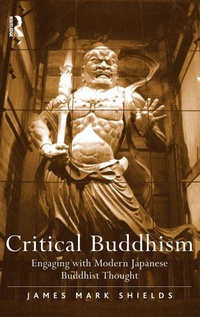
Critical Buddhism
Engaging with Modern Japanese Buddhist Thought
1st Edition
Published on 18. March 2011
Book
Hardback
216 pages
978-1-4094-1798-9 (ISBN)
Description
In the late 1980s and early 1990s, the relative calm world of Japanese Buddhist scholarship was thrown into chaos with the publication of several works by Buddhist scholars Hakamaya Noriaki and Matsumoto Shiro, dedicated to the promotion of something they called Critical Buddhism (hihan bukkyo). In their quest to re-establish a "true" - rational, ethical and humanist - form of East Asian Buddhism, the Critical Buddhists undertook a radical deconstruction of historical and contemporary East Asian Buddhism, particularly Zen. While their controversial work has received some attention in English-language scholarship, this is the first book-length treatment of Critical Buddhism as both a philosophical and religious movement, where the lines between scholarship and practice blur. Providing a critical and constructive analysis of Critical Buddhism, particularly the epistemological categories of critica and topica, this book examines contemporary theories of knowledge and ethics in order to situate Critical Buddhism within modern Japanese and Buddhist thought as well as in relation to current trends in contemporary Western thought.
Reviews / Votes
A Baker & Taylor Academic Essentials Title in Religion 'James Mark Shields has succeeded in presenting clearly a complex and little-known Japanese philosophico-political current and in analyzng its historical implications.' Bernard Bernier, Universite de Montreal, Canada 'A valuable appraisal and critique of the Critical Buddhism movement. This book will be of interest to anyone with an interest in contemporary Zen and Japanese thought.' Damien Keown, Goldsmiths College, University of London 'Anyone interested in Buddhism, philosophy, or comparative religious ethics will relish this important book. Shields accomplishes what he takes as his goal in writing this rich and incisive book: initiating a second wave? of Critical Buddhism. After analyzing how Critical Buddhists reject topicalism? in Japanese Buddhism and advocate criticalism,? Shields explores the ethical issues on which they have focused and then draws skillfully on Levinas, Gadamer, Rorty, and other philosophers to expand and reposition Critical Buddhism.' Christopher Ives, Stonehill College, USA 'Shields...offers the first substantial analysis of Critical Buddhism's presuppositions and conclusions...The details of Shields's analysis are particularly commendable - he clearly understands the history and dynamics of Critical Buddhism and has crafted an important and readable contribution to the field of Buddhist studies...Highly recommended.' ChoiceMore details
Language
English
Place of publication
London
United Kingdom
Publishing group
Taylor & Francis Ltd
Target group
College/higher education
Dimensions
Height: 240 mm
Width: 161 mm
Thickness: 16 mm
Weight
496 gr
ISBN-13
978-1-4094-1798-9 (9781409417989)
Copyright in bibliographic data and cover images is held by Nielsen Book Services Limited or by the publishers or by their respective licensors: all rights reserved.
Schweitzer Classification
Other editions
Additional editions
Book
10/2016
1st Edition
Routledge
€79.30
Shipment within 10-20 days
E-Book
04/2016
1st Edition
Routledge
€73.99
Available for download
E-Book
04/2016
1st Edition
Routledge
€73.99
Available for download
Person
James Mark Shields received a B.A. in politics and anthropology from McGill University, Montreal, Canada in 1991, followed by a Masters in Philosophy from the University of Cambridge, U.K. in 1993, and a M.A. in philosophy of religion from McGill University in 1997. In 2000 he received a Monbugakusho (Ministry of Culture and Education) Fellowship from the Japanese government, allowing him to study at Kyoto University's Institute for Japanese Philosophy from 2000-2002. He received his Ph.D. in Buddhism and philosophy of religion from McGill University in 2006. His research includes modern Buddhist thought, Japanese philosophy, comparative ethics and philosophy of religion. He has published over a dozen articles, chapters and translations in peer-reviewed scholarly publications, and is currently engaged in writing a manuscript on the progressive and radical 'New Buddhist' movements of late-Meiji, Taisho and early Showa Japan. He has taught courses on a variety of subjects, including Asian and comparative religions and philosophy, sexual ethics, religion and gender studies, and religion and the arts for McGill University, Antioch College, Bucknell University and Doshisha University. He is currently Assistant Professor of Asian and Comparative Thought at Bucknell University, Lewisburg, PA and Visiting Faculty Fellow at Doshisha University, Kyoto, Japan, 2009-10.
Content
Acknowledgments List of Abbreviations; Introduction; Chapter 1 Buddhism, Criticism, and Postwar Japan; Chapter 2 The Roots of "Topicalism"; Chapter 3 Problems in Modern Zen Thought; Chapter 4 Criticism as Anamnesis; Chapter 5 Radical Contingency and Compassion;