

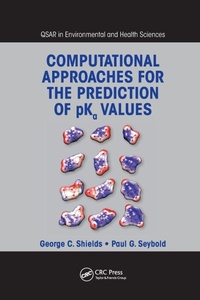
Computational Approaches for the Prediction of pKa Values
1st Edition
Published on 18. October 2017
Book
Paperback/Softback
175 pages
978-1-138-19991-0 (ISBN)
Description
The pKa of a compound describes its acidity or basicity and, therefore, is one of its most important properties. Its value determines what form of the compound-positive ion, negative ion, or neutral species-will be present under different circumstances. This is crucial to the action and detection of the compound as a drug, pollutant, or other active chemical agent. In many cases it is desirable to predict pKa values prior to synthesizing a compound, and enough is now known about the salient features that influence a molecule's acidity to make these predictions.
Computational Approaches for the Prediction of pKa Values describes the insights that have been gained on the intrinsic and extrinsic features that influence a molecule's acidity and discusses the computational methods developed to estimate acidity from a compound's molecular structure. The authors examine the strengths and weaknesses of the theoretical techniques and show how they have been used to obtain information about the acidities of different classes of chemical compounds.
The book presents theoretical methods for both general and more specific applications, covering methods for various acids in aqueous solutions-including oxyacids and related compounds, nitrogen acids, inorganic acids, and excited-state acids-as well as acids in nonaqueous solvents. It also considers temperature effects, isotope effects, and other important factors that influence pKa. This book provides a resource for predicting pKa values and understanding the bases for these determinations, which can be helpful in designing better chemicals for future uses.
Computational Approaches for the Prediction of pKa Values describes the insights that have been gained on the intrinsic and extrinsic features that influence a molecule's acidity and discusses the computational methods developed to estimate acidity from a compound's molecular structure. The authors examine the strengths and weaknesses of the theoretical techniques and show how they have been used to obtain information about the acidities of different classes of chemical compounds.
The book presents theoretical methods for both general and more specific applications, covering methods for various acids in aqueous solutions-including oxyacids and related compounds, nitrogen acids, inorganic acids, and excited-state acids-as well as acids in nonaqueous solvents. It also considers temperature effects, isotope effects, and other important factors that influence pKa. This book provides a resource for predicting pKa values and understanding the bases for these determinations, which can be helpful in designing better chemicals for future uses.
More details
Series
Language
English
Place of publication
London
United Kingdom
Publishing group
Taylor & Francis Ltd
Target group
College/higher education
Academic and industrial chemists in computational chemistry, organic chemistry, pharmaceuticals, and environmental chemistry; academics in physical chemistry; and graduate students in organic, physical organic, and physical chemistry.
Illustrations
25 s/w Abbildungen, 12 s/w Tabellen
12 Tables, black and white; 25 Illustrations, black and white
Dimensions
Height: 234 mm
Width: 156 mm
Thickness: 10 mm
Weight
281 gr
ISBN-13
978-1-138-19991-0 (9781138199910)
Copyright in bibliographic data and cover images is held by Nielsen Book Services Limited or by the publishers or by their respective licensors: all rights reserved.
Schweitzer Classification
Other editions
Additional editions
George C. Shields | Paul G. Seybold
Computational Approaches for the Prediction of pKa Values
Book
12/2013
1st Edition
CRC Press
€271.80
Shipment within 15-20 days
George C. Shields | Paul G. Seybold
Computational Approaches for the Prediction of pKa Values
E-Book
12/2013
CRC Press
€111.99
Available for download
George C. Shields | Paul G. Seybold
Computational Approaches for the Prediction of pKa Values
E-Book
12/2013
CRC Press
€111.99
Available for download
Persons
George Shields, Ph.D., is currently a professor of chemistry and dean of the College of Arts and Sciences at Bucknell University. His research uses computational chemistry to investigate atmospheric and biological chemistry.
Paul Seybold, Ph.D., has been has been a faculty member and department chair (1999-2004) in the Department of Chemistry at Wright State University in Ohio and a visiting scholar and visiting professor at a number of universities in the United States and Europe. His research interests center on chemical and biochemical applications of quantum chemistry, molecular structure-activity relationships, luminescence spectroscopy, and cellular automata models of complex systems.
Paul Seybold, Ph.D., has been has been a faculty member and department chair (1999-2004) in the Department of Chemistry at Wright State University in Ohio and a visiting scholar and visiting professor at a number of universities in the United States and Europe. His research interests center on chemical and biochemical applications of quantum chemistry, molecular structure-activity relationships, luminescence spectroscopy, and cellular automata models of complex systems.
Content
Introduction. Absolute pKa Calculations. Relative pKa Calculations. Quantitative Structure-Acidity Methods. Oxyacids and Related Compounds. Nitrogen Acids. Additional Types of Acids. Acids in Nonaqueous Solvents. Additional Factors Influencing Acidity and Basicity. Conclusions. References.