

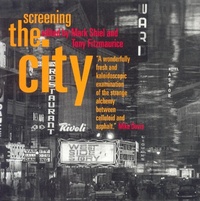
Screening the City
Published on 17. March 2003
Book
Paperback/Softback
322 pages
978-1-85984-476-2 (ISBN)
Description
The city has long been an important location for film-makers. Visually compelling and always "modern," it is the perfect metaphor for man's place in the contemporary world.
In this provocative collection of essays, a diverse range of films are examined in terms of the relationship between cinema and paradigmatic urban experience in Europe and North America since the early twentieth century. Moscow, Leningrad, Berlin, Prague and Warsaw-sites of dramatic upheaval in the 1920s-1930s, and again in the 1970s-1980s-feature strongly in the first part of the book. In the cinematic representation of these cities, modernist experimentation combined with social and political change to produce such memorable films as The Man with the Movie Camera, Berlin: The Symphony of a Great City, Berlin Alexanderplatz and, more recently, the work of Krzysztof Kieslowski, Jan Svankmajer and the Brothers Quay. The different but comparable space of the North American city since World War Two provides the primary focus for the second part of the book. Here, New York, Los Angeles, Chicago, San Francisco and Toronto provide the settings for an investigation of the relationship between cinema and race, and cinema and postmodern global capitalism, in a comprehensive range of films from Point Blank, Medium Cool, Network and Annie Hall in the 1960s and 1970s, to Boyz N the Hood, Falling Down, Pulp Fiction, [Safe], Crash and The End of Violence in the 1990s.
Throughout the book, the cinema's artistic encounter with the city always intersects with a social and political engagement in which urgent issues of class, race, sexuality, the environment, liberty, capital, and totalitarianism are everywhere at stake.
In this provocative collection of essays, a diverse range of films are examined in terms of the relationship between cinema and paradigmatic urban experience in Europe and North America since the early twentieth century. Moscow, Leningrad, Berlin, Prague and Warsaw-sites of dramatic upheaval in the 1920s-1930s, and again in the 1970s-1980s-feature strongly in the first part of the book. In the cinematic representation of these cities, modernist experimentation combined with social and political change to produce such memorable films as The Man with the Movie Camera, Berlin: The Symphony of a Great City, Berlin Alexanderplatz and, more recently, the work of Krzysztof Kieslowski, Jan Svankmajer and the Brothers Quay. The different but comparable space of the North American city since World War Two provides the primary focus for the second part of the book. Here, New York, Los Angeles, Chicago, San Francisco and Toronto provide the settings for an investigation of the relationship between cinema and race, and cinema and postmodern global capitalism, in a comprehensive range of films from Point Blank, Medium Cool, Network and Annie Hall in the 1960s and 1970s, to Boyz N the Hood, Falling Down, Pulp Fiction, [Safe], Crash and The End of Violence in the 1990s.
Throughout the book, the cinema's artistic encounter with the city always intersects with a social and political engagement in which urgent issues of class, race, sexuality, the environment, liberty, capital, and totalitarianism are everywhere at stake.
Reviews / Votes
A wonderfully kaleidoscopic examination of the strange alchemy between celluloid and asphalt. -- Mike DavisMore details
Language
English
Place of publication
London
United Kingdom
Target group
College/higher education
Professional and scholarly
Product notice
Paperback (trade)
Unsewn / adhesive bound
Dimensions
Height: 199 mm
Width: 195 mm
Thickness: 18 mm
Weight
717 gr
ISBN-13
978-1-85984-476-2 (9781859844762)
Copyright in bibliographic data and cover images is held by Nielsen Book Services Limited or by the publishers or by their respective licensors: all rights reserved.
Schweitzer Classification
Other editions
Previous edition

Mark Shiel | Tony Fitzmaurice
Screening the City
Book
03/2003
Verso Books
€69.60
Article exhausted; check for reprint
Persons
Mark Shiel is Senior Lecturer in Film Studies at King's College, London. Tony Fitzmaurice is College Lecturer in Film Studies at the Centre for Film Studies/UCD School of Film, University College Dublin. Matthew Gandy teaches geography at University College London and has published widely on urban and environmental issues.