

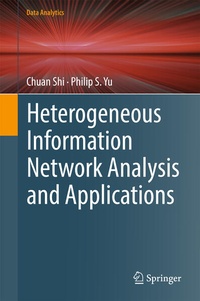
Heterogeneous Information Network Analysis and Applications
Published on 1. June 2017
Book
Hardback
IX, 227 pages
978-3-319-56211-7 (ISBN)
Description
This book offers researchers an understanding of the fundamental issues and a good starting point to work on this rapidly expanding field. It provides a comprehensive survey of current developments of heterogeneous information network. It also presents the newest research in applications of heterogeneous information networks to similarity search, ranking, clustering, recommendation.
This information will help researchers to understand how to analyze networked data with heterogeneous information networks. Common data mining tasks are explored, including similarity search, ranking, and recommendation. The book illustrates some prototypes which analyze networked data.
Professionals and academics working in data analytics, networks, machine learning, and data mining will find this content valuable. It is also suitable for advanced-level students in computer science who are interested in networking orpattern recognition.
This information will help researchers to understand how to analyze networked data with heterogeneous information networks. Common data mining tasks are explored, including similarity search, ranking, and recommendation. The book illustrates some prototypes which analyze networked data.
Professionals and academics working in data analytics, networks, machine learning, and data mining will find this content valuable. It is also suitable for advanced-level students in computer science who are interested in networking orpattern recognition.
More details
Series
Edition
1st ed. 2017
Language
English
Place of publication
Cham
Switzerland
Publishing group
Springer International Publishing
Target group
Professional and scholarly
Illustrations
53 farbige Abbildungen, 9 s/w Abbildungen
IX, 227 p. 62 illus., 53 illus. in color.
Dimensions
Height: 241 mm
Width: 160 mm
Thickness: 19 mm
Weight
530 gr
ISBN-13
978-3-319-56211-7 (9783319562117)
DOI
10.1007/978-3-319-56212-4
Schweitzer Classification
Other editions
Additional editions
Chuan Shi | Philip S. Yu
Heterogeneous Information Network Analysis and Applications
Book
08/2018
Springer
€149.79
Shipment within 10-15 days
Chuan Shi | Philip S. Yu
Heterogeneous Information Network Analysis and Applications
E-Book
05/2017
Springer
€139.09
Available for download
Persons
Chuan Shi, PhD., is a Professor and Deputy Director of Beijing Key Lab of Intelligent Telecommunications Software and Multimedia at the Beijing University of Posts and Telecommunications. He received his B.S. from Jilin University in 2001, his M.S. from Wuhan University in 2004, and his Ph.D. from the ICT of Chinese Academic of Sciences in 2007. His research interests include data mining, machine learning, and evolutionary computing. He has published more than 100 papers in refereed journals and conferences.
Xiao Wang, Ph.D., is an Associate Professor in the School of Computer Science at the Beijing University of Posts and Telecommunications. He received his Ph.D. from the School of Computer Science and Technology at Tianjin University in 2016. He was a postdoctoral researcher in the Department of Computer Science and Technology at Tsinghua University. His current research interests include data mining, social network analysis, and machine learning. He has published more than 70 papers in refereed journals and conferences.
Cheng Yang, Ph.D., is an Associate Professor at the Beijing University of Posts and Telecommunications. He received his B.E. and Ph.D. from Tsinghua University in 2014 and 2019, respectively. His research interests include natural language processing and network representation learning. He has published more than 20 top-level papers in international journals and conferences including ACM TOIS, EMNLP, IJCAI, and AAAI.
Content
1. Introduction.- 2. Summarization of the developments.- 3.Uniform relevance measure of heterogeneous objects.- 4. Path based Ranking.- 5. Ranking based Clustering.- 6. Recommendation with heterogeneous information.- 7. Information fusion with heterogeneous network.- 8. Prototype system.- 9. Future research directions.- 10. Conclusion.