

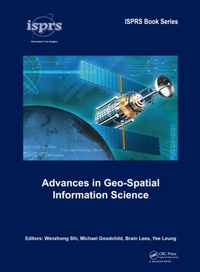
Advances in Geo-Spatial Information Science
1st Edition
Published on 12. June 2012
Book
Hardback
336 pages
978-0-415-62093-2 (ISBN)
Description
Advances in Geo-Spatial Information Science presents recent advances regarding fundamental issues of geo-spatial information science (space and time, spatial analysis, uncertainty modeling and geo-visualization), and new scientific and technological research initiatives for geo-spatial information science (such as spatial data mining, mobile data modeling, and location-based services). The book contains selected and revised papers presented at the joint International Conference on Theory, Data Handling and Modelling in GeoSpatial Information Science (Hong Kong, 26-28 May 2010), and brings together three related international academic communities: spatial information science, spatial data handling, and modeling geographic systems.
Advances in Geo-Spatial Information Science will be of interest for academics and professionals interested in spatial information science, spatial data handling, and modeling of geographic systems.
Advances in Geo-Spatial Information Science will be of interest for academics and professionals interested in spatial information science, spatial data handling, and modeling of geographic systems.
Reviews / Votes
In summary, this edited book provides an excellent coverage of the history, current state, and potential future of GIScience as an academic discipline. A variety of audiences will find the book to be a useful source of ideas and state-ofthe-art research.Shivanand Balram. In: Geomatica, Vol. 66, No. 4, 2012, pp 337-338.
More details
Series
Language
English
Place of publication
London
United Kingdom
Publishing group
Taylor & Francis Ltd
Target group
College/higher education
Professional and scholarly
Academic and Postgraduate
Dimensions
Height: 246 mm
Width: 174 mm
Weight
816 gr
ISBN-13
978-0-415-62093-2 (9780415620932)
Copyright in bibliographic data and cover images is held by Nielsen Book Services Limited or by the publishers or by their respective licensors: all rights reserved.
Schweitzer Classification
Other editions
Additional editions
Wenzhong Shi | Michael Goodchild | Brian Lees
Advances in Geo-Spatial Information Science
Book
10/2024
1st Edition
CRC Press
€75.70
Shipment within 10-20 days
Persons
Wenzhong Shi, The Hong Kong Polytechnic University, Hong Kong SAR, China. Michael F. Goodchild, University of California, Santa Barbara, USA Brian Lees, The University of New South Wales at the Australian Defence Force Academy, Australia. Yee Leung, The Chinese University of Hong Kong, Hong Kong SAR, China.
Content
Foreword; Introduction; GIScience in the 21st century; Modeling space and time: A unified spatial model for GIS; Space-time kernels; Generalization of tiled models with curved surfaces using typification; Spatio-temporal trajectory analysis of mobile objects following the same itinerary; Modelling the land allocation process in time and space; Spatial analysis and data mining: Automatically and accurately matching objects in geospatial datasets; The estimation of MOEs change based on CBR; Multi-view augmented concept to improve semantic interoperability of geospatial data; Influence Power-based Hierarchy Tree Neighbor Function Clustering Algorithm; Cooperative information augmentation in a geosensor network; Implementation of the marked Strauss point process model to the epicenters of earthquake aftershocks; Uncertainty modelling; Accuracy assessment of extensional uncertainty modelled by random sets; Hierarchical approach for an accuracy-based conflation of multi-topographic databases; Mobile data modelling: Enhancing travel time forecasting with traffic condition detection; An indexing method for supporting spatial queries in P2P systems; A multi-modal route planning approach with an improved genetic algorithm; Geo-visualization: Using digital globes to visualize climate change impact; An online geographical visualisation portal for communicating and sharing natural resource information; Multi-resolution representation of digital terrain and building models; Location-based computing and service; Individual differences in the tourist wayfinding decision-making process: A case study of Phillip Island, Victoria, Australia; Routing with minimum number of landmarks; Location based context awareness through tag-cloud visualizations; An epilogue