

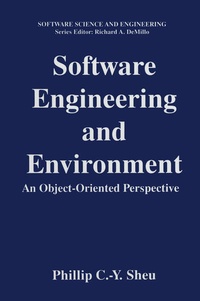
Software Engineering and Environment
An Object-Oriented Perspective
Published on 5. November 2012
Book
Paperback/Softback
XI, 323 pages
978-1-4613-7710-8 (ISBN)
Description
Software Engineering and Environment
examines the various aspects of software development, describing a number of software life cycle models. Twelve in-depth chapters discuss the different phases of a software life cycle, with an emphasis on the object-oriented paradigm. In addition to technical models, algorithms, and programming styles, the author also covers several managerial issues key to software project management. Featuring an abundance of helpful illustrations, this cogent work is an excellent resource for project managers, programmers, and other computer scientists involved in software production.
More details
Series
Edition
Softcover reprint of the original 1st ed. 1997
Language
English
Place of publication
New York
United States
Target group
Professional and scholarly
Research
Illustrations
XI, 323 p.
Dimensions
Height: 229 mm
Width: 152 mm
Thickness: 19 mm
Weight
494 gr
ISBN-13
978-1-4613-7710-8 (9781461377108)
DOI
10.1007/978-1-4615-5907-8
Schweitzer Classification
Other editions
Additional editions
Book
12/1996
1st Edition
Kluwer Academic / Plenum Publishers
€96.00
Article exhausted; check different version
Content
1. Software Life Cycle Models.- Problems.- References.- 2. Object-Oriented Concepts and Modeling.- 2.1. Basic Concepts of the Object-Oriented Paradigm.- 2.2. Object Modeling.- 2.3. Advanced Object Models.- Problems.- References.- 3. Formal Specification and Verification.- 3.1. First-Order Logic.- 3.2. Logic and Database.- 3.3. Formal Specification in Z.- 3.4. Object-Oriented Logic System.- 3.5. Algebraic Specifications.- 3.6. Petri Nets.- 3.7. Verifying Specifications.- 3.8. Final Remarks.- Problems.- References.- 4. Design Methodologies and Specifications.- 4.1. Design Concepts.- 4.2. Process Description Languages and Design Methodologies.- 4.3. Dynamic and Functional Modeling.- 4.4. Object-Oriented Design Methodologies.- 4.5. Design Verification and CASE Tools.- Problems.- References.- 5. Programming and Coding.- 5.1. Object-Oriented Programming Languages.- 5.2. c++.- 5.3. SMALLTALK.- 5.4. Distributed Programming Languages.- 5.5. Communicating Sequential Processes and OCCAM.- Problems.- References.- 6. Programming Tools.- 6.1. Object-Oriented Programming for Windows.- 6.2. IDE-An Interactive Programming Environment.- 6.3. X-Window Programming.- 6.4. UNIX Network Programming.- Problems.- References.- 7. Declarative Programming.- 7.1. Very High Level Programming.- 7.2. Object-Oriented Declarative Programming.- 7.3. Logic Programming-PROLOG.- 7.4. COMPOSE-An Object-Oriented Programming Environment.- Problems.- References.- 8. Automatic Program Synthesis and Reuse.- 8.1. Deductive Program Synthesis.- 8.2. Transformational Program Synthesis.- 8.3. Program Abstraction and Instantiation.- 8.4. Automatic Software Reuse.- Problems.- References.- 9. Program Verification and Testing.- 9.1. Formal Program Verification.- 9.2. Black Box Testing.- 9.3. Structural Testing.-9.4. Error-Based Testing.- 9.5. Automatic Test Case Generation.- 9.6. Testing and Debugging Distributed Programs.- 9.7. Analysis Tools and Software Metrics.- Problems.- References.- 10. Software Maintenance.- 10.1. Components of Software Maintenance.- 10.2. Database and Software Maintenance.- 10.3. Programming Object Bases.- 10.4. Program Management.- 10.5. Reverse Engineering and Design Recovery.- Problems.- References.- 11. Advanced Programming Environments.- 11.1. Knowledge-Based Programming Environments.- 11.2. Visual Programming Environments.- 11.3. Distributed Object-Oriented Programming Systems.- 11.4. Component Software.- 11.5. Programming Environments for Concurrent Engineering.- References.- 12. Other Selected Topics.- 12.1. Project Management.- 12.2. Fault-Tolerant System Design.- 12.3. Discrete Event Simulation.- 12.4. Internet Programming.- References.