

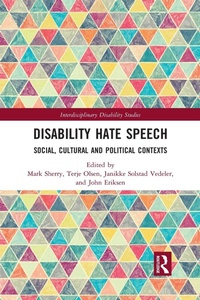
Disability Hate Speech
Social, Cultural and Political Contexts
1st Edition
Published on 30. June 2021
Book
Paperback/Softback
268 pages
978-1-032-08605-7 (ISBN)
Description
This book, the first to specifically focus on disability hate speech, explains what disability hate speech is, why it is important, what laws regulate it (both online and in person) and how it is different from other forms of hate. Unfortunately, disability is often ignored or overlooked in academic, legal, political, and cultural analyses of the broader problem of hate speech. Its unique personal, ideological, economic, political and legal dimensions have not been recognized - until now.
Disability hate speech is an everyday experience for many people, leaving terrible psycho-emotional scars. This book includes personal testimonies from victims discussing the personal impact of disability hate speech, explaining in detail how such hatred affects them. It also presents legal, historical, psychological, and cultural analyses, including the results of the first surveys and in-depth interviews ever conducted on this topic in some countries.
This book makes a vital contribution to understanding disability hatred and prejudice, and will be of particular interest to those studying issues associated with hate speech, disability, psychology, law, and prejudice.
Disability hate speech is an everyday experience for many people, leaving terrible psycho-emotional scars. This book includes personal testimonies from victims discussing the personal impact of disability hate speech, explaining in detail how such hatred affects them. It also presents legal, historical, psychological, and cultural analyses, including the results of the first surveys and in-depth interviews ever conducted on this topic in some countries.
This book makes a vital contribution to understanding disability hatred and prejudice, and will be of particular interest to those studying issues associated with hate speech, disability, psychology, law, and prejudice.
Reviews / Votes
This book is a must have for anyone who is interested in or supports people who experiences disability hate crime/speech. Stop Hate UK 2020.More details
Series
Language
English
Place of publication
London
United Kingdom
Publishing group
Taylor & Francis Ltd
Target group
College/higher education
Postgraduate
Illustrations
2 s/w Abbildungen
2 Illustrations, black and white
Dimensions
Height: 234 mm
Width: 156 mm
Thickness: 15 mm
Weight
412 gr
ISBN-13
978-1-032-08605-7 (9781032086057)
Copyright in bibliographic data and cover images is held by Nielsen Book Services Limited or by the publishers or by their respective licensors: all rights reserved.
Schweitzer Classification
Other editions
Additional editions
Mark Sherry | Terje Olsen | Janikke Solstad Vedeler
Disability Hate Speech
Social, Cultural and Political Contexts
Book
11/2019
1st Edition
Routledge
€179.81
Shipment within 15-20 days
Mark Sherry | Terje Olsen | Janikke Solstad Vedeler
Disability Hate Speech
Social, Cultural and Political Contexts
E-Book
11/2019
1st Edition
Routledge
€55.49
Available for download
Mark Sherry | Terje Olsen | Janikke Solstad Vedeler
Disability Hate Speech
Social, Cultural and Political Contexts
E-Book
11/2019
1st Edition
Routledge
€55.49
Available for download
Persons
Mark Sherry is Professor of Sociology at The University of Toledo in Ohio, USA. He is Editor of the Routledge Interdisciplinary Disability Studies Series. His books include If I Only Had a Brain: Deconstructing Brain Injury (Routledge, 2006) and Disability Hate Crimes: Does Anyone Really Hate Disabled People? (Routledge, 2010).
Terje Olsen, PhD in Sociology, is Research Director at Fafo Institute for Labour and Social Research in Oslo, Norway. His research interests include welfare state issues, disability studies, youth research, marginalization, labour market participation, legal rights and access to justice for persons with disabilities. He is Editor-in-chief of the journal Nordic Welfare Research.
Janikke Solstad Vedeler, PhD in Sociology, is a Senior Researcher at Norwegian Social Research at OsloMet - Oslo Metropolitan University and at the Nordland Research Institute. Her research interest includes disability and topics like hate speech and inclusive working life practices.
John Eriksen holds a BA in Economics and Business Administration and a Master's degree in Sociology. He is an Emeritus Researcher and formerly a Research Director at NOVA - Norwegian Social Research Institute, Oslo, Norway, and Editor-in-chief of the Scandinavian Journal of Disability Research. His former research interests include welfare policies, quality of life, disability studies, and family organization.
Terje Olsen, PhD in Sociology, is Research Director at Fafo Institute for Labour and Social Research in Oslo, Norway. His research interests include welfare state issues, disability studies, youth research, marginalization, labour market participation, legal rights and access to justice for persons with disabilities. He is Editor-in-chief of the journal Nordic Welfare Research.
Janikke Solstad Vedeler, PhD in Sociology, is a Senior Researcher at Norwegian Social Research at OsloMet - Oslo Metropolitan University and at the Nordland Research Institute. Her research interest includes disability and topics like hate speech and inclusive working life practices.
John Eriksen holds a BA in Economics and Business Administration and a Master's degree in Sociology. He is an Emeritus Researcher and formerly a Research Director at NOVA - Norwegian Social Research Institute, Oslo, Norway, and Editor-in-chief of the Scandinavian Journal of Disability Research. His former research interests include welfare policies, quality of life, disability studies, and family organization.
Content
List of contributors; Introduction Mark Sherry, Terje Olsen, Janikke Solstad Vedeler, and John Eriksen. Part I The nature of disability hate speech: Chapter 1; Disability hate speech laws Mark Sherry and Louise Walker, Chapter 2; Disablist hate speech online Mark Sherry, Chapter 3;Towards a conceptual and experiential understanding of disablist hate speech: Acceptance, harm, and resistance Leah Burch. Part II The personal impact of disability hate speech: Chapter 4; Disability hate speech: "They think they can call me anything" Armineh Soorenian, Chapter 5; Very bad bedside manner: Medical professionals and hate speech Sheri Wells-Jensen and Claire Wells-Jensen, Chapter 6; Everyday ableism and hate speech: A tale of three encounters in one day Damien Milton, Chapter 7: Hate speech and dwarfism: The influence of cultural representations Erin Pritchard. Part III Disabilist hate speech within a geopolitical context: Chapter 8; Hate speech targeting Sami people with disabilities Line Melboe and Hege Gjertsen, Chapter 9; Stereotypes fomenting hate: Perceptions, stigma, and real-world consequences for Africans with disabilities Mark P. Mostert, Chapter 10: Amputation of disability as hate speech pattern in Poland Beata Borowska-Beszta, Chapter 11; Disability under austerity: Do some forms of political rhetoric constitute disability hate speech? Lisa Davies, Chapter 12; Hate speech by carers: Exploring an Australian case Mark Sherry and Solomon Amoatey, Chapter 13; Hammerin' Hank, (dis)ablism, racism, homophobia, and hate speech Stephen A. Rosenbaum, Chapter 14; Hate speech as an expression of disablism: An examination of reported hate speech experiences and consequences Terje Olsen, Janikke Solstad Vedeler, and John Eriksen. Index