

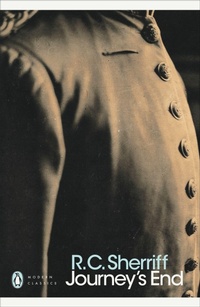
Journey's End
Published on 26. October 2000
Book
Paperback/Softback
96 pages
978-0-14-118326-8 (ISBN)
Description
Hailed by George Bernard Shaw as 'useful [corrective] to the romantic conception of war', R.C. Sherriff's Journey's End is an unflinching vision of life in the trenches towards the end of the First World War, published in Penguin Classics.
Set in the First World War, Journey's End concerns a group of British officers on the front line and opens in a dugout in the trenches in France. Raleigh, a new eighteen-year-old officer fresh out of English public school, joins the besieged company of his friend and cricketing hero Stanhope, and finds him dramatically changed. Laurence Olivier starred as Stanhope in the first performance of Journey's End in 1928; the play was an instant stage success and remains a remarkable anti-war classic.
R.C. Sherriff (1896-1975) joined the army shortly after the outbreak of the First World War, serving as a captain in the East Surrey regiment. After the war, an interest in amateur theatricals led him to try his hand at writing. Following rejection by many theatre managements, Journey's End was given a single performance by the Incorporated Stage Society, in which Lawrence Olivier took the lead role. The play's enormous success enabled Sherriff to become a full-time writer, with plays such as Badger's Green (1930), St Helena (1935), and The Long Sunset (1955); though he is also remembered as a screenplay writer, for films such as The Invisible Man (1933), Goodbye Mr Chips (1933) and The Dam Busters (1955).
If you enjoyed Journey's End, you might like Robert Graves's Goodbye to All That, available in Penguin Modern Classics.
'Its unrelenting tension, and its regard for human decency in a vast world of human waste, are impressive and, even now, moving'
Clive Barnes
Set in the First World War, Journey's End concerns a group of British officers on the front line and opens in a dugout in the trenches in France. Raleigh, a new eighteen-year-old officer fresh out of English public school, joins the besieged company of his friend and cricketing hero Stanhope, and finds him dramatically changed. Laurence Olivier starred as Stanhope in the first performance of Journey's End in 1928; the play was an instant stage success and remains a remarkable anti-war classic.
R.C. Sherriff (1896-1975) joined the army shortly after the outbreak of the First World War, serving as a captain in the East Surrey regiment. After the war, an interest in amateur theatricals led him to try his hand at writing. Following rejection by many theatre managements, Journey's End was given a single performance by the Incorporated Stage Society, in which Lawrence Olivier took the lead role. The play's enormous success enabled Sherriff to become a full-time writer, with plays such as Badger's Green (1930), St Helena (1935), and The Long Sunset (1955); though he is also remembered as a screenplay writer, for films such as The Invisible Man (1933), Goodbye Mr Chips (1933) and The Dam Busters (1955).
If you enjoyed Journey's End, you might like Robert Graves's Goodbye to All That, available in Penguin Modern Classics.
'Its unrelenting tension, and its regard for human decency in a vast world of human waste, are impressive and, even now, moving'
Clive Barnes
More details
Series
Language
English
Place of publication
London
United Kingdom
Publishing group
Penguin Books Ltd
Product notice
Paperback (UK-B)
Dimensions
Height: 195 mm
Width: 126 mm
Thickness: 10 mm
Weight
80 gr
ISBN-13
978-0-14-118326-8 (9780141183268)
Copyright in bibliographic data and cover images is held by Nielsen Book Services Limited or by the publishers or by their respective licensors: all rights reserved.
Schweitzer Classification
Other editions
Additional editions
Person
R.C. Sherriff (1896-1975) served as a captain in the East Surrey regiment during the First World War and subsequently tried his hand at writing. Following rejection by many theatre managements, Journey's End was given a single performance by the Incorporated Stage Society, in which Lawrence Olivier took the lead role. The play's enormous success enabled Sherriff to become a full-time writer. He is remembered for his plays, the screenplays for the films The Invisible Man (1933), Goodbye Mr Chips (1933) and The Dam Busters (1955), and the novel The Hopkins Manuscript (1939).