

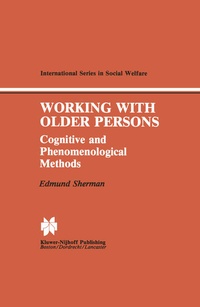
Working with Older Persons
Cognitive and Phenomenological Methods
Published on 11. March 2012
Book
Paperback/Softback
244 pages
978-94-011-7419-0 (ISBN)
Description
The essential purpose of this book is to provide practitioners and students of the human service professions with a practice approach and methodology that has been developed over the past ten years in both research and clinical work with older persons. It is concerned with the kinds of emotional prob lems that are salient and pervasive in the second half of life, that is, from about the ages of 50 on into the 60s, 70s, and 80s. These problems are often related to inevitable developmental and situational events and losses, as well as the decrements and concerns that are prevalent in the latter decades of life: physical decline and illness, loss of loved ones, concerns about one's own mortality, loss of major occupational and family roles, and the issues of meaning in and about one's life which are raised by these losses and concerns. The approach to these problems will include a range of assessment and treatment methods for counseling and psychotherapy. It will, however, em phasize two particular kinds of methods for dealing with these problems. The first of these, cognitive methods, tend to focus on how older persons think about or construe these problems whereas phenomenological methods focus on how persons experience or feel about them. What is common to both is that they are oriented toward the person's perception of the prob lem.
More details
Series
Edition
Softcover reprint of the original 1st ed. 1984
Language
English
Place of publication
Dordrecht
Netherlands
Target group
Professional and scholarly
Research
Illustrations
244 p.
Dimensions
Height: 229 mm
Width: 152 mm
Thickness: 12 mm
Weight
321 gr
ISBN-13
978-94-011-7419-0 (9789401174190)
DOI
10.1007/978-94-011-7417-6
Schweitzer Classification
Other editions
Additional editions
Book
10/1984
Kluwer Academic Publishers
€96.00
Article not available at the moment
Content
1 Introduction.- 2 Theoretical Foundations for Practice.- 3 Methods of Assessment.- 4 Methods of Treatment.- 5 Problems of Anxiety.- 6 Problems of Demoralization.- 7 Problems of Identity and Meaning.- 8 Conclusions.- References.