

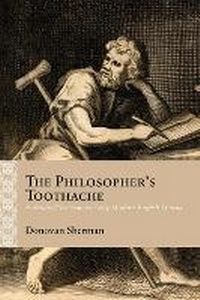
The Philosopher's Toothache
Embodied Stoicism in Early Modern English Drama
Will be published approx. on 30. November 2021
Book
Paperback/Softback
208 pages
978-0-8101-4414-9 (ISBN)
Description
The Philosopher's Toothache proposes that early modern Stoicism constituted a radical mode of performance. Stoicism-with its focus on bodily sensation, imagined spectatorship, and daily mental and physical exercise-exists as what the philosopher Pierre Hadot calls a "way of life," a set of habits and practices. To be a Stoic is not to espouse doctrine but to act.
Informed by work in both classical philosophy and performance studies, Donovan Sherman argues that Stoicism infused the complex theatrical culture of early modern England. Plays written and performed during this period gave life to Stoic exercises that instructed audiences to cultivate their virtue, self-awareness, and creativity. By foregrounding Stoicism's embodied nature, Sherman recovers a vital dimension too often lost in reductive portrayals of the Stoics by early modern writers and contemporary scholars alike. The Philosopher's Toothache features readings of dramatic works by William Shakespeare, Cyril Tourneur, and John Marston alongside considerations of early modern adaptations of classical Stoics (Seneca, Epictetus, and Marcus Aurelius) and Neo-Stoics such as Justus Lipsius. These plays model Stoic virtues like unpredictability, indifference, vulnerability, and dependence-attributes often framed as negative but that can also rekindle a sense of responsible public action.
Informed by work in both classical philosophy and performance studies, Donovan Sherman argues that Stoicism infused the complex theatrical culture of early modern England. Plays written and performed during this period gave life to Stoic exercises that instructed audiences to cultivate their virtue, self-awareness, and creativity. By foregrounding Stoicism's embodied nature, Sherman recovers a vital dimension too often lost in reductive portrayals of the Stoics by early modern writers and contemporary scholars alike. The Philosopher's Toothache features readings of dramatic works by William Shakespeare, Cyril Tourneur, and John Marston alongside considerations of early modern adaptations of classical Stoics (Seneca, Epictetus, and Marcus Aurelius) and Neo-Stoics such as Justus Lipsius. These plays model Stoic virtues like unpredictability, indifference, vulnerability, and dependence-attributes often framed as negative but that can also rekindle a sense of responsible public action.
Reviews / Votes
"In this striking and original study, Donovan Sherman deftly brings into focus the performative nature of Stoic practical ethics-most notably, its encouragement toward habitual, even if imperfect, practice and its more humane concessions to embodiment than caricatures of the Stoic sage normally allow-in order to persuasively rewrite the history of early modern theater's engagement with Stoic philosophy. Alert to the nuances of intellectual history as well as to the material conditions of performance, The Philosopher's Toothache will prove indispensable for anyone interested in the intersections of classical philosophy and the Renaissance stage." -Christopher Crosbie, author of Revenge Tragedy and Classical Philosophy on the Early Modern Stage". . . an ambitious and often ingenious bid to reopen the boundaries of a long-established field of study." -Adam Rzepka, contributor to Knowing Shakespeare: Senses, Embodiment and CognitionMore details
Series
Language
English
Place of publication
Evanston
United States
Target group
Professional and scholarly
Dimensions
Height: 229 mm
Width: 152 mm
Thickness: 12 mm
Weight
279 gr
ISBN-13
978-0-8101-4414-9 (9780810144149)
Copyright in bibliographic data and cover images is held by Nielsen Book Services Limited or by the publishers or by their respective licensors: all rights reserved.
Schweitzer Classification
Other editions
Additional editions
E-Book
11/2021
1st Edition
Northwestern University Press
€96.99
Available for download
Person
Donovan Sherman is an associate professor of English at Seton Hall University and the author of Second Death: Theatricalities of the Soul in Shakespeare's Drama.
Content
Acknowledgments
Introduction: More Things
1. Dining with Lipsius
2. We Know the World: Stoic Fate in Marston's Antonio Plays
3. Acting Indifferently: Apatheia in Much Ado about Nothing
4. Unbrace the Air: Stoic Cosmology in The Atheist's Tragedy
5. Othello's Slave
Conclusion: The Dust of the Humanities
Notes
Index
Introduction: More Things
1. Dining with Lipsius
2. We Know the World: Stoic Fate in Marston's Antonio Plays
3. Acting Indifferently: Apatheia in Much Ado about Nothing
4. Unbrace the Air: Stoic Cosmology in The Atheist's Tragedy
5. Othello's Slave
Conclusion: The Dust of the Humanities
Notes
Index