

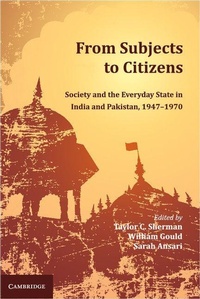
From Subjects to Citizens
Society and the Everyday State in India and Pakistan, 1947-1970
Published on 6. March 2014
Book
Hardback
258 pages
978-1-107-06427-0 (ISBN)
Description
This book explores the shift from colonial rule to independence in India and Pakistan, with the aim of unravelling the explicit meaning and relevance of 'independence' for the new citizens of India and Pakistan during the two decades post 1947. While the study of postcolonial South Asia has blossomed in recent years, this volume addresses a number of imbalances in this dynamic and highly popular field. Firstly, the histories of India and Pakistan after 1947 have been conceived separately, with many scholars assuming that the two states developed along divergent paths after independence. Thus, the dominant historical paradigm has been to examine either India or Pakistan in relative isolation from one another. Viewing the two states in the same frame not only allows the contributors of this volume to explore common themes, but also facilitates an exploration of the powerful continuities between the pre- and post-independence periods.
More details
Language
English
Place of publication
Cambridge
United Kingdom
Target group
Professional and scholarly
Dimensions
Height: 235 mm
Width: 157 mm
Thickness: 19 mm
Weight
529 gr
ISBN-13
978-1-107-06427-0 (9781107064270)
Copyright in bibliographic data and cover images is held by Nielsen Book Services Limited or by the publishers or by their respective licensors: all rights reserved.
Schweitzer Classification
Other editions
Additional editions
Taylor C. Sherman
From Subjects to Citizens
Society and the Everyday State in India and Pakistan, 1947-1970
E-Book
03/2014
Cambridge University Press
€85.99
Available for download
Persons
Taylor C. Sherman is lecturer at Department of International History, London School of Economics. Dr Sherman's research concerns the cultural and political history of India in the transition from colonial rule to independence in the middle decades of the twentieth century. Her publications include State Violence and Punishment in India (2010). William Gould is professor of Indian History at School of History, University of Leeds. He researches on the politics of religious conflict and 'communalism' in South Asia, and the historical narratives of South Asian migrants to the UK after 1947. His publications include Hindu Nationalism and the Language of Politics in Late Colonial India (2004) and Religion and Conflict in South Asia (2012). Sarah Ansari is Reader at Department of History, Royal Holloway, University of London. Her research interests focus on the recent history of South Asia, in particular those parts of the subcontinent that became Pakistan in 1947.
Content
Acknowledgements; Introduction Taylor C. Sherman, William Gould and Sarah Ansari; 1. Personal law and citizenship in India's transition to independence Eleanor Newbigin; 2. From subjects to citizens? Rationing, refugees and the publicity of corruption over independence in UP William Gould; 3. Performing peace: Gandhi's assassination as a critical moment in the consolidation of the Nehruvian state Yasmin Khan; 4. Migration, citizenship and belonging in Hyderabad (Deccan), 1946-1956 Taylor C. Sherman; 5. Punjabi refugees' rehabilitation and the Indian state: discourses, denials and dissonances Ian Talbot; 6. Sovereignty, governmentality and development in Ayub's Pakistan: the case of Korangi Township Markus Daechsel; 7. Everyday expectations of the state during Pakistan's early years: letters to the Editor, Dawn (Karachi), 1950-1953 Sarah Ansari; 8. Concrete 'progress': irrigation, development and modernity in mid-twentieth century Sind Daniel Haines; 9. Partition narratives: displaced trauma and culpability among British civil servants in 1940s Punjab Catherine Coombs; Contributors; Index.