

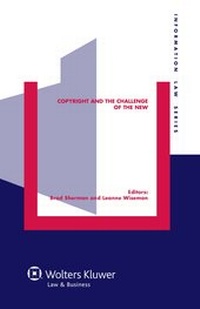
Copyright and the Challenge of the New
1st Edition
Published on 14. August 2012
Book
Hardback
288 pages
978-90-411-3669-5 (ISBN)
Description
Copyright is not, as is often thought, something that is periodically 'extended' to cover a new field or medium; rather, copyright redefines itself whenever its efficacy is challenged. While many factors have contributed to this process, the most consistent has been the challenges created by new technologies. The contributing authors build upon this insight to show that copyright law is, and has always been, a creature of technology. Each chapter focuses on a specific technology or group of technologies - photography, telegraphy, the phonogram, radio, film, the photocopier, the tape player, television, and computer programs - emphasizing the changes that each technology instigated and the challenges and opportunities it created.
Perhaps the most profound insight of this extraordinary book is the authors' claim - ably supported in a series of intriguing chapters - that the way the law responds and reacts to new technologies is always mediated by the political, social, economic, and cultural environment in which the interaction occurs. For example, these chapters describe and explain how:
- statutory schemes of remuneration arose from failures to effectively police new forms of piracy;
- persistent litigation and lobbying by copyright owners forces legislatures and courts to devise new
laws;
- content (e.g., sporting events) generates new rules of access to broadcasts; and
- 'fair copying' (e.g., by libraries) is the necessary exception that proves the rule.
As well as providing insight into the ways that copyright law interacted with old technologies when they were new, the book also offers important insights into problems and issues currently confronting copyright law and policy such as the appropriate scope of copyright and the relation between copyright and the public interest. With the broad perspectives opened by these essays, academics, practitioners and policymakers in the field will find themselves well equipped to deal with the problems that will inevitably be created by technologies in the future.
Perhaps the most profound insight of this extraordinary book is the authors' claim - ably supported in a series of intriguing chapters - that the way the law responds and reacts to new technologies is always mediated by the political, social, economic, and cultural environment in which the interaction occurs. For example, these chapters describe and explain how:
- statutory schemes of remuneration arose from failures to effectively police new forms of piracy;
- persistent litigation and lobbying by copyright owners forces legislatures and courts to devise new
laws;
- content (e.g., sporting events) generates new rules of access to broadcasts; and
- 'fair copying' (e.g., by libraries) is the necessary exception that proves the rule.
As well as providing insight into the ways that copyright law interacted with old technologies when they were new, the book also offers important insights into problems and issues currently confronting copyright law and policy such as the appropriate scope of copyright and the relation between copyright and the public interest. With the broad perspectives opened by these essays, academics, practitioners and policymakers in the field will find themselves well equipped to deal with the problems that will inevitably be created by technologies in the future.
More details
Other editions
Additional editions
Brad Sherman | Leanne Wiseman
Copyright and the Challenge of the New
E-Book
08/2012
Kluwer Law International
€157.99
Available for download
Brad Sherman | Leanne Wiseman
Copyright and the Challenge of the New
E-Book
08/2012
Kluwer Law International
€157.99
Available for download
Content
1. Copyright, When Old Technologies Were New; B. Sherman, L. Wiseman. 2. The World Daguerreotyped - 'What a Spectacle!' Copyright Law, Photography and the Economic Mission of Empire; K. Bowrey. 3. The Electric Telegraph and the Struggle over Copyright in News in Australia, Great Britain and India; L. Bently. 4. The Phonogram: A Tale of Vested Interests and Seized Opportunities; J. Okpaluba. 5. Radio: Early Battles over the Public Performance Right; G. Austin. 6 . How Did Film Become Property? Copyright and the Early American Film Industry; O. Bracha. 7. The Story of the Tape Recorder and the History of Copyright Levies; B. Hugenholtz. 8. Making Copies: Photocopying and Copyright; L. Wiseman. 9. Public Ownership of Private Spectacles: Copyright and Television; B. Sherman. 10. A Square Peg in a Round Hole? Copyright Protection for Computer Programs; P. Samuelson.