

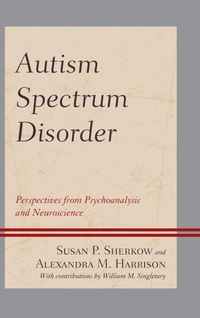
Autism Spectrum Disorder
Perspectives from Psychoanalysis and Neuroscience
Published on 14. November 2013
Book
Hardback
232 pages
978-0-7657-0862-5 (ISBN)
Description
Autism Spectrum Disorder: Perspectives from Psychoanalysis is written by practicing child psychoanalysts with extensive experience treating children with autistic spectrum disorders (ASD) and uneven development. The authors bridge the gap between a psychodynamic approach to ASD and burgeoning data from the fields of neurobiology and neurofunction.
Based on current research showing neuroplasticity of the brain, the authors posit that treating ASD through intensive engagement of caregiver and child makes possible the successful psychoanalytic treatment of a neurobiological disorder. To this end, the authors examine both the clinical dynamics of their treatments and the possible impact of the treatment on neurobiological processes.
Detailed case studies of children treated by the authors comprise the heart of the book. The cases emphasize the importance of engaging these young children intensively with the social world, first of their caregivers and then their peers, while also helping child and caregiver make sense of the child's "nonsense" behavior through insight into their inner worlds. The authors explain how and why such treatment works through examining the processes by which infant and caregiver learn to know each other and how a baby comes to know the world. This approach emphasizes the intimate connection between infant and caregiver in forming the emotional, cognitive, attentional, and interpersonal experiences that give a child the ability to make meaning and grow.
In addition, this volume presents a selective summary of the neurobiological research in the area of ASD to provide the reader with the related neurobiological and psychological factors. This underscores the thesis that ASD is a potentially reversible neurodevelopmental disorder with experiential and psychological consequences, and lays groundwork for an integrated treatment approach with psychoanalysis at its core.
Based on current research showing neuroplasticity of the brain, the authors posit that treating ASD through intensive engagement of caregiver and child makes possible the successful psychoanalytic treatment of a neurobiological disorder. To this end, the authors examine both the clinical dynamics of their treatments and the possible impact of the treatment on neurobiological processes.
Detailed case studies of children treated by the authors comprise the heart of the book. The cases emphasize the importance of engaging these young children intensively with the social world, first of their caregivers and then their peers, while also helping child and caregiver make sense of the child's "nonsense" behavior through insight into their inner worlds. The authors explain how and why such treatment works through examining the processes by which infant and caregiver learn to know each other and how a baby comes to know the world. This approach emphasizes the intimate connection between infant and caregiver in forming the emotional, cognitive, attentional, and interpersonal experiences that give a child the ability to make meaning and grow.
In addition, this volume presents a selective summary of the neurobiological research in the area of ASD to provide the reader with the related neurobiological and psychological factors. This underscores the thesis that ASD is a potentially reversible neurodevelopmental disorder with experiential and psychological consequences, and lays groundwork for an integrated treatment approach with psychoanalysis at its core.
Reviews / Votes
This book, with its central focus on the parent-child relationship, offers a unique and very important contribution. Parents struggle terribly in their efforts to make sense of the behavior of a child with a wide range of neuro-developmental challenges that currently fall under the heading of Autism Spectrum Disorders. Drawing on extensive evidence from the fields of genetics and neuroscience as well as in-depth clinical material, the authors show how a clinician can set these children on healthy developmental paths by supporting parents' efforts to find meaning in their children's behavior. -- Claudia M. Gold, MD, Newton-Wellesley Hospital, author of "Keeping Your Child in Mind" This is a cutting-edge book about autism spectrum disorder. It has concise summaries of numerous etiologic and associated factors known concerning ASD. The clinical vignettes include heartening and compelling examples of new and old therapies and how treated children can 'lose' their ASD diagnoses. -- Gilbert Kliman, MD, The Children's Psychological Trauma CenterMore details
Language
English
Place of publication
Northvale NJ
United States
Target group
Professional and scholarly
Illustrations
4 b/w illustrations; 1 table
Dimensions
Height: 235 mm
Width: 157 mm
Thickness: 18 mm
Weight
533 gr
ISBN-13
978-0-7657-0862-5 (9780765708625)
Copyright in bibliographic data and cover images is held by Nielsen Book Services Limited or by the publishers or by their respective licensors: all rights reserved.
Schweitzer Classification
Other editions
Additional editions
Susan P. Sherkow | Alexandra M. Harrison Harrison
Autism Spectrum Disorder
Perspectives from Psychoanalysis and Neuroscience
E-Book
11/2013
1st Edition
Jason Aronson Publishers
€98.99
Available for download
Susan P. Sherkow | Alexandra M. Harrison Harrison
Autism Spectrum Disorder
Perspectives from Psychoanalysis and Neuroscience
E-Book
11/2013
1st Edition
Jason Aronson, Inc.
€98.99
Available for download
Persons
Susan P. Sherkow, MD, is a training and supervising analyst at the Berkshire Psychoanalytic Institute and Society as well as a child supervising analyst at the New York Psychoanalytic Institute. She has forty years of experience working with autistic children and is founder of the Sherkow Center.
Alexandra M. Harrison, MD, is a training and supervising analyst at the Boston Psychoanalytic Society and Institute. She is the author of the blog supportingchildcaregivers.com.
William M. Singletary,MD, is a child and adult psychiatrist and psychoanalyst on the faculty of the Psychoanalytic Center of Philadelphia with approximately twenty-five years of experience treating autism spectrum disorder.
Alexandra M. Harrison, MD, is a training and supervising analyst at the Boston Psychoanalytic Society and Institute. She is the author of the blog supportingchildcaregivers.com.
William M. Singletary,MD, is a child and adult psychiatrist and psychoanalyst on the faculty of the Psychoanalytic Center of Philadelphia with approximately twenty-five years of experience treating autism spectrum disorder.
Content
Acknowledgments
Preface
William Singletary, MD
Introduction
Part I. Dyadic Therapy
Chapter 1: Introduction to Dyadic Work with Toddlers
Chapter 2: Johnny
Chapter 3: Corey
Chapter 4: Ethan
Chapter 5: Conclusion
Part II. Referential Network Therapy
Chapter 6: Introduction to the Method of Referential Network Therapy
Chapter 7: Dahlia
Part III. Neurobiology and Psychoanalysis
William Singletary, MD
Chapter 8: Neurobiology, Neuroplasticity and Psychoanalytic Treatment
Chapter 9: Models of ASD: A Remarkable Confluence
Conclusion
References
Index
About the Authors
Preface
William Singletary, MD
Introduction
Part I. Dyadic Therapy
Chapter 1: Introduction to Dyadic Work with Toddlers
Chapter 2: Johnny
Chapter 3: Corey
Chapter 4: Ethan
Chapter 5: Conclusion
Part II. Referential Network Therapy
Chapter 6: Introduction to the Method of Referential Network Therapy
Chapter 7: Dahlia
Part III. Neurobiology and Psychoanalysis
William Singletary, MD
Chapter 8: Neurobiology, Neuroplasticity and Psychoanalytic Treatment
Chapter 9: Models of ASD: A Remarkable Confluence
Conclusion
References
Index
About the Authors