

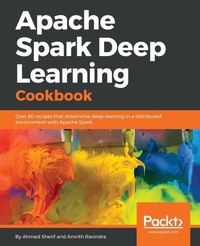
Apache Spark Deep Learning Cookbook
Over 80 best practice recipes for the distributed training and deployment of neural networks using Keras and TensorFlow
Published on 13. July 2018
Book
Paperback/Softback
474 pages
978-1-78847-422-1 (ISBN)
Description
Run efficient deep learning models on Apache Spark using TensorFlow and Keras
Key Features
Train distributed complex neural networks on Apache Spark
Use TensorFlow and Keras to train and deploy deep learning models
Explore practical tips to enhance performance
Book DescriptionOrganizations these days need to integrate popular big data tools such as Apache Spark with highly efficient deep learning libraries if they're looking to gain faster and more powerful insights from their data. With this book, you'll discover over 80 recipes to help you train fast, enterprise-grade, deep learning models on Apache Spark.
Each recipe addresses a specific problem, and offers a proven, best-practice solution to difficulties encountered while implementing various deep learning algorithms in a distributed environment. The book follows a systematic approach, featuring a balance of theory and tips with best practice solutions to assist you with training different types of neural networks such as convolutional neural networks (CNNs) and recurrent neural networks (RNNs). You'll also have access to code written in TensorFlow and Keras that you can run on Spark to solve a variety of deep learning problems in computer vision and natural language processing (NLP), or tweak to tackle other problems encountered in deep learning.
By the end of this book, you'll have the skills you need to train and deploy state-of-the-art deep learning models on Apache Spark.What you will learn
Set up a fully functional Spark environment
Understand practical machine learning and deep learning concepts
Employ built-in machine learning libraries within Spark
Discover libraries that are compatible with TensorFlow and Keras
Explore NLP models such as word2vec and TF-IDF on Spark
Organize DataFrames for deep learning evaluation
Apply testing and training modeling to ensure accuracy
Access readily available code that can be reused
Who this book is forIf you're looking for a practical resource for implementing efficiently distributed deep learning models with Apache Spark, then this book is for you. Knowledge of core machine learning concepts and a basic understanding of the Apache Spark framework is required to get the most out of this book. Some knowledge of Python programming will also be useful.
Key Features
Train distributed complex neural networks on Apache Spark
Use TensorFlow and Keras to train and deploy deep learning models
Explore practical tips to enhance performance
Book DescriptionOrganizations these days need to integrate popular big data tools such as Apache Spark with highly efficient deep learning libraries if they're looking to gain faster and more powerful insights from their data. With this book, you'll discover over 80 recipes to help you train fast, enterprise-grade, deep learning models on Apache Spark.
Each recipe addresses a specific problem, and offers a proven, best-practice solution to difficulties encountered while implementing various deep learning algorithms in a distributed environment. The book follows a systematic approach, featuring a balance of theory and tips with best practice solutions to assist you with training different types of neural networks such as convolutional neural networks (CNNs) and recurrent neural networks (RNNs). You'll also have access to code written in TensorFlow and Keras that you can run on Spark to solve a variety of deep learning problems in computer vision and natural language processing (NLP), or tweak to tackle other problems encountered in deep learning.
By the end of this book, you'll have the skills you need to train and deploy state-of-the-art deep learning models on Apache Spark.What you will learn
Set up a fully functional Spark environment
Understand practical machine learning and deep learning concepts
Employ built-in machine learning libraries within Spark
Discover libraries that are compatible with TensorFlow and Keras
Explore NLP models such as word2vec and TF-IDF on Spark
Organize DataFrames for deep learning evaluation
Apply testing and training modeling to ensure accuracy
Access readily available code that can be reused
Who this book is forIf you're looking for a practical resource for implementing efficiently distributed deep learning models with Apache Spark, then this book is for you. Knowledge of core machine learning concepts and a basic understanding of the Apache Spark framework is required to get the most out of this book. Some knowledge of Python programming will also be useful.
More details
Language
English
Place of publication
Birmingham
United Kingdom
Dimensions
Height: 235 mm
Width: 191 mm
Thickness: 26 mm
Weight
877 gr
ISBN-13
978-1-78847-422-1 (9781788474221)
Copyright in bibliographic data and cover images is held by Nielsen Book Services Limited or by the publishers or by their respective licensors: all rights reserved.
Schweitzer Classification
Other editions
Additional editions
Ahmed Sherif | Amrith Ravindra | Michal Malohlava
Apache Spark Deep Learning Cookbook
Over 80 best practice recipes for the distributed training and deployment of neural networks using Keras and TensorFlow
E-Book
09/2024
1st Edition
Packt Publishing Limited
€42.99
Available for download
Persons
Ahmed Sherif is a data scientist who has worked with data in various roles since 2005. He started off with BI solutions and transitioned to data science in 2013. In 2016, he obtained a master's in Predictive Analytics from Northwestern University, where he studied the science and application of machine learning and predictive modeling using both Python and R. Lately, he has been developing machine learning and deep learning solutions on the cloud using Azure. In 2016, he published his first book, Practical Business Intelligence. He currently works as a Technology Solution Profession in Data and AI for Microsoft. Amrith Ravindra is a machine learning enthusiast who holds degrees in electrical and industrial engineering. While pursuing his masters, he dove deeper into the world of machine learning and developed a love for data science. Graduate-level courses in engineering gave him the mathematical background to launch himself into a career in machine learning. He met Ahmed Sherif at a local data science meetup in Tampa. They decided to put their brains together to write a book on their favorite machine learning algorithms. He hopes this book will help him achieve his ultimate goal of becoming a data scientist and actively contributing to machine learning. Michal Malohlava, creator of Sparkling Water, is a geek and the developer; Java, Linux, programming languages enthusiast who has been developing software for over 10 years. He obtained his PhD from Charles University in Prague in 2012, and post doctorate from Purdue University. During his studies, he was interested in the construction of not only distributed but also embedded and real-time, component-based systems, using model-driven methods and domain-specific languages. He participated in the design and development of various systems, including SOFA and Fractal component systems and the jPapabench control system. Now, his main interest is big data computation. He participates in the development of the H2O platform for advanced big data math and computation, and its embedding into Spark engine, published as a project called Sparkling Water. Adnan Masood, PhD is an artificial intelligence and machine learning researcher, visiting scholar at Stanford AI Lab, software engineer, Microsoft MVP (Most Valuable Professional), and Microsoft's regional director for artificial intelligence. As chief architect of AI and machine learning at UST Global, he collaborates with Stanford AI Lab and MIT CSAIL, and leads a team of data scientists and engineers building artificial intelligence solutions to produce business value and insights that affect a range of businesses, products, and initiatives.
Content
Table of Contents
Setting Up Spark for Deep Learning Development
Creating a Neural Network in Spark
Pain Points of Convolutional Neural Networks
Pain Points of Recurrent Neural Networks
Predicting Fire Department Calls with Spark ML
Using LSTMs in Generative Networks
Natural Language Processing with TF-IDF
Real Estate Value Prediction using XGBoost
Predicting Apple Stock Market Cost with LSTM
Face Recognition using Deep Convolutional Networks
Creating and Visualizing Word Vectors Using Word2Vec
Creating a Movie Recommendation Engine with Keras
Image Classification with TensorFlow on Spark
Setting Up Spark for Deep Learning Development
Creating a Neural Network in Spark
Pain Points of Convolutional Neural Networks
Pain Points of Recurrent Neural Networks
Predicting Fire Department Calls with Spark ML
Using LSTMs in Generative Networks
Natural Language Processing with TF-IDF
Real Estate Value Prediction using XGBoost
Predicting Apple Stock Market Cost with LSTM
Face Recognition using Deep Convolutional Networks
Creating and Visualizing Word Vectors Using Word2Vec
Creating a Movie Recommendation Engine with Keras
Image Classification with TensorFlow on Spark