

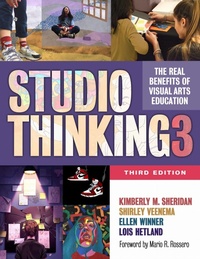
Studio Thinking 3
The Real Benefits of Visual Arts Education
3rd Edition
Published on 3. June 2022
Book
Paperback/Softback
192 pages
978-0-8077-6650-7 (ISBN)
Description
Studio Thinking 3 is a new edition of a now-classic text, a research-based account of teaching and learning in high school studio arts classes. It poses a framework that identifies eight habits of mind taught in visual arts and four studio structures by which they are taught. This edition includes new material about how the framework has been used since the original study, with new perspectives from artist-teachers who currently apply the Studio Thinking Framework in their own practice. It also reviews how contemporary organizations, educators, and researchers outside the arts have utilized the framework, highlighting its flexibility to inform teaching and learning. The authors have added a new chapter on assessment to introduce the practical and thoughtful ways that teachers are using Studio Thinking to assess and evaluate students' work, working processes, and thinking in the arts.The first edition of this bestseller was featured in The New York Times and The Boston Globe for its groundbreaking research on the positive effects of art education on student learning across the curriculum. Studio Thinking 3 will help advocates explain arts education to policymakers, support art teachers in developing and refining their teaching and assessment practices, and assist educators in other disciplines to learn from existing practices in arts education.
Book Features:
An explanation of "art as thinking" that unpacks and clarifies how teaching art is the process of teaching thinking.
An account of what Studio Thinking looks like in diverse contemporary settings.
Models of studio arts instruction that illuminate what educators are doing to support students' learning in the arts and why they are doing it that way.
A new chapter with rich examples of approaches to assessment.
New analyses on how studio art teachers support learner agency.
Updated examples from practice showing how artist-teachers are using the Studio Thinking Framework.
Full-color images with examples of student art.
Book Features:
An explanation of "art as thinking" that unpacks and clarifies how teaching art is the process of teaching thinking.
An account of what Studio Thinking looks like in diverse contemporary settings.
Models of studio arts instruction that illuminate what educators are doing to support students' learning in the arts and why they are doing it that way.
A new chapter with rich examples of approaches to assessment.
New analyses on how studio art teachers support learner agency.
Updated examples from practice showing how artist-teachers are using the Studio Thinking Framework.
Full-color images with examples of student art.
Reviews / Votes
Praise for Previous Editions of Studio Thinking-"Winner and Hetland have set out to show what it means to take education in the arts seriously, in its own right." - The New York Times
"This book is very educational and would be helpful to art teachers in promoting quality teaching in their classrooms." - School Arts Magazine<
"Studio Thinking is a major contribution to the field."-Arts & Learning Review
"The research in Studio Thinking is groundbreaking and important because it is anchored in the actual practice of teaching artists ...The ideas in Studio Thinking continue to provide a vehicle with which to navigate and understand the complex work in which we are all engaged."- Teaching Artists Journal
More details
Edition
Third Edition
Language
English
Place of publication
New York
United States
Target group
Professional and scholarly
Edition type
New edition
Product notice
Paperback (trade)
Unsewn / adhesive bound
Dimensions
Height: 277 mm
Width: 215 mm
Thickness: 10 mm
Weight
463 gr
ISBN-13
978-0-8077-6650-7 (9780807766507)
Copyright in bibliographic data and cover images is held by Nielsen Book Services Limited or by the publishers or by their respective licensors: all rights reserved.
Schweitzer Classification
Persons
Kimberly M. Sheridan is an associate professor in the College of Education and Human Development and the College of Visual and Performing Arts at George Mason University and is co-director of the Mason Arts Research Center. Shirley Veenema is an art teacher (elementary and high school), a researcher at Project Zero from 1987-2007, and a visual artist. Ellen Winner is professor emerita of psychology at Boston College and a senior research associate at Project Zero, Harvard Graduate School of Education. Lois Hetland is professor emerita of art education at Massachusetts College of Art and Design.
Content
Contents
Foreword to the Third Edition by Mario R. Rossero ?ix
Foreword to the First Edition by David N. Perkins ?xi
Preface to the Third Edition ?xiii
Acknowledgments ?xv
1. ?Making the Case for the Arts: Arts Education Is Not Just a Luxury ?1
The Framework of Studio Thinking ?1
Why a Frame for Studio Teaching and Learning? ?2
Conclusion ?5Part I. Studio Classrooms: The How of Studio Teaching
2. ?Elements of Studio Classrooms ?13
Creating a Studio Culture ?13
Focusing Thinking With Studio Assignments ?15
Teaching Through Artworks ?153. ?Studio Structures for Learning ?18
The Demonstration-Lecture ?18
Setting Tasks: African Pottery Project (Example 3.1) ?19
Illustrating Concepts: Tile Project (Example 3.2) ?20
Modeling Processes, Approaches, and Attitudes: Light and Boxes Project (Example 3.3) ?21
Students-at-Work ?22
The Critique ?23
Variations in Use of the Studio Structures ?25
A Fourth Overarching Structure: Exhibition ?26
Features of Exhibition ?27
What Can Be Learned from Exhibition ?27
Part II. Introducing the Studio Habits of Mind: A Dispositional View of What the Arts Teach
4. ?Develop Craft: Technique, Studio Practice ?31
Technique ?31
Teaching the Theory and Practice of Color: Inventing Colors Project (Example 4.1) ?31
Studio Practice ?34
Teaching the Practice of Maintaining the Studio: Self-Portraits in Colored Pencil Project (Example 4.2) ?34
Teaching the Studio Practice of Keeping a Portfolio: Light and Boxes Project (Example 4.3) ?34
Structuring a Class to Focus on Both Technique and Studio Practice ?35
Teaching Care of the Wheel and Throwing Technique: Introducing Centering on the Wheel (Example 4.4) ?355. ?Engage and Persist: Committing and Following Through ?41
Designing in Clay: Completing the Tile Project (Example 5.1) ?41
Finishing the Process: Making Puppets Project (Example 5.2) ?43
6. ?Envision: Thinking in Images ?48
Places for an Imaginary Creature: Inventing Colors Project (Example 6.1) ?48
Designing in Clay: Beginning the Tile Project (Example 6.2) ?50
7. ?Express: Finding Meaning ?53
Drawing for Feeling: Figures in Evocative Space Project (Example 7.1) ?53
Drawing for Meaning: Imaginary Creatures Project (Example 7.2) ?56
8. ?Observe: Really Seeing, Not Just Looking ?59
Seeing with New Eyes: Using the Viewfinder (Example 8.1) ?59
Seeing the World and Putting It on Paper: Light and Boxes Project (Example 8.2) ?60
9. ?Reflect: Question and Explain, Evaluate ?67
Question and Explain ?68
Drawing Yourself as Mythical: Imaginary Creatures Project (Example 9.1) ?68
Building Objects in Relation: Coil Sculpture Project (Example 9.2) ?68
Evaluate ?70
Drawing Values in Color: Self-Portrait in Colored Pencil Project (Example 9.3) ?71
10. ?Stretch and Explore: Taking a Leap ?77
Introducing the Medium: Sketching in Clay (Example 10.1) ?77
Building Form: Repeating Units Project (Example 10.2) ?79
11. ?Understand Art Worlds: Domain, Communities ?84
Domain ?85
Considering Representations: Figures in Evocative Space Project (Example 11.1) ?85
Drawing Inspiration from Images: African Pottery Project (Example 11.2) ?85
Design Inspired by Objects: Ceramic Sets Project (Example 11.3) ?86
Structuring a Whole Class to Focus on Domain: Cubism Project (Example 11.4) ?87
Communities ?90
Creating a Library of Molds: Coil Sculpture Project (Example 11.5) ?91
Focusing on Strength and Form: The Egg Drop Project (Example 11.6) ?91
Part III: Integrating Studio Structures of Learning With the Studio Habits of Mind
12. ?Demonstration-Lecture and the Studio Habits of Mind ?97
Fostering Particular Studio Habits of Mind Through Demonstration-Lectures ?97
Integrating Studio Habits of Mind in the Demonstration-Lecture ?100
Teaching the Theory and Practice of Color: Inventing Colors Project (Example 12.1) ?100
Design Inspired by Objects: Ceramic Sets Project (Example 12.2) ?10113. ?Students-at-Work and the Studio Habits of Mind ?104
Studio Habits of Mind Are Taught in Clusters ?104
Introducing Throwing: Centering on the Wheel Project (Example 13.1) ?104
Connecting Worlds: Secret Ritual Vessels Project (Example 13.2) ?105
Individualizing During Students-at-Work Sessions ?105
Differentiating for Students of Various Ability/Experience Levels: Abstraction Project (Example 13.3) ?106
Individualizing for Multiple Agendas: Creating Hat and Vest Project (Example 13.4) ?109
14. ?Critique and the Studio Habits of Mind ?110
Teaching Studio Habits of Mind Through Critique ?110
Integrating Studio Habits of Mind Through Critique ?111
Comparing Works: Contour Drawing Project (Example 14.1) ?112
Critiquing Throughout the Process: Figures in Evocative Space Project (Example 14.2) ?113
15. ?Exhibition and the Studio Habits of Mind ?116
Using Exhibition to Teach Studio Habits of Mind ?116
Integrating Studio Habits of Mind in the Exhibition ?119
A First Show (Example 15.1) ?119
A Sophomore Show (Example 15.2) ?119
Junior Shows (Example 15.3) ?120
A Senior Show (Example 15.4) ?120
End-of-Term Exhibitions (Example 15.5) ?120
A Senior Show (Example 15.6) ?121
Korean Student Show in Korea (Example 15.7) ?121
16. ?Students as Contemporary Artists: Building Agency in the Studio ?123
How Teachers Support Student Agency ?123
Students Are Contemporary Artists ?127
Part IV: Studio Thinking in Contemporary Practice
17. ?Artist-Teachers: Using Studio Thinking to Connect Artistic and Teaching Practices ?131
Artistic Practice Informs Teaching ?131
Teaching Practice Informs Artistic Practice ?131
Two Practices: Nurturing the Relationship ?132
About the Artist-Teachers ?133
David Ardito: Mistakes as Portals of Discovery ?135
Kimberley D'Adamo: Finding a Fit ?136
Danielle DeVellis: Making a Room Into a Studio ?137
Natalia Dominguez: Words Matter ?138
Bryce Johnson: Balancing Craft and Expression ?138
Trena Noval: Using the Studio Habits as Process ?139
Jaimee Taborda: Nurturing a Community of Artists ?140
Seeing Studio Thinking Across the Artist-Teachers' Stories ?14118. ?Assessment Is a Conversation ?143
Assessing Visual Art ?143
Assessment Defanged: Learning and Assessment in the Arts as a Form of Conversation With Todd Elkin ?145
Assessment Moments That Support Individual Development With Kimberley D'Adamo ?147
Assessing the Thinking Process With Studio Habits With JoE Douillette ?150
Conclusion ?154
19. ?Studio Thinking ?155
A Common Language in the Arts ?155
Studio Thinking Beyond the Arts ?161
Reinventing Studio Thinking ?162
Appendix A: Project Examples ?164
Appendix B: Conducting the Research ?165
References ?167
Index ?170
About the Authors ?176
Foreword to the Third Edition by Mario R. Rossero ?ix
Foreword to the First Edition by David N. Perkins ?xi
Preface to the Third Edition ?xiii
Acknowledgments ?xv
1. ?Making the Case for the Arts: Arts Education Is Not Just a Luxury ?1
The Framework of Studio Thinking ?1
Why a Frame for Studio Teaching and Learning? ?2
Conclusion ?5Part I. Studio Classrooms: The How of Studio Teaching
2. ?Elements of Studio Classrooms ?13
Creating a Studio Culture ?13
Focusing Thinking With Studio Assignments ?15
Teaching Through Artworks ?153. ?Studio Structures for Learning ?18
The Demonstration-Lecture ?18
Setting Tasks: African Pottery Project (Example 3.1) ?19
Illustrating Concepts: Tile Project (Example 3.2) ?20
Modeling Processes, Approaches, and Attitudes: Light and Boxes Project (Example 3.3) ?21
Students-at-Work ?22
The Critique ?23
Variations in Use of the Studio Structures ?25
A Fourth Overarching Structure: Exhibition ?26
Features of Exhibition ?27
What Can Be Learned from Exhibition ?27
Part II. Introducing the Studio Habits of Mind: A Dispositional View of What the Arts Teach
4. ?Develop Craft: Technique, Studio Practice ?31
Technique ?31
Teaching the Theory and Practice of Color: Inventing Colors Project (Example 4.1) ?31
Studio Practice ?34
Teaching the Practice of Maintaining the Studio: Self-Portraits in Colored Pencil Project (Example 4.2) ?34
Teaching the Studio Practice of Keeping a Portfolio: Light and Boxes Project (Example 4.3) ?34
Structuring a Class to Focus on Both Technique and Studio Practice ?35
Teaching Care of the Wheel and Throwing Technique: Introducing Centering on the Wheel (Example 4.4) ?355. ?Engage and Persist: Committing and Following Through ?41
Designing in Clay: Completing the Tile Project (Example 5.1) ?41
Finishing the Process: Making Puppets Project (Example 5.2) ?43
6. ?Envision: Thinking in Images ?48
Places for an Imaginary Creature: Inventing Colors Project (Example 6.1) ?48
Designing in Clay: Beginning the Tile Project (Example 6.2) ?50
7. ?Express: Finding Meaning ?53
Drawing for Feeling: Figures in Evocative Space Project (Example 7.1) ?53
Drawing for Meaning: Imaginary Creatures Project (Example 7.2) ?56
8. ?Observe: Really Seeing, Not Just Looking ?59
Seeing with New Eyes: Using the Viewfinder (Example 8.1) ?59
Seeing the World and Putting It on Paper: Light and Boxes Project (Example 8.2) ?60
9. ?Reflect: Question and Explain, Evaluate ?67
Question and Explain ?68
Drawing Yourself as Mythical: Imaginary Creatures Project (Example 9.1) ?68
Building Objects in Relation: Coil Sculpture Project (Example 9.2) ?68
Evaluate ?70
Drawing Values in Color: Self-Portrait in Colored Pencil Project (Example 9.3) ?71
10. ?Stretch and Explore: Taking a Leap ?77
Introducing the Medium: Sketching in Clay (Example 10.1) ?77
Building Form: Repeating Units Project (Example 10.2) ?79
11. ?Understand Art Worlds: Domain, Communities ?84
Domain ?85
Considering Representations: Figures in Evocative Space Project (Example 11.1) ?85
Drawing Inspiration from Images: African Pottery Project (Example 11.2) ?85
Design Inspired by Objects: Ceramic Sets Project (Example 11.3) ?86
Structuring a Whole Class to Focus on Domain: Cubism Project (Example 11.4) ?87
Communities ?90
Creating a Library of Molds: Coil Sculpture Project (Example 11.5) ?91
Focusing on Strength and Form: The Egg Drop Project (Example 11.6) ?91
Part III: Integrating Studio Structures of Learning With the Studio Habits of Mind
12. ?Demonstration-Lecture and the Studio Habits of Mind ?97
Fostering Particular Studio Habits of Mind Through Demonstration-Lectures ?97
Integrating Studio Habits of Mind in the Demonstration-Lecture ?100
Teaching the Theory and Practice of Color: Inventing Colors Project (Example 12.1) ?100
Design Inspired by Objects: Ceramic Sets Project (Example 12.2) ?10113. ?Students-at-Work and the Studio Habits of Mind ?104
Studio Habits of Mind Are Taught in Clusters ?104
Introducing Throwing: Centering on the Wheel Project (Example 13.1) ?104
Connecting Worlds: Secret Ritual Vessels Project (Example 13.2) ?105
Individualizing During Students-at-Work Sessions ?105
Differentiating for Students of Various Ability/Experience Levels: Abstraction Project (Example 13.3) ?106
Individualizing for Multiple Agendas: Creating Hat and Vest Project (Example 13.4) ?109
14. ?Critique and the Studio Habits of Mind ?110
Teaching Studio Habits of Mind Through Critique ?110
Integrating Studio Habits of Mind Through Critique ?111
Comparing Works: Contour Drawing Project (Example 14.1) ?112
Critiquing Throughout the Process: Figures in Evocative Space Project (Example 14.2) ?113
15. ?Exhibition and the Studio Habits of Mind ?116
Using Exhibition to Teach Studio Habits of Mind ?116
Integrating Studio Habits of Mind in the Exhibition ?119
A First Show (Example 15.1) ?119
A Sophomore Show (Example 15.2) ?119
Junior Shows (Example 15.3) ?120
A Senior Show (Example 15.4) ?120
End-of-Term Exhibitions (Example 15.5) ?120
A Senior Show (Example 15.6) ?121
Korean Student Show in Korea (Example 15.7) ?121
16. ?Students as Contemporary Artists: Building Agency in the Studio ?123
How Teachers Support Student Agency ?123
Students Are Contemporary Artists ?127
Part IV: Studio Thinking in Contemporary Practice
17. ?Artist-Teachers: Using Studio Thinking to Connect Artistic and Teaching Practices ?131
Artistic Practice Informs Teaching ?131
Teaching Practice Informs Artistic Practice ?131
Two Practices: Nurturing the Relationship ?132
About the Artist-Teachers ?133
David Ardito: Mistakes as Portals of Discovery ?135
Kimberley D'Adamo: Finding a Fit ?136
Danielle DeVellis: Making a Room Into a Studio ?137
Natalia Dominguez: Words Matter ?138
Bryce Johnson: Balancing Craft and Expression ?138
Trena Noval: Using the Studio Habits as Process ?139
Jaimee Taborda: Nurturing a Community of Artists ?140
Seeing Studio Thinking Across the Artist-Teachers' Stories ?14118. ?Assessment Is a Conversation ?143
Assessing Visual Art ?143
Assessment Defanged: Learning and Assessment in the Arts as a Form of Conversation With Todd Elkin ?145
Assessment Moments That Support Individual Development With Kimberley D'Adamo ?147
Assessing the Thinking Process With Studio Habits With JoE Douillette ?150
Conclusion ?154
19. ?Studio Thinking ?155
A Common Language in the Arts ?155
Studio Thinking Beyond the Arts ?161
Reinventing Studio Thinking ?162
Appendix A: Project Examples ?164
Appendix B: Conducting the Research ?165
References ?167
Index ?170
About the Authors ?176