

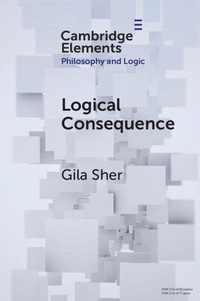
Logical Consequence
Published on 8. September 2022
Book
Paperback/Softback
100 pages
978-1-108-98684-7 (ISBN)
Description
To understand logic is, first and foremost, to understand logical consequence. This Element provides an in-depth, accessible, up-to-date account of and philosophical insight into the semantic, model-theoretic conception of logical consequence, its Tarskian roots, and its ideas, grounding, and challenges. The topics discussed include: (i) the passage from Tarski's definition of truth (simpliciter) to his definition of logical consequence, (ii) the need for a non-proof-theoretic definition, (iii) the idea of a semantic definition, (iv) the adequacy conditions of preservation of truth, formality, and necessity, (v) the nature, structure, and totality of models, (vi) the logicality problem that threatens the definition of logical consequence (the problem of logical constants), (vii) a general solution to the logicality, formality, and necessity problems/challenges, based on the isomorphism-invariance criterion of logicality, (viii) philosophical background and justification of the isomorphism-invariance criterion, and (ix) major criticisms of the semantic definition and the isomorphism-invariance criterion.
More details
Series
Language
English
Place of publication
Cambridge
United Kingdom
Target group
College/higher education
Product notice
Paperback (trade)
Illustrations
Worked examples or Exercises
Dimensions
Height: 224 mm
Width: 149 mm
Thickness: 9 mm
Weight
154 gr
ISBN-13
978-1-108-98684-7 (9781108986847)
Copyright in bibliographic data and cover images is held by Nielsen Book Services Limited or by the publishers or by their respective licensors: all rights reserved.
Schweitzer Classification
Other editions
Additional editions
Person
Content
1. Introduction; 2. The Semantic Definition of Logical Consequence and its Roots in Tarski; 3. Solution to the Challenges of Necessity, Formality, and Logicality; 4. Philosophical Perspective on Logicality and Other Significant Matters; 5. Criticisms of the Semantic Definition of Logical Consequence; 6. Criticisms of the Isomorphism-Invariance Criterion of Logicality; 7. Conclusion.