

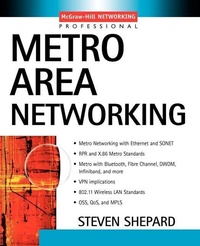
Metro Area Networking
Published on 23. October 2002
Book
Paperback/Softback
327 pages
978-0-07-139914-2 (ISBN)
Description
This work examines the tricks and traps awaiting service providers in the Metro Area space, detailing the technological challenges and opportunities. It covers: Metro networking with Ethernet and Optical; Metro with Bluetooth, InfiniBand, DWDM and more; VPN implications; and support services.
More details
Language
English
Place of publication
New York
United States
Publishing group
McGraw-Hill Education - Europe
Target group
Professional and scholarly
Product notice
Paperback (trade)
Unsewn / adhesive bound
Illustrations
100 Illustrations
Dimensions
Height: 236 mm
Width: 182 mm
Thickness: 24 mm
Weight
685 gr
ISBN-13
978-0-07-139914-2 (9780071399142)
Copyright in bibliographic data and cover images is held by Nielsen Book Services Limited or by the publishers or by their respective licensors: all rights reserved.
Schweitzer Classification
Other editions
Additional editions
Steven Shepard
Metro Area Networking
E-Book
10/2002
1st Edition
McGraw-Hill Education
€91.59
Available for download
Person
Steven Shepard (Williston, VT) is a professional writer and educator specializing in international telecommunications. He has written and taught technical courses on a broad range of topics around the globe. He is the author of several books, including Telecommunications Convergence and Optical Networking Demystified.
Content
Acknowledgments
Introduction
PART 1: A LESSON IN MEDIEVAL HISTORY
The Evolution of Modern Networks
Further Diversification
Core Versus Edge: A Few Words
The Birth of Metro
Fiber Distributed Data Interface (FDDI)
Switched Multimegabit Data Service (SMDS)
The Maturing Metro Market
Metro Market Segments
Carrier-Class Ethernet
MPLS/GMPLS-Enabled Networks
DWDM
The Next-Generation Intelligent Network
Network Management
An Aside: Resilient Packet Ring (RPR)
Anatomy of the Metro Network: The Edge
The Multiservice Metro Network
Network Inversion
Cisco's Central Role
The Metro Network: Access
Anatomy of the Metro Network: The Core
Optical Burst Switching
Freespace Optics
synchronous Transfer Mode (ATM)
Metro Topologies
Point-to-Point Architectures
Ring Architectures
Summary
PART 2: THE METRO NETWORK
What is a Metro Network?
Metro Touch Points
Long-Haul Networks
Access Networks
The Metro Area Itself
The Evolving Metro Network
Metro Demographics
Regulatory Impacts
Likely Regulatory Solutions
Summary
PART 3: ENABLING TECHNOLOGIES
Introduction
Overview and Terminology
Ethernet Services
Ethernet: A Brief History
Phase Two: Xerox and DEC
The Arrival of Fast Ethernet
Full-Duplex Ethernet
Up the Stack: The Ethernet Physical Layer
The Arrival of Fast Ethernet (100BaseT)
One Step Up: Gigabit Ethernet (1000BaseT)
10-Gigabit Ethernet
Ethernet Summary
Service Providers
Alternative Premises Schemes
Access Technologies
Marketplace Realities
ISDN
Digital Subscriber Line (DSL)
Cable-Based Access Technologies
Wireless Access Technologies
Transport Technologies
Asynchronous Transfer Mode (ATM)
Optical Networking
Putting It All Together
Fiber Nonlinearities
Intermodulation Effects
Optical Amplification
Optical Receivers
Dense Wavelength: Division Multiplexing (DWDM)
Course Wavelength Division Multiplexing (CWDM)
Optical Switching and Routing
Switching Versus Routing: What's the Difference?
Switching in the Optical Domain
Multipoint Circuit Support
Nonintrusive Monitoring
New Services
Transporting Subrate Payloads: Virtual Tributaries
SDH Nomenclature
Metro Networking: SONET and Ethernet
Summary
PART 4: METRO APPLICATIONS
Corporate Evolution
The Importance of Corporate Knowledge
The ERP Process
Data Mining
Knowledge Management
Obstacles to Effective Knowledge Management
Managing Quality of Service (QoS)
An Aside: The SLA
Supply-Chain Issues
ERP in the Telecomm Space
Customer Relationship Management (CRM)
Putting It All Together
Network Management in Metro Networks
Summary
PART 5: PLAYERS IN THE METRO GAME
Component Manufacturers
The Component Players
Systems Manufacturers
Service Provider Issues
CONCLUSION
APPENDIX A: COMMON INDUSTRY ACRONYMS
APPENDIX B: GLOSSARY
INDEX
Introduction
PART 1: A LESSON IN MEDIEVAL HISTORY
The Evolution of Modern Networks
Further Diversification
Core Versus Edge: A Few Words
The Birth of Metro
Fiber Distributed Data Interface (FDDI)
Switched Multimegabit Data Service (SMDS)
The Maturing Metro Market
Metro Market Segments
Carrier-Class Ethernet
MPLS/GMPLS-Enabled Networks
DWDM
The Next-Generation Intelligent Network
Network Management
An Aside: Resilient Packet Ring (RPR)
Anatomy of the Metro Network: The Edge
The Multiservice Metro Network
Network Inversion
Cisco's Central Role
The Metro Network: Access
Anatomy of the Metro Network: The Core
Optical Burst Switching
Freespace Optics
synchronous Transfer Mode (ATM)
Metro Topologies
Point-to-Point Architectures
Ring Architectures
Summary
PART 2: THE METRO NETWORK
What is a Metro Network?
Metro Touch Points
Long-Haul Networks
Access Networks
The Metro Area Itself
The Evolving Metro Network
Metro Demographics
Regulatory Impacts
Likely Regulatory Solutions
Summary
PART 3: ENABLING TECHNOLOGIES
Introduction
Overview and Terminology
Ethernet Services
Ethernet: A Brief History
Phase Two: Xerox and DEC
The Arrival of Fast Ethernet
Full-Duplex Ethernet
Up the Stack: The Ethernet Physical Layer
The Arrival of Fast Ethernet (100BaseT)
One Step Up: Gigabit Ethernet (1000BaseT)
10-Gigabit Ethernet
Ethernet Summary
Service Providers
Alternative Premises Schemes
Access Technologies
Marketplace Realities
ISDN
Digital Subscriber Line (DSL)
Cable-Based Access Technologies
Wireless Access Technologies
Transport Technologies
Asynchronous Transfer Mode (ATM)
Optical Networking
Putting It All Together
Fiber Nonlinearities
Intermodulation Effects
Optical Amplification
Optical Receivers
Dense Wavelength: Division Multiplexing (DWDM)
Course Wavelength Division Multiplexing (CWDM)
Optical Switching and Routing
Switching Versus Routing: What's the Difference?
Switching in the Optical Domain
Multipoint Circuit Support
Nonintrusive Monitoring
New Services
Transporting Subrate Payloads: Virtual Tributaries
SDH Nomenclature
Metro Networking: SONET and Ethernet
Summary
PART 4: METRO APPLICATIONS
Corporate Evolution
The Importance of Corporate Knowledge
The ERP Process
Data Mining
Knowledge Management
Obstacles to Effective Knowledge Management
Managing Quality of Service (QoS)
An Aside: The SLA
Supply-Chain Issues
ERP in the Telecomm Space
Customer Relationship Management (CRM)
Putting It All Together
Network Management in Metro Networks
Summary
PART 5: PLAYERS IN THE METRO GAME
Component Manufacturers
The Component Players
Systems Manufacturers
Service Provider Issues
CONCLUSION
APPENDIX A: COMMON INDUSTRY ACRONYMS
APPENDIX B: GLOSSARY
INDEX