

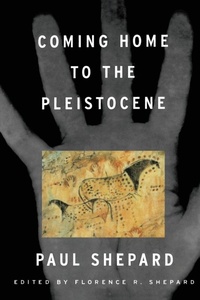
Coming Home to the Pleistocene
Will be published approx. on 1. February 2004
Book
Paperback/Softback
208 pages
978-1-55963-590-5 (ISBN)
Description
Paul Shepard was one of the most profound and original thinkers of our time. Seminal works like The Tender Carnivore and the Sacred Game, Thinking Animals, and Nature and Madness introduced readers to new and provocative ideas about humanity and its relationship to the natural world. Throughout his long and distinguished career, Shepard returned repeatedly to his guiding theme: that our essential human nature is a product of our genetic heritage, formed through thousands of years of evolution during the Pleistocene epoch, and that the current subversion of that Pleistocene heritage lies at the heart of today's ecological and social ills. Coming Home to the Pleistocene, published posthumously in 1998 and now available for the first time in paperback, provides the fullest summation of that theme and the clearest expression of his ideas. In bold, poetic language, Shepard asks us to counter the blind destruction of the earth's creatures and natural systems by drawing on primal wisdom embedded in our genomes and fine-tuned by hundreds of thousands of years of evolution.
To do so, he assures us, is not regressive; we cannot avoid the inherent and essential demands of an ancient, repetitive pattern. In addition, the book explicitly addresses the fundamental question raised by Shepard's work - What can we do to recreate a life more in tune with our genetic roots? - and presents concrete suggestions for fostering the kinds of ecological settings and cultural practices that are optimal for human health and well-being.
To do so, he assures us, is not regressive; we cannot avoid the inherent and essential demands of an ancient, repetitive pattern. In addition, the book explicitly addresses the fundamental question raised by Shepard's work - What can we do to recreate a life more in tune with our genetic roots? - and presents concrete suggestions for fostering the kinds of ecological settings and cultural practices that are optimal for human health and well-being.
More details
Language
English
Place of publication
United States
Publishing group
Princeton University Press
Target group
College/higher education
Professional and scholarly
Product notice
Paperback (trade)
Dimensions
Height: 223 mm
Width: 141 mm
Thickness: 14 mm
Weight
263 gr
ISBN-13
978-1-55963-590-5 (9781559635905)
Copyright in bibliographic data and cover images is held by Nielsen Book Services Limited or by the publishers or by their respective licensors: all rights reserved.
Schweitzer Classification
Persons
Before his death in 1996, Paul Shepard was Avery Professor of Human Ecology and Natural Philosophy at Pitzer College and the Claremont Graduate School. Among his books are The Others: How Animals Make Us Human (Island Press/Shearwater Books, 1995) and Encounters with Nature, (Island Press/Shearwater Books, 1999).