

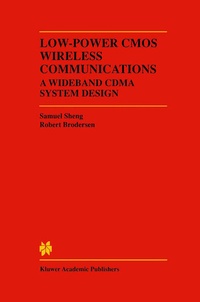
Low-Power CMOS Wireless Communications
A Wideband CDMA System Design
Published on 30. November 1997
Book
Hardback
XI, 275 pages
978-0-7923-8085-6 (ISBN)
Description
Low-Power CMOS Wireless Communications: A Wideband CDMA System Design
focuses on the issues behind the development of a high-bandwidth, silicon complementary metal-oxide silicon (CMOS) low-power transceiver system for mobile RF wireless data communications. In the design of any RF communications system, three distinct factors must be considered: the propagation environment in question, the multiplexing and modulation of user data streams, and the complexity of hardware required to implement the desired link. None of these can be allowed to dominate. Coupling between system design and implementation is the key to simultaneously achieving high bandwidth and low power and is emphasized throughout the book.
The material presented in Low-Power CMOS Wireless Communications: A Wideband CDMA System Design is the result of broadband wireless systems research done at the University of California, Berkeley. The wireless development was motivated by a much larger collaborative effort known as the Infopad Project, which was centered on developing a mobile information terminal for multimedia content - a wireless `network computer'. The desire for mobility, combined with the need to support potentially hundreds of users simultaneously accessing full-motion digital video, demanded a wireless solution that was of far lower power and higher data rate than could be provided by existing systems. That solution is the topic of this book: a case study of not only wireless systems designs, but also the implementation of such a link, down to the analog and digital circuit level.
The material presented in Low-Power CMOS Wireless Communications: A Wideband CDMA System Design is the result of broadband wireless systems research done at the University of California, Berkeley. The wireless development was motivated by a much larger collaborative effort known as the Infopad Project, which was centered on developing a mobile information terminal for multimedia content - a wireless `network computer'. The desire for mobility, combined with the need to support potentially hundreds of users simultaneously accessing full-motion digital video, demanded a wireless solution that was of far lower power and higher data rate than could be provided by existing systems. That solution is the topic of this book: a case study of not only wireless systems designs, but also the implementation of such a link, down to the analog and digital circuit level.
More details
Edition
1998 ed.
Language
English
Place of publication
New York
United States
Target group
College/higher education
Professional and scholarly
Research
Illustrations
XI, 275 p.
Dimensions
Height: 241 mm
Width: 160 mm
Thickness: 21 mm
Weight
606 gr
ISBN-13
978-0-7923-8085-6 (9780792380856)
DOI
10.1007/978-1-4615-5457-8
Schweitzer Classification
Other editions
Additional editions
Samuel Sheng | Robert W. Brodersen
Low-Power CMOS Wireless Communications
A Wideband CDMA System Design
Book
12/2012
Springer
€160.49
Shipment within 7-9 days
Samuel Sheng | Robert W. Brodersen
Low-Power CMOS Wireless Communications
A Wideband CDMA System Design
E-Book
12/2012
Springer
€149.79
Available for download
Content
1. Introduction.- 2. Modulation, Multiple Access, and How Radio Waves Behave Indoors.- 3. System Overview: The Broadband CDMA Downlink.- 4. Transmit Architecture and The Baseband Modulator Chip.- 5. Broadband RF Transmission and Modulation.- 6. The Receiver: Analog RF Front-End.- 7. The Receiver: Baseband Analog Processing.- 8. The Receiver: Baseband Spread-Spectrum Digital Signal Processor.- 9. The Matched-Filter Correlator.- 10. Conclusions and Future Directions.