

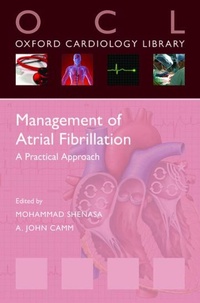
Management of Atrial Fibrillation
A Practical Approach
Published on 11. December 2014
Book
Paperback/Softback
168 pages
978-0-19-968631-5 (ISBN)
Description
Atrial Fibrillation is becoming a twenty-first century epidemic. It remains the most common form of sustained arrhythmia with significant mortality, morbidity and cost to the health care system. It is the most common cause of hospital admissions among all arrhythmias. Its prevalence increases with the aging population and is often associated with many other cardiac and noncardiac conditions, most notably congestive heart failure, hypertension, diabetes, and coronary artery disease. Although significant progress in understanding the epidemiology, natural history and mechanism has been made, the antiarrhythmic therapy in patients with Atrial Fibrillation is less satisfactory.
Management of Atrial Fibrillation: A Practical Approach is the perfect pocket guide for those who care for patients afflicted by Atrial Fibrillation. From the history of the condition and the subsets of patients, to therapeutic and preventive procedures, Management of Atrial Fibrillation comprehensively covers all aspects in managing this increasingly prevalent disorder. Written by leading authorities in the field with vast experience in practical medicine, the book creates a clinically orientated, evidence based "fast fact" type resource for cardiologists, trainees and related healthcare professionals.
Management of Atrial Fibrillation: A Practical Approach is the perfect pocket guide for those who care for patients afflicted by Atrial Fibrillation. From the history of the condition and the subsets of patients, to therapeutic and preventive procedures, Management of Atrial Fibrillation comprehensively covers all aspects in managing this increasingly prevalent disorder. Written by leading authorities in the field with vast experience in practical medicine, the book creates a clinically orientated, evidence based "fast fact" type resource for cardiologists, trainees and related healthcare professionals.
More details
Series
Language
English
Place of publication
Oxford
United Kingdom
Target group
College/higher education
Professional and scholarly
Product notice
Paperback (trade)
Unsewn / adhesive bound
Dimensions
Height: 195 mm
Width: 130 mm
Thickness: 12 mm
Weight
211 gr
ISBN-13
978-0-19-968631-5 (9780199686315)
Copyright in bibliographic data and cover images is held by Nielsen Book Services Limited or by the publishers or by their respective licensors: all rights reserved.
Schweitzer Classification
Other editions
Additional editions
E-Book
12/2014
1st Edition
OUP eBook
€25.99
Available for download
Mohammad Shenasa | A. John Camm
Management of Atrial Fibrillation: A Practical Approach
A Practical Approach
E-Book
01/2014
1st Edition
Oxford University Press, USA
€25.99
Available for download
Persons
Dr. Mohammad Shenasa qualified in 1975. He trained at the University of Pennsylvania, Philadelphia, Guy's Hospital University of London, and Mount Sinai Medical Center-University of Wisconsin, Milwuakee. Dr Shenasa then took academic positions at the University of Montreal, Canada and in 1989 he became professor of medicine and director of clinical cardiac electrophysiology at the University of Pittsburg, Pennsylvania. He spent two years as a visiting professor at the University of Munster, Germany. He is currently an attending physician at the O'Connor Hospital department of cardiovascular services and Heart & Rhythm Medical Group in San Jose, CA. Dr. Shenasa published many research papers and edited several books relating to cardiac arrhythmias and its management.
Professor John Camm qualified in 1971. He worked at Guy's Hospital before working at St. Bartholomew's Hospital, London. In 1986 he moved to St. George's Hospital Medical School in London as Professor of Clinical Cardiology (British Heart Foundation). Professor Camm was elected the Chairman of Medicine in October 1990, a post rotated from in 1995. He is now the Chairman of the Division of Cardiac and Vascular Sciences at St. George's University of London. His major speciality is cardiac arrhythmias but he is also much involved in clinical cardiac electrophysiology, cardiac pacemakers, risk stratification in post myocardial infarction, heart failure and cardiomyopathy patients. He has a major interest in cardiovascular safety of cardiac and non-cardiac drugs. John has given over 1500 lectures to national and international audiences, written more than 1000 peer review papers and over 250 detailed reviews. He has authored and edited numerous books.
Professor John Camm qualified in 1971. He worked at Guy's Hospital before working at St. Bartholomew's Hospital, London. In 1986 he moved to St. George's Hospital Medical School in London as Professor of Clinical Cardiology (British Heart Foundation). Professor Camm was elected the Chairman of Medicine in October 1990, a post rotated from in 1995. He is now the Chairman of the Division of Cardiac and Vascular Sciences at St. George's University of London. His major speciality is cardiac arrhythmias but he is also much involved in clinical cardiac electrophysiology, cardiac pacemakers, risk stratification in post myocardial infarction, heart failure and cardiomyopathy patients. He has a major interest in cardiovascular safety of cardiac and non-cardiac drugs. John has given over 1500 lectures to national and international audiences, written more than 1000 peer review papers and over 250 detailed reviews. He has authored and edited numerous books.
Editor
Attending PhysicianAttending Physician, Department of Cardiovascular Services, O'Connor Hospital, Heart & Rhythm Medical Group, San Jose, California, USA
Professor of Clinical CardiologyProfessor of Clinical Cardiology, Department of Clinical Sciences, St. George's and University of London , London, UK
Content
1. The Epidemiology of Atrial Fibrillation ; 2. What should be done when Atrial Fibrillation first presents ; 3. Workup of Patients with Atrial Fibrillation ; 4. Atrial Fibrillation in Different Clinical Subsets ; 5. Management of Atrial Fibrillation, Antiarrhythmic Selection, Etiology Based ; 6. Anticoagulation Selection and Stroke Prevention ; 7. When to Refer Patients for Non Pharmacological Therapies (AF ablation, Atrioventricular nodal ablation, Pacer/ICD and Left Atrial Appendage closure) ; 8. Summary Guidelines for Management of Atrial Fibrillation