

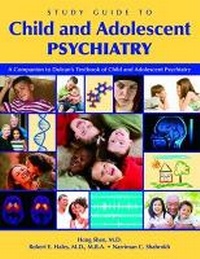
Study Guide to Child and Adolescent Psychiatry
A Companion to Dulcan's Textbook of Child and Adolescent Psychiatry
Published on 30. October 2009
Book
Paperback/Softback
350 pages
978-1-58562-353-2 (ISBN)
Description
Study Guide to Child and Adolescent Psychiatry is a question-and-answer companion that allows you to evaluate your mastery of the subject matter as you progress through Dulcan's Textbook of Child and Adolescent Psychiatry. The Study Guide is made up of 332 questions divided into 65 individual quizzes of 5-10 questions each that correspond to chapters in the Textbook. Questions are followed by an Answer Guide that references relevant text (including the page number) in the Textbook to allow quick access to needed information. Each answer is accompanied by a discussion that not only addresses the correct response but also explains why other responses are not correct.
The Study Guide's companion, Dulcan's Textbook of Child and Adolescent Psychiatry offers the most up-to-date and comprehensive text in child and adolescent psychiatry as presented by more than 110 contributors, with 56 of the 65 chapters featuring new lead authors. Both the organization of the original text and the structure of the chapters have been overhauled to highlight what we now know about evidence-based practices in assessment and treatment, while preserving clinical wisdom.
The Study Guide's companion, Dulcan's Textbook of Child and Adolescent Psychiatry offers the most up-to-date and comprehensive text in child and adolescent psychiatry as presented by more than 110 contributors, with 56 of the 65 chapters featuring new lead authors. Both the organization of the original text and the structure of the chapters have been overhauled to highlight what we now know about evidence-based practices in assessment and treatment, while preserving clinical wisdom.
More details
Language
English
Place of publication
VA
United States
Target group
Professional and scholarly
US School Grade: College Graduate Student and over
Illustrations
4 tables
Dimensions
Height: 279 mm
Width: 215 mm
Thickness: 22 mm
Weight
907 gr
ISBN-13
978-1-58562-353-2 (9781585623532)
Copyright in bibliographic data and cover images is held by Nielsen Book Services Limited or by the publishers or by their respective licensors: all rights reserved.
Schweitzer Classification
Other editions
New editions
Philip R. Muskin | Anna L. Dickerman | Oliver M. Stroeh
Study Guide to Child and Adolescent Psychiatry
A Companion to Dulcan's Textbook of Child and Adolescent Psychiatry, Second Edition
Book
01/2018
American Psychiatric Association Publishing
€85.61
Article is exhausted; no reprint
Previous edition

Stephen J. Cozza | Narriman Shahrokh | Robert E. Hales
Study Guide to Child and Adolescent Psychiatry
A Companion to the American Psychiatric Publishing "Textbook of Child and Adolescent Psychiatry"
Book
04/2006
3rd Edition
American Psychiatric Press Inc.
€59.62
Article exhausted; check for reprint
Persons
Hong Shen, M.D., is Clinical Associate Professor of Psychiatry in the Department of Psychiatry and Behavioral Sciences at University of California, Davis School of Medicine in Sacramento, California
Robert E. Hales, M.D., M.B.A., is the Joe P. Tupin Chair of the Department of Psychiatry and Behavioral Sciences and Interim Director of the M.I.N.D. Institute at the University of California, Davis School of Medicine in Sacramento, California.
Narriman C. Shahrokh, is Chief Administrative Officer in the Department of Psychiatry and Behavioral Sciences at the University of California, Davis, School of Medicine in Sacramento, California.
Robert E. Hales, M.D., M.B.A., is the Joe P. Tupin Chair of the Department of Psychiatry and Behavioral Sciences and Interim Director of the M.I.N.D. Institute at the University of California, Davis School of Medicine in Sacramento, California.
Narriman C. Shahrokh, is Chief Administrative Officer in the Department of Psychiatry and Behavioral Sciences at the University of California, Davis, School of Medicine in Sacramento, California.
Content
Preface. Additional resources. Questions. Assessing infants and toddlers. Assessing the preschool-age child. Assessing the elementary school--age child. Assessing adolescents. Classification of psychiatric disorders. The process of assessment and diagnosis. Diagnostic interviews. Rating scales. Pediatric evaluation and laboratory testing. Neurological examination, electroencephalography, and neuroimaging. Psychological and neuropsychological testing. Intellectual disability (mental retardation). Autism spectrum disorders. Developmental disorders of learning, communication, and motor skills. Attention-deficit/hyperactivity disorder. Oppositional defiant disorder and conduct disorder. Substance abuse and addictions. Depression and dysthymia. Bipolar disorder. Generalized anxiety disorder, specific phobia, panic disorder, social phobia, and selective mutism. Separation anxiety disorder and school refusal. Posttraumatic stress disorder. Obsessive-compulsive disorder. Early onset schizophrenia. besity. Anorexia nervosa and bulimia nervosa. Tic disorders. Elimination disorders. Sleep disorders. Evidence-based practices. Child abuse and neglect. HIV and aids. Bereavement and traumatic grief. Ethnic, cultural, and religious issues. Youth suicide. Gender identity and sexual orientation. Aggression and violence. Genetics: fundamentals relevant to child and adolescent psychiatry. Psychiatric emergencies. Family transitions: challenges and resilience. Psychiatric aspects of chronic physical disorders. Children of parents with psychiatric and substance abuse disorders. Legal and ethical issues. Telepsychiatry. Principles of psychopharmacology. Medications used for attention-deficit/hyperactivity disorder. Antidepressants. Mood stabilizers. Antipsychotic medications. Alpha-adrenergics, beta-blockers, benzodiazepines, buspirone, and desmopressin. Medications used for sleep. Electroconvulsive therapy, transcranial magnetic stimulation, and deep brain stimulation. Individual psychotherapy. Parent counseling, psychoeducation, and parent support groups. Behavioral parent training. Family therapy. Interpersonal psychotherapy for depressed adolescents. Cognitive-behavioral treatment for anxiety disorders. Cognitive-behavioral therapy for depression. Motivational interviewing. Systems of care, wraparound services, and home-based services. Milieu treatment: inpatient, partial hospitalization, and residential programs. School-based interventions. Collaborating with primary care. Juvenile justice. Answer Guide. Index.