

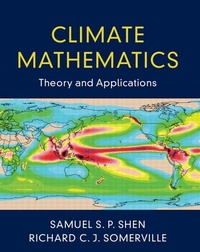
Climate Mathematics
Theory and Applications
Published on 19. September 2019
Book
Hardback
456 pages
978-1-108-47687-4 (ISBN)
Description
This unique text provides a thorough, yet accessible, grounding in the mathematics, statistics, and programming that students need to master for coursework and research in climate science, meteorology, and oceanography. Assuming only high school mathematics, it presents carefully selected concepts and techniques in linear algebra, statistics, computing, calculus and differential equations within the context of real climate science examples. Computational techniques are integrated to demonstrate how to visualize, analyze, and apply climate data, with R code featured in the book and both R and Python code available online. Exercises are provided at the end of each chapter with selected solutions available to students to aid self-study and further solutions provided online for instructors only. Additional online supplements to aid classroom teaching include datasets, images, and animations. Guidance is provided on how the book can support a variety of courses at different levels, making it a highly flexible text for undergraduate and graduate students, as well as researchers and professional climate scientists who need to refresh or modernize their quantitative skills.
Reviews / Votes
'Climate Mathematics is an engaging work that provides students of climate science with the most essential mathematical and computational tools of the trade. This may well prove the most useful text they will encounter on the road to becoming climate scientists.' Kerry A. Emanuel, Massachusetts Institute of Technology 'Combining traditional techniques with the judicious use of computer codes, Shen and Somerville show how mathematics is intimately connected with the science, and how it can be used to address climate problems occurring in the real world. The book is user-friendly for the beginner, but pays due attention to detail for the more advanced student. Taken with the extensive online resources, it brings a fresh new perspective to our curriculum that students and instructors will surely value.' Geoffrey Vallis, University of Exeter 'This book provides a timely introduction to the mathematical approaches and statistical techniques that students will need to understand climate change and how to respond to its impacts. I especially like how it gets students into using the important programming capabilities of R and Python to do such analyses. Climate Mathematics is a wonderful resource - one I will use myself and recommend to all of our students.' Donald J. Wuebbles, University of Illinois, Urbana-ChampaignMore details
Language
English
Place of publication
Cambridge
United Kingdom
Target group
Professional and scholarly
College/higher education
Illustrations
Worked examples or Exercises; 7 Tables, color; 46 Halftones, color; 1 Halftones, black and white; 75 Line drawings, color; 32 Line drawings, black and white
Dimensions
Height: 260 mm
Width: 208 mm
Thickness: 27 mm
Weight
1110 gr
ISBN-13
978-1-108-47687-4 (9781108476874)
Copyright in bibliographic data and cover images is held by Nielsen Book Services Limited or by the publishers or by their respective licensors: all rights reserved.
Schweitzer Classification
Other editions
Additional editions
E-Book
09/2019
Cambridge University Press
€56.49
Available for download
E-Book
09/2019
Cambridge University Press
€48.49
Available for download
Persons
Samuel S. P. Shen is Distinguished Professor of Mathematics and Statistics at San Diego State University, and Visiting Research Mathematician at the Scripps Institution of Oceanography, University of California, San Diego. Formerly, he was McCalla Professor of Mathematical and Statistical Sciences at the University of Alberta, Canada, and President of the Canadian Applied and Industrial Mathematics Society. He has held a variety of visiting positions at the NASA Goddard Space Flight Center, the US Climate Prediction Center, and the University of Tokyo. Richard C. J. Somerville is Distinguished Professor Emeritus at the Scripps Institution of Oceanography, University of California, San Diego. His is a Fellow of the American Association for the Advancement of Science (AAAS), the American Geophysical Union (AGU), and the American Meteorological Society (AMS). His awards include the Climate Communication Prize (2015) and the Ambassador Award (2017) from AGU. He is a leading authority on the prospects for climate change in coming decades and is a coordinating lead author of the Intergovernmental Panel on Climate Change.
Content
1. Dimensional analysis for climate science; 2. Basics of R programming; 3. Basic statistical methods for climate data analysis; 4. Climate data matrices and linear algebra; 5. Energy balance models for climate; 6. Calculus applications to climate science I: derivatives; 7. Calculus applications to climate science II: integrals; 8. Conservation laws in climate dynamics; 9. R graphics for climate science; 10. Advanced R analysis and plotting EOFs, trends, and global data; 11. R analysis of incomplete climate data; Appendix A. Dot product of two vectors; Appendix B. Cross product of two vectors; Appendix C. Spherical coordinates; Appendix D. Calculus concepts and methods; Appendix E. Sample solutions to the climate mathematics exercises.