

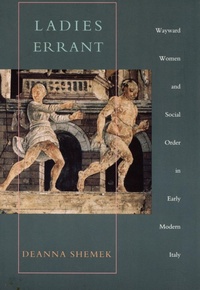
Ladies Errant
Wayward Women and Social Order in Early Modern Italy
Published on 17. July 1998
Book
Paperback/Softback
272 pages
978-0-8223-2167-5 (ISBN)
Description
The issue of a woman's place-and the possibility that she might stray from it-was one of early modern Italy's most persistent social concerns. Ladies Errant takes as its starting point the vast literature of this era devoted to the proper conduct and education of women. Deanna Shemek uses this foundation to present the problem of wayward feminine behavior as it was perceived to threaten male identity and social order in the artistic and intellectual articulations of the Italian Renaissance.
Seeing errancy as an act of resistance rather than of error, Shemek carries her study beyond the didactic and prescriptive literature on femininity in early modern Italy to an arena in which theories about femininity are considered jointly with real and fictional instances of women's waywardness. As prostitutes, warriors, lovers, and poets, the women of Shemek's study are found in canonical texts, marginal works, and popular artistic activity, appearing, for instance, in literature, paintings, legal proceedings, and accounts of public festivals. By juxtaposing these varied places of errancy-from Ariosto's chivalric Orlando furioso to the prostitutes' race in the Palio di San Giorgio-Shemek points to the important contact between elite and popular cultures in early modernity, revealing the strength and flexibility of a gender boundary fundamental to early modern conceptions of social order.
Seeing errancy as an act of resistance rather than of error, Shemek carries her study beyond the didactic and prescriptive literature on femininity in early modern Italy to an arena in which theories about femininity are considered jointly with real and fictional instances of women's waywardness. As prostitutes, warriors, lovers, and poets, the women of Shemek's study are found in canonical texts, marginal works, and popular artistic activity, appearing, for instance, in literature, paintings, legal proceedings, and accounts of public festivals. By juxtaposing these varied places of errancy-from Ariosto's chivalric Orlando furioso to the prostitutes' race in the Palio di San Giorgio-Shemek points to the important contact between elite and popular cultures in early modernity, revealing the strength and flexibility of a gender boundary fundamental to early modern conceptions of social order.
Reviews / Votes
"Ladies Errant is a brilliant piece of scholarship which makes a significant contribution to our understanding of Ariosto, of early modern representations of gender, and of the ideological dynamics that link gender tightly with other social-political structures. It will be important to anyone interested in questions of gender in the European early modern period."-Albert Russell Ascoli, University of California, Berkeley "A far-reaching and innovative work with important and suggestive revisions of previous notions of errancy and feminine behavior in Renaissance Italy. Ladies Errant succeeds brilliantly in weaving together texts by providing sophisticated theoretical framings that are at once subtle and powerful."-Margaret F. Rosenthal, University of Southern CaliforniaMore details
Language
English
Place of publication
North Carolina
United States
Target group
Professional and scholarly
Product notice
Paperback (trade)
Illustrations
8 b&w photographs
Dimensions
Height: 230 mm
Width: 157 mm
Thickness: 20 mm
Weight
445 gr
ISBN-13
978-0-8223-2167-5 (9780822321675)
Copyright in bibliographic data and cover images is held by Nielsen Book Services Limited or by the publishers or by their respective licensors: all rights reserved.
Schweitzer Classification
Other editions
Additional editions

E-Book
07/1998
1st Edition
Duke University Press Books
€198.99
Available for download
Person
Deanna Shemek is Associate Professor of Literature at the University of California, Santa Cruz.