

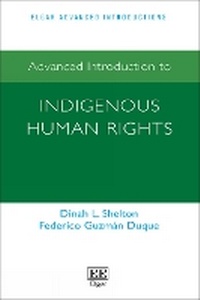
Advanced Introduction to Indigenous Human Rights
Published on 12. April 2024
Book
Paperback/Softback
190 pages
978-1-0353-2866-6 (ISBN)
Description
Elgar Advanced Introductions are stimulating and thoughtful introductions to major fields in the social sciences, business and law, expertly written by the world's leading scholars. Designed to be accessible yet rigorous, they offer concise and lucid surveys of the substantive and policy issues associated with discrete subject areas.
In this vital Advanced Introduction, Dinah Shelton and Federico Guzman Duque examine the human rights of indigenous peoples and communities under current international law. Setting out a historical overview of the legal treatment of native populations from the colonial period to the present, the authors deftly analyse frameworks of institutions monitoring indigenous human rights, theoretical issues relating to these, access to justice and reparations, and special considerations afforded to specific indigenous communities.
Key Features:
Surveyance of the jurisprudence of all major regional human rights systems, including UN-Charter based and UN-treaty bodies
Analysis of indigenous rights case law adopted by international bodies, with emphasis on leading and ground-breaking rulings
Special focus on less-understood emerging aspects of the law, including the situation of hunter-gatherers and pastoralists, the nuances of territorial rights, and the impacts of violence and armed conflict upon indigenous existences
Providing a panoramic view of a complex and rapidly evolving subject, this Advanced Introduction will prove a crucial read for legal practitioners and public officials, as well as indigenous leaders and human rights defenders. It will also appeal to students, scholars and researchers of human rights law, and law and society.
In this vital Advanced Introduction, Dinah Shelton and Federico Guzman Duque examine the human rights of indigenous peoples and communities under current international law. Setting out a historical overview of the legal treatment of native populations from the colonial period to the present, the authors deftly analyse frameworks of institutions monitoring indigenous human rights, theoretical issues relating to these, access to justice and reparations, and special considerations afforded to specific indigenous communities.
Key Features:
Surveyance of the jurisprudence of all major regional human rights systems, including UN-Charter based and UN-treaty bodies
Analysis of indigenous rights case law adopted by international bodies, with emphasis on leading and ground-breaking rulings
Special focus on less-understood emerging aspects of the law, including the situation of hunter-gatherers and pastoralists, the nuances of territorial rights, and the impacts of violence and armed conflict upon indigenous existences
Providing a panoramic view of a complex and rapidly evolving subject, this Advanced Introduction will prove a crucial read for legal practitioners and public officials, as well as indigenous leaders and human rights defenders. It will also appeal to students, scholars and researchers of human rights law, and law and society.
Reviews / Votes
'Advanced Introduction to Indigenous Human Rights is a clear, concise and comprehensive introduction to a field of increasing global importance. It belongs in the library of every individual and organization interested or involved in international human rights advocacy and advocacy for the rights of indigenous peoples.' -- Lindsay Roberston, The University of Oklahoma College of Law, US 'Advanced Introduction to Indigenous Human Rights is an important contribution to the expanding literature on the internationally-recognized rights of indigenous peoples. It thoughtfully synthesizes diverse sources to provide a coherent overview of the human rights themes and standards in this dynamic area of international law, and it does so in a way that is accessible to the non-specialist. This book is an essential reference for all those interested in the rights of indigenous peoples or human rights more generally.' -- S. James Anaya, University of Colorado Boulder, USMore details
Series
Language
English
Place of publication
Cheltenham
United Kingdom
Target group
College/higher education
Professional and scholarly
Dimensions
Height: 216 mm
Width: 138 mm
ISBN-13
978-1-0353-2866-6 (9781035328666)
Copyright in bibliographic data and cover images is held by Nielsen Book Services Limited or by the publishers or by their respective licensors: all rights reserved.
Schweitzer Classification
Persons
Dinah L. Shelton, Manatt/Ahn Professor of International Law (emeritus), George Washington University Law School, US and former member of the Inter-American Commission on Human Rights (2010-2014) and Federico Guzman Duque, Lawyer of Human Rights and previously Universidad de los Andes in Bogota, Colombia
Content
Contents:
1 Introduction to Indigenous Human Rights
2 Historical overview
3 Sources of law
4 Institutions
5 Questions of definition and conceptual delimitation
6 Collective and individual indigenous rights
7 The rights guaranteed (part 1)
8 The rights guaranteed (part 2)
9 Access to justice and reparations
10 The right to a safe and healthy environment
11 Selected problems
1 Introduction to Indigenous Human Rights
2 Historical overview
3 Sources of law
4 Institutions
5 Questions of definition and conceptual delimitation
6 Collective and individual indigenous rights
7 The rights guaranteed (part 1)
8 The rights guaranteed (part 2)
9 Access to justice and reparations
10 The right to a safe and healthy environment
11 Selected problems