

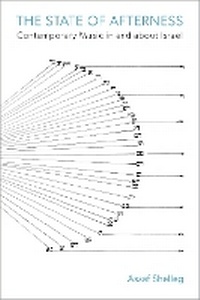
The State of Afterness
Contemporary Music in and about Israel
Published on 22. May 2025
Book
Hardback
368 pages
978-0-19-778672-7 (ISBN)
Description
The State of Afterness traces the histories and cultural histories of contemporary music in Israel since the 1980s and through the 2020s. With afterness defined as the state of being unconditioned by territorialism while opting for previously unavailable temporalities and ethnographies, Assaf Shelleg studies the compositional approaches that record the attenuation of territorial nationalism, and assembles a network of composers trained in the post-ideological climate of the 1970s and 80s. This network features operas, electronic music, orchestral, and chamber and ensemble works by Chaya Czernowin, Betty Olivero, Luciano Berio, Leon Schidlowsky, Josef Bardanashvili, and Arik Shapira, in addition to Jewish oral musical traditions and novels by David Grossman, A. B. Yehoshua, Yishai Sarid, and Ruby Namdar.
While in previous eras the statist subject superseded or subsumed any competing political project, since the 1980s such self-referential acts have been losing their ability to confer homogeneity and project the monologic of national Hebrew culture and its telos. As a result, Shelleg writes, the composers discussed in this book do not form a cohesive group, yet they share constituent cultural and historical sensibilities: they opt for diasporism irrespective of their compositional approaches but refrain from universalizing Jewish diasporas (as did classic Zionism); they display postmodern patrimonies but reject their essentialist qualities; they admonish their country's ethnocracy and democratic facade; they denationalize Holocaust memorialization; and they narrate the failure of territorial nationalism. In this sense, the state of afterness is a drama still etched in our everyday.
While in previous eras the statist subject superseded or subsumed any competing political project, since the 1980s such self-referential acts have been losing their ability to confer homogeneity and project the monologic of national Hebrew culture and its telos. As a result, Shelleg writes, the composers discussed in this book do not form a cohesive group, yet they share constituent cultural and historical sensibilities: they opt for diasporism irrespective of their compositional approaches but refrain from universalizing Jewish diasporas (as did classic Zionism); they display postmodern patrimonies but reject their essentialist qualities; they admonish their country's ethnocracy and democratic facade; they denationalize Holocaust memorialization; and they narrate the failure of territorial nationalism. In this sense, the state of afterness is a drama still etched in our everyday.
Reviews / Votes
The book might be considered a fine work of curation. * Yosef Goldenberg, MUSICJ *More details
Language
English
Place of publication
New York
United States
Target group
Professional and scholarly
Product notice
sewn/stitched
Cloth over boards
Illustrations
31 music examples, 3 figures, 1 table
Dimensions
Height: 241 mm
Width: 167 mm
Thickness: 30 mm
Weight
667 gr
ISBN-13
978-0-19-778672-7 (9780197786727)
Copyright in bibliographic data and cover images is held by Nielsen Book Services Limited or by the publishers or by their respective licensors: all rights reserved.
Schweitzer Classification
Other editions
Additional editions
E-Book
03/2025
OUP eBook
€94.99
Available for download
E-Book
03/2025
OUP eBook
€94.99
Available for download
Person
Musicologist Assaf Shelleg (The Hebrew University of Jerusalem) is the author of Theological Stains: Art Music and the Zionist Project (OUP 2020) and Jewish Contiguities and the Soundtrack of Israeli History (OUP 2014), which received the 2016 AJS Jordan Schnitzer Book Prize (Association for Jewish Studies) and the 2015 Joel Engel Prize for the Study of Hebrew Music. Shelleg is a music contributor for Haaretz, and has previously served as the director of the Cherrick Center for the Study of Zionism, the Yishuv, and the State of Israel at The Hebrew University, and as a curator for the Israel Philharmonic Orchestra.
Content
Acknowledgements
Abbreviations
Illustrations
Music Examples
Introduction: The Afterness of State
Afterness
Chapter 1: Adamot
Do Not Be Like Your Fathers
Hebrew Culture as a Non-Reference
A Tel Avivian Ecosystem
Shifting
Golem
Postmodern Ethnographies?
The Poetics of Distance
Binding (Oneself)
Expand
Chapter 2: Pnima
Transcribing Disnarration
See Under: Love
Inward (pnima)
Securing the Disfigured
Adama (and Mozart, Too)
Local Renderings
Ethnographic Renderings
Atrophy (Willing and Unwilling)
Notes
Index
Abbreviations
Illustrations
Music Examples
Introduction: The Afterness of State
Afterness
Chapter 1: Adamot
Do Not Be Like Your Fathers
Hebrew Culture as a Non-Reference
A Tel Avivian Ecosystem
Shifting
Golem
Postmodern Ethnographies?
The Poetics of Distance
Binding (Oneself)
Expand
Chapter 2: Pnima
Transcribing Disnarration
See Under: Love
Inward (pnima)
Securing the Disfigured
Adama (and Mozart, Too)
Local Renderings
Ethnographic Renderings
Atrophy (Willing and Unwilling)
Notes
Index