

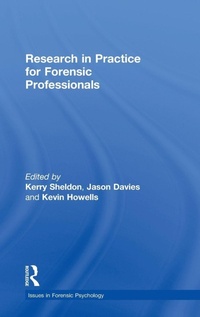
Research in Practice for Forensic Professionals
1st Edition
Published on 10. October 2011
Book
Hardback
368 pages
978-0-415-67271-9 (ISBN)
Description
This book explores applied research methods used in forensic settings - prisons, the probation service, courts and forensic mental health establishments - and provides a comprehensive 'how-to' guide for forensic practitioners and researchers.
It provides practitioners and researchers with grounding in the practical techniques appropriate for research in applied forensic settings. This includes knowledge and skills of the research process and the wide range of research methods (both quantitative and qualitative) being applied in this arena. The text provides a critical understanding of the problems, challenges and ethical issues which can arise and ideas for managing these. Specific attention is paid to empirical research within forensic populations and settings including researching vulnerable groups (e.g. offenders and the mentally ill in secure settings), evaluating treatment programmes, and the uses and problems of randomised control trials.
The book is clearly structured, with each methodology chapter describing the background of the approach; the type of research questions addressed; design principles and issues; the types of analysis that can be utilised; strengths and limitations of the method; future directions and further sources of information. Through the inclusion of case studies and illustrative examples from forensic researchers and practitioners who have extensive experience of conducting applied research, this book tackles real-life problems typically faced by researchers and practitioners.
Research in Practice for Forensic Professionals is an essential one-stop resource for practitioners (such as psychologists, nursing and medical staff, prison and probation workers, social workers, occupational therapists) who have an interest in research and in evaluating their own work and the services in which they work. It will also be of interest to students studying areas of applied research, such as forensic psychology or applied criminology and those teaching them.
It provides practitioners and researchers with grounding in the practical techniques appropriate for research in applied forensic settings. This includes knowledge and skills of the research process and the wide range of research methods (both quantitative and qualitative) being applied in this arena. The text provides a critical understanding of the problems, challenges and ethical issues which can arise and ideas for managing these. Specific attention is paid to empirical research within forensic populations and settings including researching vulnerable groups (e.g. offenders and the mentally ill in secure settings), evaluating treatment programmes, and the uses and problems of randomised control trials.
The book is clearly structured, with each methodology chapter describing the background of the approach; the type of research questions addressed; design principles and issues; the types of analysis that can be utilised; strengths and limitations of the method; future directions and further sources of information. Through the inclusion of case studies and illustrative examples from forensic researchers and practitioners who have extensive experience of conducting applied research, this book tackles real-life problems typically faced by researchers and practitioners.
Research in Practice for Forensic Professionals is an essential one-stop resource for practitioners (such as psychologists, nursing and medical staff, prison and probation workers, social workers, occupational therapists) who have an interest in research and in evaluating their own work and the services in which they work. It will also be of interest to students studying areas of applied research, such as forensic psychology or applied criminology and those teaching them.
Reviews / Votes
'There is no single way to do good research. The Editors of this text have taken a broad perspective, and contributions cover a wide range of research issues and specific methods applicable in forensic work. Chapters are authored by leading researchers, who explain their methods clearly, without sacrificing detail. This book will certainly be of use to students who are developing their research skills. I would also strongly recommend it to qualified practitioners who wish to gather information about their service users, evaluate their interventions, or better understand the systems in which they work with offenders. Whether your job is to catch and convict offenders, or to work with them to reduce risk, in this book you will find a way to answer some of the important questions you have no doubt asked in the past.' - Professor Mary McMurran, Institute of Mental Health, University of NottinghamMore details
Series
Language
English
Place of publication
London
United Kingdom
Publishing group
Taylor & Francis Ltd
Target group
College/higher education
Illustrations
33 s/w Abbildungen, 33 s/w Zeichnungen, 34 s/w Tabellen
34 Tables, black and white; 33 Line drawings, black and white; 33 Illustrations, black and white
Dimensions
Height: 240 mm
Width: 161 mm
Thickness: 24 mm
Weight
716 gr
ISBN-13
978-0-415-67271-9 (9780415672719)
Copyright in bibliographic data and cover images is held by Nielsen Book Services Limited or by the publishers or by their respective licensors: all rights reserved.
Schweitzer Classification
Other editions
Additional editions
Kerry Sheldon | Jason Davies | Kevin Howells
Research in Practice for Forensic Professionals
E-Book
03/2012
1st Edition
Routledge
€64.49
Available for download
Kerry Sheldon | Jason Davies | Kevin Howells
Research in Practice for Forensic Professionals
E-Book
03/2012
1st Edition
Routledge
€64.49
Available for download
Kerry Sheldon | Jason Davies | Kevin Howells
Research in Practice for Forensic Professionals
Book
10/2011
1st Edition
Routledge
€72.30
Shipment within 15-20 days
Persons
Kerry Sheldon is Research Fellow at Rampton High Secure Hospital. She has worked for the probation service in sex offender treatment and as a lecturer in psychology and criminology.
Jason Davies is a Consultant Forensic and Clinical Psychologist and Lead Psychologist in Rehabilitation/Recovery and Low Secure Services with Abertawe Bro Morgannwg University Health Board
Kevin Howells trained initially as a clinical psychologist before specialising in forensic work. He has worked as a practitioner in a range of forensic mental health services in the UK and the USA as well as holding a number of academic positions and publishing extensively in the field.
Jason Davies is a Consultant Forensic and Clinical Psychologist and Lead Psychologist in Rehabilitation/Recovery and Low Secure Services with Abertawe Bro Morgannwg University Health Board
Kevin Howells trained initially as a clinical psychologist before specialising in forensic work. He has worked as a practitioner in a range of forensic mental health services in the UK and the USA as well as holding a number of academic positions and publishing extensively in the field.
Content
Part 1: Introduction to Forensic Research 1. Conducting Research in Forensic Settings: Philosophical and Practical Issues 2. Ethical Problems Arising in Forensic and Correctional Research Part 2: Risk, Investigative and Criminal Justice Research 3. Risk Research 4. Facet Theory and Multi-Dimensional Scaling Methods in Forensic Research 5. Court Relevant Research Methods Part 3: Approaches at the Qualitative Level 6. Qualitative Research With Staff In Forensic Settings: A Grounded Theory Example 7. Using Qualitative Methods to Research Offenders and Forensic Patients Part 4: Assessing Individual Change 8. Single Case Methodologies 9. The Idiographic Measurement of Change 10. Functional Analysis Part 5: Approaches at the Group Level 10. Strengths and Weaknesses of Randomised Control Trials 11. Evaluation of Regimes and Environments 12. Evaluating the quality of criminal justice programmes 13. Treatment and Rehabilitation Evaluation and Large Scale Outcomes 14. Systematic Reviews and Meta-Analysis 15. Conclusion