

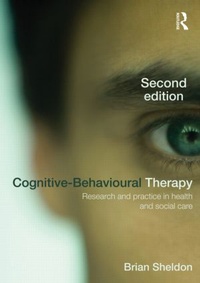
Cognitive-Behavioural Therapy
Research and Practice in Health and Social Care
2nd Edition
Published on 12. January 2011
Book
Paperback/Softback
288 pages
978-0-415-56435-9 (ISBN)
Description
Cognitive-behavioural therapy (CBT) has been extensively researched and shown to be solidly underpinned by evidence. Broadly applicable across a wide range of personal and social problems - from depression and phobias to child behavioural problems - it is only now beginning to be used to its full potential in health and social care practice.
This second edition of Cognitive-Behavioural Therapy is comprehensively revised and updated. It takes into account the significant amount of new research in the discipline, and integrates theory, research and practice. The text includes plentiful case studies from across health and social care to illustrate particular approaches, different problems and different professional circumstances. Topics covered include:
a discussion of the development and distinctive features of CBT;
a comprehensive review of research on learning and cognition, examining the therapeutic implications of these studies;
a thorough guide to assessment and therapeutic procedures, including methods of evaluation;
illustrations of the main methods of helping with case examples from social work, nursing and psychotherapy;
consideration of the ethical implications of such methods as part of mainstream practice.
Cognitive-Behavioural Therapy is written in a lively and accessible style, and is designed to give a thorough grounding in cognitive-behavioural methods and their application. It is essential reading for students and professionals in psychology, social work, psychiatric nursing and psychotherapy.
This second edition of Cognitive-Behavioural Therapy is comprehensively revised and updated. It takes into account the significant amount of new research in the discipline, and integrates theory, research and practice. The text includes plentiful case studies from across health and social care to illustrate particular approaches, different problems and different professional circumstances. Topics covered include:
a discussion of the development and distinctive features of CBT;
a comprehensive review of research on learning and cognition, examining the therapeutic implications of these studies;
a thorough guide to assessment and therapeutic procedures, including methods of evaluation;
illustrations of the main methods of helping with case examples from social work, nursing and psychotherapy;
consideration of the ethical implications of such methods as part of mainstream practice.
Cognitive-Behavioural Therapy is written in a lively and accessible style, and is designed to give a thorough grounding in cognitive-behavioural methods and their application. It is essential reading for students and professionals in psychology, social work, psychiatric nursing and psychotherapy.
More details
Edition
2nd edition
Language
English
Place of publication
London
United Kingdom
Publishing group
Taylor & Francis Ltd
Target group
College/higher education
Professional and scholarly
Postgraduate and Professional
Illustrations
29 s/w Abbildungen, 9 s/w Tabellen
9 Tables, black and white; 29 Illustrations, black and white
Dimensions
Height: 246 mm
Width: 174 mm
Weight
566 gr
ISBN-13
978-0-415-56435-9 (9780415564359)
Copyright in bibliographic data and cover images is held by Nielsen Book Services Limited or by the publishers or by their respective licensors: all rights reserved.
Schweitzer Classification
Other editions
Additional editions
E-Book
03/2011
2nd Edition
Routledge
€59.49
Available for download
E-Book
03/2011
2nd Edition
Routledge
€59.49
Available for download
Book
01/2011
2nd Edition
Routledge
€215.41
Shipment within 15-20 days
Previous edition
Book
01/1995
Routledge
€58.37
Article exhausted; check for reprint
Person
Brian Sheldon is Emeritus Professor of Applied Social Research at the University of Exeter, UK. A registered Cognitive Behavioural Therapist, he is also a qualified psychiatric nurse, a qualified social worker and holds a PhD in Psychology. He was previously Director of the Centre for Evidence-Based Social Services in the medical school at the University of Exeter.
Content
1. Origins and Development of Cognitive-Behavioural Therapy 2. Research on the Effectiveness of Cognitive-Behavioural Therapy 3. Philosophical Implications 4. Learning Theory and Research 5. Emotional Reactions 6. Assessment, Monitoring and Evaluation 7. Stimulus-Control Techniques 8. Response-Control Techniques 9. Ethical Considerations