

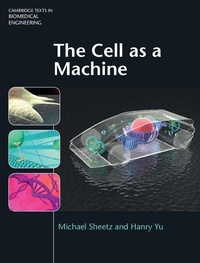
The Cell as a Machine
Published on 11. January 2018
Book
Hardback
434 pages
978-1-107-05273-4 (ISBN)
Description
This unique introductory text explains cell functions using the engineering principles of robust devices. Adopting a process-based approach to understanding cell and tissue biology, it describes the molecular and mechanical features that enable the cell to be robust in operating its various components, and explores the ways in which molecular modules respond to environmental signals to execute complex functions. The design and operation of a variety of complex functions are covered, including engineering lipid bilayers to provide fluid boundaries and mechanical controls, adjusting cell shape and forces with dynamic filament networks, and DNA packaging for information retrieval and propagation. Numerous problems, case studies and application examples help readers connect theory with practice, and solutions for instructors and videos of lectures accompany the book online. Assuming only basic mathematical knowledge, this is an invaluable resource for graduate and senior undergraduate students taking single-semester courses in cell mechanics, biophysics and cell biology.
More details
Series
Language
English
Place of publication
Cambridge
United Kingdom
Target group
College/higher education
Illustrations
1 Halftones, black and white; 136 Line drawings, color; 1 Line drawings, black and white
Dimensions
Height: 246 mm
Width: 189 mm
Thickness: 24 mm
Weight
1110 gr
ISBN-13
978-1-107-05273-4 (9781107052734)
Copyright in bibliographic data and cover images is held by Nielsen Book Services Limited or by the publishers or by their respective licensors: all rights reserved.
Schweitzer Classification
Other editions
Additional editions
Michael Sheetz | Hanry Yu
The Cell as a Machine
E-Book
01/2018
Cambridge University Press
€82.99
Available for download
Michael Sheetz
Cell as a Machine
E-Book
01/2018
Cambridge University Press
€68.99
Available for download
Persons
Michael Sheetz is the Founding Director of the Mechanobiology Institute and a Distinguished Professor in the Department of Biological Sciences at the National University of Singapore. Hanry Yu is a Professor in both the Department of Physiology and the Mechanobiology Institute at the National University of Singapore. He is also the Director of the National University Health System's research facilities in microscopy and cytometry.
Content
Part I. Principle of Complex Function in Robust Machines: 1. Robust self-replicating machines shaped by evolution; 2. Complex functions of robust machines with emergent properties; 3. Integrated complex functions with dynamic feedback; 4. Cells exhibit multiple states, each with different functions; 5. Life at low Reynolds number and the mesoscale leads to stochastic phenomena; Part II. Design and Operation of Complex Functions: 6. Engineering lipid bilayers to provide fluid boundaries and mechanical controls; 7. Membrane trafficking - flow and barriers create asymmetries; 8. Signaling and cell volume control through ion transport and volume regulators; 9. Structuring a cell by cytoskeletal filaments; 10. Moving and maintaining functional assemblies with motors; 11. Microenvironment controls life, death and regeneration; 12. Adjusting cell shape and forces with dynamic filament networks; 13. DNA packaging for information retrieval and propagation; 14. Transcribing the right information and packaging for delivery; 15. Turning RNA into functional proteins and removing unwanted proteins; Part III. Coordination of Complex Functions: 16. How to approach a coordinated function - cell rigidity sensing and force generation across length scale; 17. Integration of cellular functions for decision making; 18. Moving from omnipotency to death; 19. Cancer versus regeneration - the wrong versus right response to the microenvironment.