

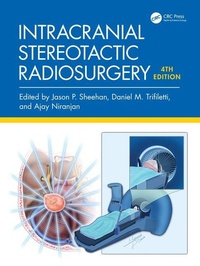
Intracranial Stereotactic Radiosurgery
4th Edition
Will be published approx. on 27. January 2026
Book
Hardback
400 pages
978-1-041-09281-0 (ISBN)
Description
This fourth edition of Intracranial Stereotactic Radiosurgery builds upon the success of its previous editions to provide a comprehensive assessment of contemporary approaches and indications for intracranial stereotactic radiosurgery (SRS).
Key topics include benign and malignant tumors, cerebrovascular abnormality, and functional disorders. In addition, two brand new chapters are introduced, focusing on the application of AI to SRS for intracranial lesions, and the consideration of large-scale brain networks. Authored by leading experts from across the world, this book offers a fundamental insight into the field of radiosurgery.
Suitable for postgraduate students studying radiation therapy and medical physics, this text is a fundamental resource for all professionals and practitioners working in radiosurgery and radiation therapy.
Key topics include benign and malignant tumors, cerebrovascular abnormality, and functional disorders. In addition, two brand new chapters are introduced, focusing on the application of AI to SRS for intracranial lesions, and the consideration of large-scale brain networks. Authored by leading experts from across the world, this book offers a fundamental insight into the field of radiosurgery.
Suitable for postgraduate students studying radiation therapy and medical physics, this text is a fundamental resource for all professionals and practitioners working in radiosurgery and radiation therapy.
More details
Edition
4th edition
Language
English
Place of publication
London
United Kingdom
Publishing group
Taylor & Francis Ltd
Target group
College/higher education
Professional and scholarly
Academic, Postgraduate, and Professional Practice & Development
Product notice
sewn/stitched
Cloth over boards
Illustrations
67 farbige Abbildungen, 42 s/w Photographien bzw. Rasterbilder, 65 Farbfotos bzw. farbige Rasterbilder, 23 s/w Zeichnungen, 2 farbige Zeichnungen, 52 s/w Tabellen, 65 s/w Abbildungen
52 Tables, black and white; 2 Line drawings, color; 23 Line drawings, black and white; 65 Halftones, color; 42 Halftones, black and white; 67 Illustrations, color; 65 Illustrations, black and white
Dimensions
Height: 280 mm
Width: 210 mm
Weight
930 gr
ISBN-13
978-1-041-09281-0 (9781041092810)
Copyright in bibliographic data and cover images is held by Nielsen Book Services Limited or by the publishers or by their respective licensors: all rights reserved.
Schweitzer Classification
Other editions
Additional editions
Jason P. Sheehan | Daniel M. Trifiletti | Ajay Niranjan
Intracranial Stereotactic Radiosurgery
E-Book
01/2026
4th Edition
CRC Press
€265.99
Available for download
Jason P. Sheehan | Daniel M. Trifiletti | Ajay Niranjan
Intracranial Stereotactic Radiosurgery
E-Book
01/2026
4th Edition
CRC Press
€265.99
Available for download
Previous edition
Jason P. Sheehan
Intracranial Stereotactic Radiosurgery
Book
12/2021
3rd Edition
CRC Press
€223.21
Shipment within 15-20 days
Persons
Jason P. Sheehan is the Vice Chair and Harrison Distinguished Professor of Neurological Surgery at the University of Virginia (UVA). In addition, he is also a Professor of Radiation Oncology and Biomedical Engineering at the University of Virginia. He serves as the Editor-In-Chief of the Journal of Neuro-Oncology and Associate Editor of Neurosurgical Focus. He has held many leadership positions including ones in the American Association of Neurological Surgeons, the AANS/CNS Tumor Section, International Stereotactic Radiosurgery Society, and the International Radiosurgery Research Foundation. He has published more than 800 peer reviewed papers in journals and contributed to and/or edited dozens of books.
Daniel M. Trifiletti, M.D, is an international leader in radiation oncology and stereotactic radiosurgery. His research includes numerous clinical studies involving radiation, surgery and drug therapies in the treatment of tumors. Dr. Trifiletti's short-term research goals focus on describing the impact of radiation on the priming of the brain tumor microenvironment. Discovering the biological underpinnings of radiation priming will allow for novel, "game-changing" cancer therapies, rapid translation to early-stage clinical trials and, ultimately, improved outcomes in patients with fatal diseases.
Ajay Niranjan, MD, MBA, is a professor of Neurological surgery at the University of Pittsburgh. He is the Director of Radiosurgery Research and associate director of Center of image guided neurosurgery (CIGNS) at University of Pittsburgh Medical Center. In addition, he is the director of UPMC Brain Mapping Center. He serves as the associate editor for the radiosurgery section of Neurosurgery and is the Executive Director of International Radiosurgery Research Foundation (IRRF). He has published more than 350 peer reviewed papers in journals and edited 5 books.
Daniel M. Trifiletti, M.D, is an international leader in radiation oncology and stereotactic radiosurgery. His research includes numerous clinical studies involving radiation, surgery and drug therapies in the treatment of tumors. Dr. Trifiletti's short-term research goals focus on describing the impact of radiation on the priming of the brain tumor microenvironment. Discovering the biological underpinnings of radiation priming will allow for novel, "game-changing" cancer therapies, rapid translation to early-stage clinical trials and, ultimately, improved outcomes in patients with fatal diseases.
Ajay Niranjan, MD, MBA, is a professor of Neurological surgery at the University of Pittsburgh. He is the Director of Radiosurgery Research and associate director of Center of image guided neurosurgery (CIGNS) at University of Pittsburgh Medical Center. In addition, he is the director of UPMC Brain Mapping Center. He serves as the associate editor for the radiosurgery section of Neurosurgery and is the Executive Director of International Radiosurgery Research Foundation (IRRF). He has published more than 350 peer reviewed papers in journals and edited 5 books.
Content
1. A Short History of Gamma Knife Radiosurgery 2. History of LINAC and Proton Radiosurgery 3. History of CyberKnife Radiosurgery 4. Radiobiology of Stereotactic Radiosurgery 5. Radiology Considerations for Radiosurgery 6. Physics of Stereotactic Radiosurgery 7. Critical Structures and Tolerances for Intracranial Stereotactic Radiosurgery 8. Radiosurgery Pathological Fundamentals 9. Stereotactic Radiosurgery for Arteriovenous Malformations 10. SRS of Cavernomas 11. Stereotactic Radiosurgery for Dural Arteriovenous Fistulas 12. Radiosurgery for meningiomas: an overview of the current status quo 13. Solitary Fibrous Tumor /Hemangiopericytoma 14. SRS for Clinically Nonfunctioning Pituitary Neuroendocrine Tumors 15. Stereotactic Radiosurgery for Functioning Pituitary Neuroendocrine Tumors 16. Stereotactic Radiosurgery for craniopharyngiomas 17. SRS for Chordomas and Chondrosarcomas 18. Stereotactic Radiosurgery as a Preferred Therapeutic Approach for Glomus Tumors 19. Stereotactic Radiosurgery for Hemangioblastoma 20. Stereotactic Radiosurgery for Vestibular Schwannoma 21. Stereotactic Radiosurgery for Nonvestibular Schwannomas 22. Stereotactic Radiosurgery for Facial Neuralgias 23. Radiosurgery for Movement Disorders 24. SRS for OCD 25. Stereotactic Radiosurgery for Hypothalamic Hamartomas 26. Radiosurgical modulation for Epilepsy 27. Radiosurgery for ocular disorders 28. Stereotactic Radiosurgery for Pediatric Brain Tumors and Arteriovenous Malformations 29. Stereotactic Radiosurgery and Hypofractionated Stereotactic Radiotherapy for Gliomas 30. Stereotactic Radiosurgery for the Management of One to Five Brain Metastases 31. Stereotactic Radiosurgery for > 5 Brain Metastases 32. Hypofractionated Stereotactic Radiosurgery for Brain Metastases 33. Stereotactic Radiosurgery and Immunotherapy 34. Repeat Stereotactic Radiosurgery for Brain Metastasis 35. Recognition and Management of Adverse Radiation Effects 36. Application of Artificial Intelligence to Stereotactic Radiosurgery for Intracranial Lesions: Detection, Segmentation, and Outcome Prediction 37. Intracranial Radiosurgery in the World of Large-Scale Brain Networks