

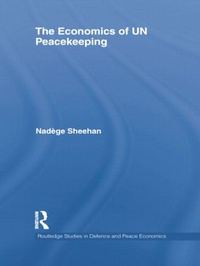
The Economics of UN Peacekeeping
1st Edition
Published on 30. May 2014
Book
Paperback/Softback
364 pages
978-1-138-80303-9 (ISBN)
Description
Peacekeeping is a security concept that is very representative of the current interventionism, multilateralism, human rights, and humanitarian ideas. UN peacekeeping plays an important role in international security and includes various activities that go beyond the original roles assigned to UN armed forces (e.g. humanitarian aid, election supervision, disarmament, mine clearance, civilian protection, and peacebuilding). The problem is to define the economic efficiency of these operations and to develop some recommendations in the context of an economic globalization process.
Although UN peacekeeping has shortcomings, it must be considered essential for organizing and defending the world politico-economic order. UN peacekeeping is a political activity, but its production strongly depends on nations' economic considerations. Governments make political decisions that also take into account the economic gains they expect to obtain from their contribution to any specific mission. With low means and inadequate strategies to meet the challenges, UN peacekeeping must pay particular attention to resolving the problems of free riding and of prisoner's dilemma in contributions that delay deployments and create significant financial problems. Understanding how peacekeeping can be most cost-effectively carried out, while considering the importance of legitimacy in interventions, is essential.
This book believes that regional organizations can ease the UN's financial responsibility by managing conflicts in their regions. But, to be most effective, they must involve the UN in their interventions. This book also emphasizes UN peacekeeping trust funds as the key to better financial effectiveness. It strongly recommends that NATO be empowered by the UN with the role of global peace police, and proposes the establishment of a UN high-ranking team of international specialists in peacekeeping issues. This research should be of interest to students and researchers looking at international and political economics, as well as international relations, defence, security and peace studies.
Although UN peacekeeping has shortcomings, it must be considered essential for organizing and defending the world politico-economic order. UN peacekeeping is a political activity, but its production strongly depends on nations' economic considerations. Governments make political decisions that also take into account the economic gains they expect to obtain from their contribution to any specific mission. With low means and inadequate strategies to meet the challenges, UN peacekeeping must pay particular attention to resolving the problems of free riding and of prisoner's dilemma in contributions that delay deployments and create significant financial problems. Understanding how peacekeeping can be most cost-effectively carried out, while considering the importance of legitimacy in interventions, is essential.
This book believes that regional organizations can ease the UN's financial responsibility by managing conflicts in their regions. But, to be most effective, they must involve the UN in their interventions. This book also emphasizes UN peacekeeping trust funds as the key to better financial effectiveness. It strongly recommends that NATO be empowered by the UN with the role of global peace police, and proposes the establishment of a UN high-ranking team of international specialists in peacekeeping issues. This research should be of interest to students and researchers looking at international and political economics, as well as international relations, defence, security and peace studies.
More details
Series
Language
English
Place of publication
London
United Kingdom
Publishing group
Taylor & Francis Ltd
Target group
College/higher education
Illustrations
26 s/w Zeichnungen, 33 s/w Tabellen
33 Tables, black and white; 26 Line drawings, black and white
Dimensions
Height: 234 mm
Width: 156 mm
Weight
498 gr
ISBN-13
978-1-138-80303-9 (9781138803039)
Copyright in bibliographic data and cover images is held by Nielsen Book Services Limited or by the publishers or by their respective licensors: all rights reserved.
Schweitzer Classification
Other editions
Additional editions
Nadege Sheehan
The Economics of UN Peacekeeping
E-Book
07/2011
1st Edition
Routledge
€69.99
Available for download
Nadege Sheehan
The Economics of UN Peacekeeping
E-Book
07/2011
1st Edition
Routledge
€69.99
Available for download
Nadege Sheehan
The Economics of UN Peacekeeping
Book
05/2011
1st Edition
Routledge
€238.09
Shipment within 15-20 days
Person
Nadege Sheehan is Research Associate at the University of Grenoble, France.
Content
Introduction 1. Theoretical Basis of UN Peacekeeping 2. The History of UN Peacekeeping Operations 3. From Traditional to Multidimensional Operations, or the Development of UN Peacekeeping 4. Financing UN Peacekeeping: An Inequitable Peacekeeping Assessment Scale 5. UN Peacekeeping Expenditures and Total Costs 6. A UN Permanent Army versus the Patchwork of National Armies 7. UN Peacekeeping, Debates and Propositions for a World Politico-Economic Order 8. UN Peacekeeping and Globalization 9. Private Organizations and Peacekeeping 10. Towards an Analysis of More Efficient Financing Solutions for UN Peacekeeping 11. Conclusion