

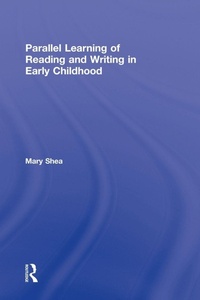
Parallel Learning of Reading and Writing in Early Childhood
1st Edition
Published on 14. March 2011
Book
Hardback
240 pages
978-0-415-88298-9 (ISBN)
Description
Parallel Learning of Reading and Writing in Early Childhood explores why it's important to provide a balanced language learning environment for young children and offers approaches for children to practice and explore language. Writing - a different but parallel process - can open the door to reading, and an effective writing approach in the home and early childhood classrooms leads to the development of phonemic awareness, understanding of phonetic principles, vocabulary, fluency, and comprehension. Effective early childhood teachers are those that extend the knowledge children have amassed at home and use the knowledge of how children learn naturally in the world to inform their practice.
This book offers the purpose, context, and outcomes of including writing right from the start in young children's literacy learning. Through analysis of writing samples, research, and principles of best practices, Shea outlines the essential ingredients for early language learning and provides a developmentally appropriate approach to language learning. Throughout the chapters, Shea integrates discussion of assessment, classroom environment, instructional/teacher scaffolding, and differentiating instruction across developmental levels along with the supporting theory.
Special features:
vignettes and descriptions of Pre-K, K, and Grade 1 classrooms that incorporate writing across the day
artifacts of children's writing that demonstrate an evolution of knowledge related to both message and word construction
concept labeling words and topic specific terms defined throughout the book to support the reader's understanding of professional terminology
discussion of seminal and current research as well as best practices
Companion Website with lesson ideas and abundant writing samples from a wide range of demographic, cultural, and language contexts for readers to view, analyze, and discuss.
This text offers pre- and in-service early childhood education teachers the content and resources to develop a deeper understanding of language learning, to prompt an examination of current practice, and to stimulate curricular re-designs that foster meaningful, joyful, and motivated learning.
This book offers the purpose, context, and outcomes of including writing right from the start in young children's literacy learning. Through analysis of writing samples, research, and principles of best practices, Shea outlines the essential ingredients for early language learning and provides a developmentally appropriate approach to language learning. Throughout the chapters, Shea integrates discussion of assessment, classroom environment, instructional/teacher scaffolding, and differentiating instruction across developmental levels along with the supporting theory.
Special features:
vignettes and descriptions of Pre-K, K, and Grade 1 classrooms that incorporate writing across the day
artifacts of children's writing that demonstrate an evolution of knowledge related to both message and word construction
concept labeling words and topic specific terms defined throughout the book to support the reader's understanding of professional terminology
discussion of seminal and current research as well as best practices
Companion Website with lesson ideas and abundant writing samples from a wide range of demographic, cultural, and language contexts for readers to view, analyze, and discuss.
This text offers pre- and in-service early childhood education teachers the content and resources to develop a deeper understanding of language learning, to prompt an examination of current practice, and to stimulate curricular re-designs that foster meaningful, joyful, and motivated learning.
Reviews / Votes
"In this book, Mary Shea subtly weaves the language arts into a whole and beautiful tapestry, sensitively guiding both new and experienced educators toward a meaningful practice, rooted in research. Substantiating this developmental framework are hundreds of artifacts, capturing the work and play of children as they enter the world of drawing and writing. This book honors all those wonderful teachable moments that scaffold students and transform them into lovers of language, making both teaching and learning an exciting adventure."--Ardith Davis Cole, Ph. D., Literacy Consultant, and Author
"Parallel Learning of Reading and Writing in Early Childhood engages early childhood education teachers to struggle against perceiving the process of becoming literate as an edifice that is best taught in isolation from all other aspects of what it means to be literate."
--Sharon Matthews, Assistant Professor, Department of Teacher Education, Shippensburg University
More details
Language
English
Place of publication
London
United Kingdom
Publishing group
Taylor & Francis Ltd
Target group
College/higher education
Illustrations
113 s/w Zeichnungen
113 Line drawings, black and white
Dimensions
Height: 260 mm
Width: 183 mm
Thickness: 18 mm
Weight
658 gr
ISBN-13
978-0-415-88298-9 (9780415882989)
Copyright in bibliographic data and cover images is held by Nielsen Book Services Limited or by the publishers or by their respective licensors: all rights reserved.
Schweitzer Classification
Other editions
Additional editions
E-Book
04/2011
1st Edition
Routledge
€52.49
Available for download
E-Book
04/2011
1st Edition
Routledge
€52.49
Available for download
Book
03/2011
1st Edition
Routledge
€58.40
Shipment within 15-20 days
Person
Mary Shea is a Professor and Director of Graduate Literacy Programs at Canisius College.
Content
Part I A Strong Foundation for Learning Language
1. Introduction
2. Function Before Form - Building Concepts About Print
3. Talk: An Essential Tool for Writing
4. The Writing We Need - At Home, At School
Part II Mindfully Mediating Language Learning
5. Getting Writing Started
6. Writing in Pre-K
7. Writing in Kindegarten
8. Writing in First Grade
9. Differentiating for Fluent Young Writers
10. Conclusion
1. Introduction
2. Function Before Form - Building Concepts About Print
3. Talk: An Essential Tool for Writing
4. The Writing We Need - At Home, At School
Part II Mindfully Mediating Language Learning
5. Getting Writing Started
6. Writing in Pre-K
7. Writing in Kindegarten
8. Writing in First Grade
9. Differentiating for Fluent Young Writers
10. Conclusion