

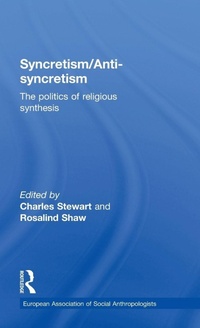
Syncretism/Anti-Syncretism
The Politics of Religious Synthesis
Published on 6. October 1994
Book
Hardback
236 pages
978-0-415-11116-4 (ISBN)
Description
Syncretism - the synthesis of different religious - is a contentious word. Some regard it as a pejorative term, referring to local versions of notionally standard `world religions' which are deemed `inauthentic' because saturated with indigenous content. Syncretic versions of Christianity do not conform to `official' (read `European') models. In other contexts however, the syncretic amalgamation of religions may be validated as a mode of resistance to colonial hegemony, a sign of cultural survival, or as a means of authorising political dominance in a multicultural state.
In Syncretism/Anti-Syncretism the contributors explore the issues of agency and power which are integral to the very process of syncretism and to the competing discourses surrounding the term.
In Syncretism/Anti-Syncretism the contributors explore the issues of agency and power which are integral to the very process of syncretism and to the competing discourses surrounding the term.
More details
Series
Language
English
Place of publication
London
United Kingdom
Publishing group
Taylor & Francis Ltd
Target group
College/higher education
Dimensions
Height: 222 mm
Width: 145 mm
Thickness: 16 mm
Weight
433 gr
ISBN-13
978-0-415-11116-4 (9780415111164)
Copyright in bibliographic data and cover images is held by Nielsen Book Services Limited or by the publishers or by their respective licensors: all rights reserved.
Schweitzer Classification
Other editions
Additional editions
E-Book
12/2003
Routledge
€65.99
Available for download
E-Book
12/2003
Routledge
€65.99
Available for download
Book
10/1994
Routledge
€71.90
Shipment within 15-20 days
Persons
Charles Stewart, Rosalind Shaw
Content
Contributors: Mariane Ferme, University of California, Berkeley; David Guss, Harvard University; Wolfgang Kempf, University of TUEbingen; Jim Kiernan, University of Natal, South Africa; Klaus-Peter Koepping, University of Heidelberg, Birgit Meyer, Amsterdam School for Social Research; David Mosse, University of Wales; Rosalind Shaw, Tufts University, USA; Charles Stewart, University College London; Peter van der Veer, University of Amsterdam; Richard Werbner, University of Manchester; Lale Yalsin-Heckmann, University of Bamberg