

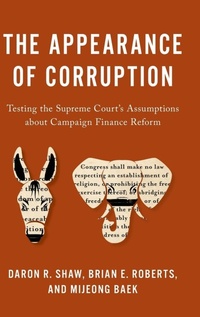
The Appearance of Corruption
Testing the Supreme Court's Assumptions about Campaign Finance Reform
Published on 15. April 2021
Book
Hardback
200 pages
978-0-19-754841-7 (ISBN)
Description
A critical analysis of the connections that the United States Supreme Court has made between campaign finance regulations and voters' behavior.
The sanctity of political speech is a key element of the United States Constitution and a cornerstone of the American republic. When the Supreme Court linked political speech to campaign finance in its landmark Buckley v. Valeo (1976) decision, the modern era of campaign finance regulation was born. The decision stated that in order to pass constitutional muster, any laws limiting money in politics must be narrowly tailored and serve a compelling state interest. The lone state interest the Court was willing to entertain was the mitigation of corruption. In order to reach this conclusion, the Court advanced a sophisticated behavioral model that made assumptions about how laws affect voters' opinions and behavior. These assumptions have received surprisingly little attention until now.
In The Appearance of Corruption, Daron Shaw, Brian Roberts, and Mijeong Baek analyze the connections that the Court made between campaign finance regulations and voters' behavior. The court argued that an increase in perceived corruption would lower engagement and turnout. Drawing from original survey data and experiments, they confront the question of what happens when the Supreme Court is wrong-and when the foundation of over 40 years of jurisprudence is simply not true. Even with the heightened awareness of campaign finance issues that emerged in the wake of the 2010 Citizens United decision, there is little empirical support for the Court's reasoning that turnout would decline. A rigorous statistical analysis, this is the first work to simultaneously name and test each and every one of the Court's assumptions in the pre- and post-Citizen's United eras. It will also fundamentally reshape how we think about campaign finance regulation's effects on voter behavior.
The sanctity of political speech is a key element of the United States Constitution and a cornerstone of the American republic. When the Supreme Court linked political speech to campaign finance in its landmark Buckley v. Valeo (1976) decision, the modern era of campaign finance regulation was born. The decision stated that in order to pass constitutional muster, any laws limiting money in politics must be narrowly tailored and serve a compelling state interest. The lone state interest the Court was willing to entertain was the mitigation of corruption. In order to reach this conclusion, the Court advanced a sophisticated behavioral model that made assumptions about how laws affect voters' opinions and behavior. These assumptions have received surprisingly little attention until now.
In The Appearance of Corruption, Daron Shaw, Brian Roberts, and Mijeong Baek analyze the connections that the Court made between campaign finance regulations and voters' behavior. The court argued that an increase in perceived corruption would lower engagement and turnout. Drawing from original survey data and experiments, they confront the question of what happens when the Supreme Court is wrong-and when the foundation of over 40 years of jurisprudence is simply not true. Even with the heightened awareness of campaign finance issues that emerged in the wake of the 2010 Citizens United decision, there is little empirical support for the Court's reasoning that turnout would decline. A rigorous statistical analysis, this is the first work to simultaneously name and test each and every one of the Court's assumptions in the pre- and post-Citizen's United eras. It will also fundamentally reshape how we think about campaign finance regulation's effects on voter behavior.
Reviews / Votes
This masterful treatise is a highly engaging and lucid analysis of Supreme Court jurisprudence on money in politics. Shaw, Roberts and Baek are first-rate scholars and communicators. They pinpoint key assertions about political behavior underlying Court opinions, then put these claims to the test in a series of empirical chapters. This logical and even-handed approach is a refreshing reprieve from the usual demagoguery that dominates the policy debate over campaign financing. The result is a compelling civics lesson not just for students of American government, but for any citizen concerned about the influence of money in politics. * Jeff Milyo, Chairman and Professor of Economics, Economics, University of Missouri * The Supreme Court, through decisions like Citizens United, have had the most powerful impact on the design of campaign finance laws. This books questions whether they have been flying blind with their assumptions about perceived corruption and its impact on American's trust and participation. The book should have a significant impact on how we think about campaign finance reform and hopefully spur some innovative thinking. It is must read for policymakers scholars, students and the engaged public. * Raymond La Raja, Professor of Political Science, University of Massachusetts Amherst *More details
Language
English
Place of publication
New York
United States
Target group
Professional and scholarly
Illustrations
39
Dimensions
Height: 240 mm
Width: 161 mm
Thickness: 15 mm
Weight
464 gr
ISBN-13
978-0-19-754841-7 (9780197548417)
Copyright in bibliographic data and cover images is held by Nielsen Book Services Limited or by the publishers or by their respective licensors: all rights reserved.
Schweitzer Classification
Other editions
Additional editions
Daron R. Shaw | Brian E. Roberts | Mijeong Baek
The Appearance of Corruption
Testing the Supreme Court's Assumptions about Campaign Finance Reform
E-Book
02/2021
OUP eBook
€30.49
Available for download
Daron R. Shaw | Brian E. Roberts | Mijeong Baek
The Appearance of Corruption
Testing the Supreme Court's Assumptions about Campaign Finance Reform
E-Book
02/2021
OUP eBook
€30.49
Available for download
Persons
Daron R. Shaw is Distinguished Teaching Professor and Frank C. Erwin, Jr. Chair of State Politics at the University of Texas at Austin. His research interests include public opinion and voting behavior, elections and campaigns, political parties, and survey research methodology. He is author of The Race to 270, co-author of Unconventional Wisdom, and co-author of The Turnout Myth. His work includes articles in American Political Science Review, American Journal of Political Science, British Journal of Political Science, Journal of Politics, Political Research Quarterly, Political Behavior, Electoral Studies, Political Communication and Election Law Journal.
Brian E. Roberts is Professor of Government at the University of Texas at Austin, specializing in applied American politics. His interests include corporate political behavior and, more generally, campaign finance. His work includes articles in American Political Science Review,
American Journal of Political Science, British Journal of Political Science, Journal of Politics, and Election Law Journal.
Mijeong Baek is currently a senior researcher at the Korean Consulate General in Los Angeles. Her research interests include public opinion, election campaigns, and American foreign policy.
Brian E. Roberts is Professor of Government at the University of Texas at Austin, specializing in applied American politics. His interests include corporate political behavior and, more generally, campaign finance. His work includes articles in American Political Science Review,
American Journal of Political Science, British Journal of Political Science, Journal of Politics, and Election Law Journal.
Mijeong Baek is currently a senior researcher at the Korean Consulate General in Los Angeles. Her research interests include public opinion, election campaigns, and American foreign policy.
Author
University Distinguished Teaching Professor & Frank C. Erwin, Jr. Chair of State PoliticsUniversity Distinguished Teaching Professor & Frank C. Erwin, Jr. Chair of State Politics, University of Texas at Austin
Professor, Department of GovernmentProfessor, Department of Government, University of Texas at Austin
Senior ResearcherSenior Researcher, Consulate General of the Republic of Korea in Los Angeles
Content
Acknowledgments
Preface
Chapter 1: The Appearance of Corruption: An Introduction
Chapter 2: What Do Americans Know about Campaign Finance?
Chapter 3: Gauging (Perceived) Corruption
Chapter 4: Perceived Corruption and Trust in Government
Chapter 5: Perceived Corruption and Political Participation
Chapter 6: Campaign Contributions and Partisan Vote Choice
Chapter 7: Campaign Finance Reform and the Court in a Post-Citizens United World?
References
Preface
Chapter 1: The Appearance of Corruption: An Introduction
Chapter 2: What Do Americans Know about Campaign Finance?
Chapter 3: Gauging (Perceived) Corruption
Chapter 4: Perceived Corruption and Trust in Government
Chapter 5: Perceived Corruption and Political Participation
Chapter 6: Campaign Contributions and Partisan Vote Choice
Chapter 7: Campaign Finance Reform and the Court in a Post-Citizens United World?
References