


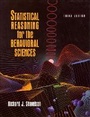
Statistical Reasoning for the Behavioral Sciences
International Edition
3rd Edition
Published on 8. February 1996
Book
Paperback/Softback
650 pages
978-0-205-19781-1 (ISBN)
Description
According to Richard Shavelson, the goal of any good statistics book is for readers not only to learn the meaning of statistical concepts but also to be able to use these concepts to solve problems. This new, revised edition of Statistical Reasoning is written with a two-pronged objective: conceptual and procedural knowledge of statistics. Extensive use of verbal as well as visual exposition, and an uncommonly wide use of figures that parallel what is being explained in the text, aids the learning process and provides, in the author's words, a "motion picture of the concepts at work." In addition, the book motivates the study of statistics with research design in areas such as psychology, education, and sociology and illustrates the usefulness of statistics for research in these fields.
More details
Edition
3rd edition
Language
English
Place of publication
United States
Publishing group
Pearson Education (US)
Target group
Professional and scholarly
Dimensions
Height: 232 mm
Width: 190 mm
Thickness: 24 mm
Weight
997 gr
ISBN-13
978-0-205-19781-1 (9780205197811)
Copyright in bibliographic data is held by Nielsen Book Services Limited or its licensors: all rights reserved.
Schweitzer Classification
Other editions
Previous edition
Book
01/1996
3rd Edition
Pearson
€353.56
Article exhausted; check for reprint
Content
Preface.
I. RESEARCH AND THE ROLE OF STATISTICS.
1. Research Design in the Behavioral Sciences.
2. Statistics in Context: Research on Teacher Expectancy.
II. DESCRIPTIVE STATISTICS FOR UNIVARIATE DISTRIBUTIONS.
3. Frequency Distributions.
4. Measures of Central Tendency and Variability.
5. The Normal Distribution.
III. DESCRIPTIVE STATISTICS FOR JOINT DISTRIBUTIONS.
6. Joint Distributions and Correlation Coefficients.
7. Linear Regression.
IV. REASONING BEHIND STATISTICAL INFERENCE.
8. Statistical Inference: By Intuition.
9. Probability Theory and Mathematical Distributions.
10. Statistical Inference Using the Normal Distribution.
11. Decisions, Error, and Power.
V. STATISTICAL TESTS FOR BETWEEN-SUBJECTS DESIGNS.
12. Tests for Case I and Case II Research.
13. One-Way Analysis of Variance.
14. Factorial Analysis of Variance.
VI. STATISTICAL TESTS FOR WITHIN-SUBJECTS AND MIXED DESIGNS.
15. Randomized-Blocks Analysis of Variance.
16. Split-Plot Analysis of Variance.
17. Analysis of Covariance.
VII. ADDITIONAL TOPICS: CORRELATIONAL AND NONPARAMETRIC STATISTICAL ANALYSIS.
18. Multiple Regression Analysis.
19. Chi Square Tests.
20. Additional Nonparametric Tests.
Appendix I. Review of Summation Notation.
Appendix II. Miscellaneous Tables.
Appendix III. Glossary of Formulas.
References.
Index.
I. RESEARCH AND THE ROLE OF STATISTICS.
1. Research Design in the Behavioral Sciences.
2. Statistics in Context: Research on Teacher Expectancy.
II. DESCRIPTIVE STATISTICS FOR UNIVARIATE DISTRIBUTIONS.
3. Frequency Distributions.
4. Measures of Central Tendency and Variability.
5. The Normal Distribution.
III. DESCRIPTIVE STATISTICS FOR JOINT DISTRIBUTIONS.
6. Joint Distributions and Correlation Coefficients.
7. Linear Regression.
IV. REASONING BEHIND STATISTICAL INFERENCE.
8. Statistical Inference: By Intuition.
9. Probability Theory and Mathematical Distributions.
10. Statistical Inference Using the Normal Distribution.
11. Decisions, Error, and Power.
V. STATISTICAL TESTS FOR BETWEEN-SUBJECTS DESIGNS.
12. Tests for Case I and Case II Research.
13. One-Way Analysis of Variance.
14. Factorial Analysis of Variance.
VI. STATISTICAL TESTS FOR WITHIN-SUBJECTS AND MIXED DESIGNS.
15. Randomized-Blocks Analysis of Variance.
16. Split-Plot Analysis of Variance.
17. Analysis of Covariance.
VII. ADDITIONAL TOPICS: CORRELATIONAL AND NONPARAMETRIC STATISTICAL ANALYSIS.
18. Multiple Regression Analysis.
19. Chi Square Tests.
20. Additional Nonparametric Tests.
Appendix I. Review of Summation Notation.
Appendix II. Miscellaneous Tables.
Appendix III. Glossary of Formulas.
References.
Index.