

Writing Early China
Published on 1. November 2023
Book
Hardback
432 pages
978-1-4384-9522-4 (ISBN)
Description
Considers what unearthed documents reveal about the creation and transmission of knowledge in ancient China.
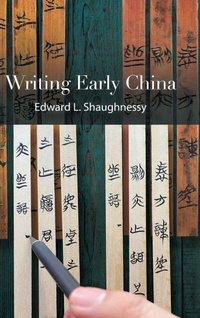
Archaeological discoveries over the past one hundred years have resulted in repeated calls to "rewrite ancient Chinese history." This is especially true of documents written on oracle bones, bronze vessels, and bamboo strips. In Writing Early China, Edward L. Shaughnessy surveys all of these types of documents and considers what they reveal about the creation and transmission of knowledge in ancient China. Opposed to the common view that most knowledge was transmitted orally in ancient China, Shaughnessy demonstrates that by no later than the tenth century BCE scribes were writing lengthy texts like portions of the Chinese classics, and that by the fourth century BCE the primary mode of textual transmission was by way of visual copying from one manuscript to another.
Archaeological discoveries over the past one hundred years have resulted in repeated calls to "rewrite ancient Chinese history." This is especially true of documents written on oracle bones, bronze vessels, and bamboo strips. In Writing Early China, Edward L. Shaughnessy surveys all of these types of documents and considers what they reveal about the creation and transmission of knowledge in ancient China. Opposed to the common view that most knowledge was transmitted orally in ancient China, Shaughnessy demonstrates that by no later than the tenth century BCE scribes were writing lengthy texts like portions of the Chinese classics, and that by the fourth century BCE the primary mode of textual transmission was by way of visual copying from one manuscript to another.
Reviews / Votes
"Writing Early China is a valuable contribution to sinology, presenting a perspective on early Chinese literacy while encouraging further scholarly discussion. For scholars and students alike, the work provides a nuanced look at how writing shaped ancient Chinese society, while the focus on archaeological findings offers a fresh counterpoint to traditional views of an orally dominated culture." - Religious Studies Review"By emphasizing the importance of writing, Shaughnessy presents a welcome complement to scholarship emphasizing the role of orality in early Chinese textual culture. There are few scholars as well-versed in newly discovered textual sources, including the Tsinghua and Anhui University collections. Shaughnessy introduces readers to important new texts, on some of which very little has so far been published in English, and he demonstrates and explains important methodological issues in studying these materials. This book will naturally attract students of early China, but it should also find interest much more broadly, both among historians of antiquity in other parts of the world as well as scholars specializing in other periods of Chinese history." - Matthias L. Richter, author of The Embodied Text: Establishing Textual Identity in Early Chinese Manuscripts
More details
Series
Language
English
Place of publication
Albany, NY
United States
Target group
Professional and scholarly
US School Grade: College Graduate Student and over
Illustrations
2 Figures; 2 Tables, black and white; 16 Illustrations, black and white
Dimensions
Height: 235 mm
Width: 157 mm
Thickness: 30 mm
Weight
848 gr
ISBN-13
978-1-4384-9522-4 (9781438495224)
Copyright in bibliographic data and cover images is held by Nielsen Book Services Limited or by the publishers or by their respective licensors: all rights reserved.
Schweitzer Classification
Other editions
Additional editions
Edward L. Shaughnessy
Writing Early China
E-Book
11/2023
1st Edition
De Gruyter
from
€91.99
Available for download
Person
Edward L. Shaughnessy is Creel Distinguished Service Professor of Early China in the Department of East Asian Languages and Civilizations at the University of Chicago. He is the author of Rewriting Early Chinese Texts, also published by SUNY Press.
Content
List of Illustrations
Acknowledgments
Introduction
Part I: Inscriptions
1. History and Inscriptions
2. The Bin Gong Xu Inscription and the Origins of the Chinese Literary Tradition
3. The Writing of a Late Western Zhou Bronze Inscription
4. On the Casting of the Art Institute of Chicago's Shi Wang Ding: With Remarks on the Important Position of Writing in the Consciousness of Ancient China
Part II: The Classics
5. A Possible Lost Classic: The *She Ming or *Command to She
6. Varieties of Textual Variants: Evidence from the Tsinghua Bamboo-Slip *Ming Xun Manuscript
7. Unearthed Documents and the Question of the Oral versus Written Nature of the Shi Jing
8. A First Reading of the Anhui University Bamboo-Slip Shi Jing
Part III: Manuscripts
9. The Mu Tianzi Zhuan and King Mu-Period Bronzes
10. The Tsinghua Manuscript *Zheng Wen Gong wen Tai Bo and the Question of the Production of Manuscripts in Early China
11. The Eighth Century BCE Civil War in Jin as Seen in the Bamboo Annals: On the Nature of the Tomb Text and Its Significance for the "Current" Bamboo Annals
12. The Qin *Bian Nian Ji and the Beginnings of Historical Writing in China
Notes
Bibliography
Index
Acknowledgments
Introduction
Part I: Inscriptions
1. History and Inscriptions
2. The Bin Gong Xu Inscription and the Origins of the Chinese Literary Tradition
3. The Writing of a Late Western Zhou Bronze Inscription
4. On the Casting of the Art Institute of Chicago's Shi Wang Ding: With Remarks on the Important Position of Writing in the Consciousness of Ancient China
Part II: The Classics
5. A Possible Lost Classic: The *She Ming or *Command to She
6. Varieties of Textual Variants: Evidence from the Tsinghua Bamboo-Slip *Ming Xun Manuscript
7. Unearthed Documents and the Question of the Oral versus Written Nature of the Shi Jing
8. A First Reading of the Anhui University Bamboo-Slip Shi Jing
Part III: Manuscripts
9. The Mu Tianzi Zhuan and King Mu-Period Bronzes
10. The Tsinghua Manuscript *Zheng Wen Gong wen Tai Bo and the Question of the Production of Manuscripts in Early China
11. The Eighth Century BCE Civil War in Jin as Seen in the Bamboo Annals: On the Nature of the Tomb Text and Its Significance for the "Current" Bamboo Annals
12. The Qin *Bian Nian Ji and the Beginnings of Historical Writing in China
Notes
Bibliography
Index