

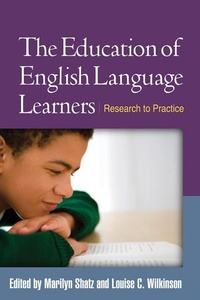
The Education of English Language Learners
Research to Practice
1st Edition
Published on 16. September 2011
Book
Paperback/Softback
306 pages
978-1-4625-0330-8 (ISBN)
Description
This comprehensive volume describes evidence-based strategies for supporting English language learners (ELLs) by promoting meaningful communication and language use across the curriculum. Leading experts explain how and why learning is different for ELLs and pinpoint specific best practices for the classroom, illustrated with vivid examples. Particular attention is given to ways in which learning English is intertwined with learning the student's home language. The book addresses both assessment and instruction for typically developing ELLs and those with language disabilities and disorders. It demonstrates how educators and speech-language professionals can draw on students' linguistic, cognitive, sociocultural, and family resources to help close the achievement gap.
Reviews / Votes
"Perhaps no topic is of greater interest today to educational researchers, policymakers, and practitioners than how best to meet the needs of ELLs. This state-of-the-art work, presented in a lively and accessible fashion, provides a thorough and practical treatment of this topic from leading experts in the field. A 'must have' for all of us."--Laura M. Justice, PhD, EHE Distinguished Professor of Educational Psychology, The Ohio State University"This definitive book represents research-to-practice at its best. The contributors are cutting-edge researchers with significant practical experience. What makes the book unique is that it takes multiple perspectives--neurological, theoretical, behavioral, social, cognitive, environmental, and individual--and weaves them into a coherent and accessible tapestry, laying to rest the notion that ELLs are destined to lag behind their monolingual peers. Educators will be able to read this book and immediately begin to implement changes in their instruction. It could serve as a text in any teacher training program and could also be used in training other professionals, such as ESL instructors, reading specialists, school psychologists, and speech/n-/language pathologists."--Brian A. Goldstein, PhD, Department of Communication Sciences and Disorders, Temple University
"A 'must read' for every inservice and preservice teacher. The book is extremely well organized, with excellent continuity from one chapter to the next. The contributors are outstanding scholars who present reader-friendly chapters that cover theory, research, and best practices for the classroom. This book should be adopted as a text in an ELL course or courses that deal with teaching any content area. Kudos to the editors on this important volume."--Lesley Mandel Morrow, PhD, Distinguished Professor of Literacy and Chair, Department of Learning and Teaching, Rutgers, The State University of New Jersey - The editors have assembled contributions from 12 experts on the subject of ELL education. They include the most current research available, which enhances and at times debunks traditionally held views....Despite the complex issues pertaining to ELL, the book presents them in a manner that novices can easily grasp. Highly recommended. Upper-division undergraduate, graduate, research, and professional collections. --Choice, 2/3/2011??For an individual reader, the greatest yield from this text might be more than the practical ideas they can apply. The text also has the promise of challenging assumptions, sometimes hidden and sometimes overt, that we as teachers or the systems within which we work make about language acquisition or the potential of ELLs. Detailed quantitative evidence and powerful qualitative descriptions offer a starting point for reflecting on one's own practice or advocating for change....A rigorous, challenging work Invaluable for educators from a variety of backgrounds, an opportunity to learn and to use theory and research-validated concepts and practices to change classrooms, policies, and personal beliefs. As has been noted, the substantial attention given to the topic of assessment and to the role of administrators is unique and adds to the value of this timely and important work.--Journal of Education, 9/9/2014 "Perhaps no topic is of greater interest today to educational researchers, policymakers, and practitioners than how best to meet the needs of ELLs. This state-of-the-art work, presented in a lively and accessible fashion, provides a thorough and practical treatment of this topic from leading experts in the field. A 'must have' for all of us."--Laura M. Justice, PhD, EHE Distinguished Professor of Educational Psychology, The Ohio State University
"This definitive book represents research-to-practice at its best. The contributors are cutting-edge researchers with significant practical experience. What makes the book unique is that it takes multiple perspectives--neurological, theoretical, behavioral, social, cognitive, environmental, and individual--and weaves them into a coherent and accessible tapestry, laying to rest the notion that ELLs are destined to lag behind their monolingual peers. Educators will be able to read this book and immediately begin to implement changes in their instruction. It could serve as a text in any teacher training program and could also be used in training other professionals, such as ESL instructors, reading specialists, school psychologists, and speech/n-/language pathologists."--Brian A. Goldstein, PhD, Department of Communication Sciences and Disorders, Temple University
"A 'must read' for every inservice and preservice teacher. The book is extremely well organized, with excellent continuity from one chapter to the next. The contributors are outstanding scholars who present reader-friendly chapters that cover theory, research, and best practices for the classroom. This book should be adopted as a text in an ELL course or courses that deal with teaching any content area. Kudos to the editors on this important volume."--Lesley Mandel Morrow, PhD, Distinguished Professor of Literacy and Chair, Department of Learning and Teaching, Rutgers, The State University of New Jersey - The editors have assembled contributions from 12 experts on the subject of ELL education. They include the most current research available, which enhances and at times debunks traditionally held views....Despite the complex issues pertaining to ELL, the book presents them in a manner that novices can easily grasp. Highly recommended. Upper-division undergraduate, graduate, research, and professional collections. --Choice, 2/3/2011AE'AE' For an individual reader, the greatest yield from this text might be more than the practical ideas they can apply. The text also has the promise of challenging assumptions, sometimes hidden and sometimes overt, that we as teachers or the systems within which we work make about language acquisition or the potential of ELLs. Detailed quantitative evidence and powerful qualitative descriptions offer a starting point for reflecting on one's own practice or advocating for changeaEUR|.A rigorous, challenging work Invaluable for educators from a variety of backgrounds, an opportunity to learn and to use theory and research-validated concepts and practices to change classrooms, policies, and personal beliefs. As has been noted, the substantial attention given to the topic of assessment and to the role of administrators is unique and adds to the value of this timely and important work.--Journal of Education, 9/9/2014
More details
Series
Language
English
Place of publication
New York
United States
Publishing group
Guilford Publications
Target group
College/higher education
Product notice
Paperback (trade)
Unsewn / adhesive bound
Dimensions
Height: 226 mm
Width: 150 mm
Thickness: 23 mm
Weight
431 gr
ISBN-13
978-1-4625-0330-8 (9781462503308)
Copyright in bibliographic data and cover images is held by Nielsen Book Services Limited or by the publishers or by their respective licensors: all rights reserved.
Schweitzer Classification
Other editions
Additional editions
Book
06/2010
1st Edition
Guilford Publications
€83.00
Shipment within 15-20 days
E-Book
04/2010
The Guilford Press
€37.99
Available for download
Persons
Marilyn Shatz, PhD, is Professor Emerita of Psychology and Linguistics at the University of Michigan and Adjunct Professor of Psychology at the University of North Carolina, Wilmington. She is a fellow of the American Psychological Society and has been a Guggenheim Fellow; a Senior Research Fulbright Scholar; and a recipient of a National Institute of Education fellowship. An expert in language and the development of communication skills, Dr. Shatz has used both naturalistic and experimental methods to carry out research on the interrelations among social, cognitive, and language development in young children. Her current research investigates how young children acquire abstract vocabulary. Dr. Shatz has published more than 70 chapters, articles, and books, and has served as an editor and editorial board member of numerous journals.
Louise C. Wilkinson, EdD, is Distinguished Professor of Education, Psychology, and Communication Sciences at Syracuse University, where she teaches courses on literacy learning for English language learners. An internationally recognized leader in education, she is best known for her extensive research on school-age children's language and literacy learning and has published 150 articles, chapters, and volumes. Dr. Wilkinson has served on the editorial boards of major research journals. She is a fellow of the American Psychological Association, the Association for Psychological Science, the American Educational Research Association, and the American Association of Applied and Preventive Psychology. Dr. Wilkinson cochairs the Literacy Leadership for Urban Teacher Education Commission of the International Reading Association.
Louise C. Wilkinson, EdD, is Distinguished Professor of Education, Psychology, and Communication Sciences at Syracuse University, where she teaches courses on literacy learning for English language learners. An internationally recognized leader in education, she is best known for her extensive research on school-age children's language and literacy learning and has published 150 articles, chapters, and volumes. Dr. Wilkinson has served on the editorial boards of major research journals. She is a fellow of the American Psychological Association, the Association for Psychological Science, the American Educational Research Association, and the American Association of Applied and Preventive Psychology. Dr. Wilkinson cochairs the Literacy Leadership for Urban Teacher Education Commission of the International Reading Association.
Content
Introduction, Marilyn Shatz and Louise C. WilkinsonI. Early Language Experience and School Readiness 1. The Brain and Language Acquisition: Variation in Language Knowledge and Readiness for Education, Barbara T. Conboy 2. The Process of Acquiring a First and Second Language, Kathryn Kohnert and Giang Pham 3. Language Choice and Competence: Code Switching and Issues of Social Identity in Young Bilingual Children, Iliana Reyes and Susan M. Ervin-TrippII. Language and Literacy Principles and Practices in School 4. Ways to Words: Learning a Second-Language Vocabulary, Lisa M. Bedore, Elizabeth D. Pena, and Karin Boerger 5. The Role of Phonology in Orthographically Different Languages, Ellen H. Newman 6. Bilingualism and Cognitive Linkages: Learning to Read in Different Languages, Ellen Bialystok and Kathleen F. Peets 7. Learning English as a Second Language, Maria Estela BriskIII. Assessment and Interaction: Working with Children and Families 8. Communicative Repertoires and English Language Learners, Betsy Rymes 9. Difficulty, Delay, or Disorder: What Makes English Hard for English Language Learners?, Carol Westby and Deborah A. Hwa-Froelich 10. Implications for Assessment and Instruction, Alison L. Bailey 11. Extended Implications for Practice: Families as Allies, Leslie Reese and Claude Goldenberg 12. Recent Research on English Language and Literacy Instruction: What We Have Learned to Guide Practice for English Language Learners in the 21st Century, Diane August, Claude Goldenberg, William M. Saunders, and Cheryl Dressler