

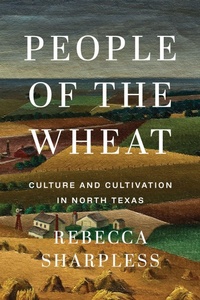
People of the Wheat
Culture and Cultivation in North Texas
Will be published approx. on 10. March 2026
Book
Hardback
272 pages
978-1-4773-3332-7 (ISBN)
Description
How wheat growing, milling, and baking shaped the people and culture of North Texas.
In the national imaginary, America's amber fields of grain lie in the country's center, but for more than a century, they also grew across one pocket of the South: North Texas. From the 1840s to the 1970s, the state's agriculture, dominated in lore by cotton in the east and livestock in the open range, was heavily invested in the cultivation, processing, sale, and consumption of wheat. Recalling a forgotten history, Rebecca Sharpless shows how the rhythms of the wheat harvest-and the evolution of the milling, distribution, and baking industries-governed daily life in what is now known as the Dallas-Forth Worth Metroplex.
In the 1840s, Anglo settlers discovered that grain flourished in North Texas and quickly built an economy that included wheat in fields, mills, and kitchens. After the Civil War, hand labor gave way to mechanization, greatly increasing production. Commercial bakeries churned out novel confections, and big cities were built on the bounty of the countryside. In the second half of the twentieth century, as production moved northward, industrial milling and baking declined, but home baking boomed, flour advertising supported regional music, and wheat fortunes financed the region's cultural life. Sharpless covers 150 years of wheat's very human history and shows how the labor that cultivated it, the sustenance it provided, and the prosperity it generated left an indelible mark on the people and institutions of Texas.
In the national imaginary, America's amber fields of grain lie in the country's center, but for more than a century, they also grew across one pocket of the South: North Texas. From the 1840s to the 1970s, the state's agriculture, dominated in lore by cotton in the east and livestock in the open range, was heavily invested in the cultivation, processing, sale, and consumption of wheat. Recalling a forgotten history, Rebecca Sharpless shows how the rhythms of the wheat harvest-and the evolution of the milling, distribution, and baking industries-governed daily life in what is now known as the Dallas-Forth Worth Metroplex.
In the 1840s, Anglo settlers discovered that grain flourished in North Texas and quickly built an economy that included wheat in fields, mills, and kitchens. After the Civil War, hand labor gave way to mechanization, greatly increasing production. Commercial bakeries churned out novel confections, and big cities were built on the bounty of the countryside. In the second half of the twentieth century, as production moved northward, industrial milling and baking declined, but home baking boomed, flour advertising supported regional music, and wheat fortunes financed the region's cultural life. Sharpless covers 150 years of wheat's very human history and shows how the labor that cultivated it, the sustenance it provided, and the prosperity it generated left an indelible mark on the people and institutions of Texas.
More details
Language
English
Place of publication
Austin, TX
United States
Target group
Professional and scholarly
Illustrations
15 b&w photos, 1 map
Dimensions
Height: 162 mm
Width: 237 mm
Thickness: 32 mm
Weight
626 gr
ISBN-13
978-1-4773-3332-7 (9781477333327)
Copyright in bibliographic data and cover images is held by Nielsen Book Services Limited or by the publishers or by their respective licensors: all rights reserved.
Schweitzer Classification
Person
Rebecca Sharpless is a professor of history at Texas Christian University. She is the author of Fertile Ground, Narrow Choices: Women on Texas Cotton Farms, Cooking in Other Women's Kitchens: Domestic Workers in the South; and Grain and Fire: A History of Baking in the American South.
Content
List of Illustrations
Prologue: "Definitive Excellence"
Introduction: Soil and People
1. "Our Prairie Flour": Colonization, 1840-1861
2. "The Granary of the Confederate States": Civil War, 1861-1865
3. From Prairie to Production: Growing Wheat, 1865-1900
4. Oxen to Electricity: Milling, 1865-1900
5. From Biscuits to Angel Food Cake: Baking, 1865-1900
6. Wheat in the Spring and Cotton in the Fall: Growing, 1900-1940
7. Mechanization, Marketing, and Music: Milling, 1900-1940
8. Homemade Sweets and Standardized Bread: Baking, 1900-1940
9. Fading Glory, Waning Memory: 1940-1972
Epilogue
Acknowledgments
Notes
Bibliography
Index
Prologue: "Definitive Excellence"
Introduction: Soil and People
1. "Our Prairie Flour": Colonization, 1840-1861
2. "The Granary of the Confederate States": Civil War, 1861-1865
3. From Prairie to Production: Growing Wheat, 1865-1900
4. Oxen to Electricity: Milling, 1865-1900
5. From Biscuits to Angel Food Cake: Baking, 1865-1900
6. Wheat in the Spring and Cotton in the Fall: Growing, 1900-1940
7. Mechanization, Marketing, and Music: Milling, 1900-1940
8. Homemade Sweets and Standardized Bread: Baking, 1900-1940
9. Fading Glory, Waning Memory: 1940-1972
Epilogue
Acknowledgments
Notes
Bibliography
Index