

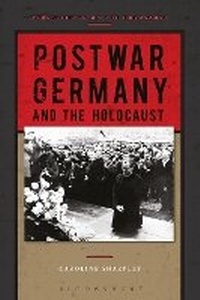
Postwar Germany and the Holocaust
Published on 17. December 2015
Book
Hardback
248 pages
978-1-4725-1374-8 (ISBN)
Description
CHOICE Outstanding Academic Title 2016
Focussing on German responses to the Holocaust since 1945, Postwar Germany and the Holocaust traces the process of Vergangenheitsbewaeltigung ('overcoming the past'), the persistence of silences, evasions and popular mythologies with regards to the Nazi era, and cultural representations of the Holocaust up to the present day. It explores the complexities of German memory cultures, the construction of war and Holocaust memorials and the various political debates and scandals surrounding the darkest chapter in German history.
The book comparatively maps out the legacy of the Holocaust in both East and West Germany, as well as the unified Germany that followed, to engender a consideration of the effects of division, Cold War politics and reunification on German understanding of the Holocaust. Synthesizing key historiographical debates and drawing upon a variety of primary source material, this volume is an important exploration of Germany's postwar relationship with the Holocaust.
Complete with chapters on education, war crime trials, memorialization and Germany and the Holocaust today, as well as a number of illustrations, maps and a detailed bibliography, Postwar Germany and the Holocaust is a pivotal text for anyone interested in understanding the full impact of the Holocaust in Germany.
Focussing on German responses to the Holocaust since 1945, Postwar Germany and the Holocaust traces the process of Vergangenheitsbewaeltigung ('overcoming the past'), the persistence of silences, evasions and popular mythologies with regards to the Nazi era, and cultural representations of the Holocaust up to the present day. It explores the complexities of German memory cultures, the construction of war and Holocaust memorials and the various political debates and scandals surrounding the darkest chapter in German history.
The book comparatively maps out the legacy of the Holocaust in both East and West Germany, as well as the unified Germany that followed, to engender a consideration of the effects of division, Cold War politics and reunification on German understanding of the Holocaust. Synthesizing key historiographical debates and drawing upon a variety of primary source material, this volume is an important exploration of Germany's postwar relationship with the Holocaust.
Complete with chapters on education, war crime trials, memorialization and Germany and the Holocaust today, as well as a number of illustrations, maps and a detailed bibliography, Postwar Germany and the Holocaust is a pivotal text for anyone interested in understanding the full impact of the Holocaust in Germany.
More details
Series
Language
English
Place of publication
London
United Kingdom
Publishing group
Bloomsbury Publishing PLC
Target group
Professional and scholarly
Illustrations
8 bw illus
Dimensions
Height: 234 mm
Width: 156 mm
Weight
531 gr
ISBN-13
978-1-4725-1374-8 (9781472513748)
DOI
CBID180090
Copyright in bibliographic data and cover images is held by Nielsen Book Services Limited or by the publishers or by their respective licensors: all rights reserved.
Schweitzer Classification
Person
Caroline Sharples is Research Fellow in the Centre for German-Jewish Studies at the University of Sussex, UK. She is the author of West Germans and the Nazi Legacy (2012) and co-editor, along with Olaf Jensen, of Britain and the Holocaust: Remembering and Representing War and Genocide (2013).
Content
Introduction: Germany and the Holocaust
1. Confronting the Holocaust, 1945-9
2. 'Victims of Fascism': Narratives of German Suffering since 1945
3. Acknowledging Suffering: Recalling the Victims of Nazi Racial Persecution since 1945
4. The Pursuit of Justice
5. The German Churches and the Holocaust
6. Memorializing the Holocaust
7. The Holocaust on Screen: Representations of the Nazi Genocide in German Film and on German Television
8. Holocaust Education in Germany
Conclusion: How the Holocaust Looks Today
Notes
Bibliography
Index
1. Confronting the Holocaust, 1945-9
2. 'Victims of Fascism': Narratives of German Suffering since 1945
3. Acknowledging Suffering: Recalling the Victims of Nazi Racial Persecution since 1945
4. The Pursuit of Justice
5. The German Churches and the Holocaust
6. Memorializing the Holocaust
7. The Holocaust on Screen: Representations of the Nazi Genocide in German Film and on German Television
8. Holocaust Education in Germany
Conclusion: How the Holocaust Looks Today
Notes
Bibliography
Index