

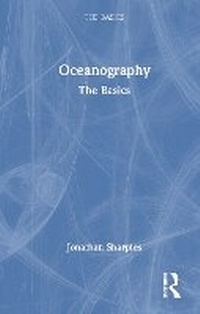
Oceanography
The Basics
1st Edition
Will be published approx. on 6. May 2026
Book
Hardback
256 pages
978-1-032-73280-0 (ISBN)
Description
Earth's oceans are vital for sustaining life on our planet. Oceanography is an intrinsically multidisciplinary science that explores how the ocean does this. The author uses plankton as a focus for the book, drawing together the physics of the ocean circulation, the chemistry of nutrients and carbon, and the biology of the plankton.
The book begins by describing the major ocean currents and tides, and the importance of stratification, or layers, in the ocean. It explains how microscopic plants and animals, the plankton, are fundamental to ocean food chains and Earth's climate, and shows how ocean currents and mixing control the global distribution of plankton. Contrasts are explored between the open ocean and the shallow coastal seas, to help understand why the shallow seas are so productive. Case studies illustrate how the ocean supports fish, including upwelling of deep nutrients, the links between plankton and fish, and how ocean currents provide vital transport routes for fish eggs and larvae. The author explores the importance of the ocean in Earth's carbon cycle and climate. A final chapter describes some of the core techniques used to observe the ocean.
Oceanography: The Basics is an essential introduction to the field for undergraduates, and includes further resources and short, quantitative diversions for students who want to take the concepts further.
The book begins by describing the major ocean currents and tides, and the importance of stratification, or layers, in the ocean. It explains how microscopic plants and animals, the plankton, are fundamental to ocean food chains and Earth's climate, and shows how ocean currents and mixing control the global distribution of plankton. Contrasts are explored between the open ocean and the shallow coastal seas, to help understand why the shallow seas are so productive. Case studies illustrate how the ocean supports fish, including upwelling of deep nutrients, the links between plankton and fish, and how ocean currents provide vital transport routes for fish eggs and larvae. The author explores the importance of the ocean in Earth's carbon cycle and climate. A final chapter describes some of the core techniques used to observe the ocean.
Oceanography: The Basics is an essential introduction to the field for undergraduates, and includes further resources and short, quantitative diversions for students who want to take the concepts further.
More details
Series
Language
English
Place of publication
London
United Kingdom
Publishing group
Taylor & Francis Ltd
Target group
College/higher education
Undergraduate Core
Illustrations
2 s/w Photographien bzw. Rasterbilder, 12 Farbfotos bzw. farbige Rasterbilder, 73 s/w Zeichnungen, 27 farbige Zeichnungen, 3 s/w Tabellen, 75 s/w Abbildungen, 39 farbige Abbildungen
3 Tables, black and white; 27 Line drawings, color; 73 Line drawings, black and white; 12 Halftones, color; 2 Halftones, black and white; 39 Illustrations, color; 75 Illustrations, black and white
Dimensions
Height: 198 mm
Width: 129 mm
Weight
720 gr
ISBN-13
978-1-032-73280-0 (9781032732800)
Copyright in bibliographic data and cover images is held by Nielsen Book Services Limited or by the publishers or by their respective licensors: all rights reserved.
Schweitzer Classification
Other editions
Additional editions
Book
05/2026
1st Edition
Routledge
€30.00
Available immediately
Person
Jonathan Sharples is Professor in Oceanography at the University of Liverpool. He teaches core oceanography to year 1 undergraduates, practical observational oceanography on undergraduate field courses, and data analysis and interpretation to students carrying out their final year research projects. His research and teaching interests lie on the boundaries between ocean physics, the plankton and Earth's climate.
Content
Chapter 1: Introduction Chapter 2: Temperature, Salinity and Density Chapter 3: The Plankton Chapter 4: The Circulation of the Ocean Chapter 5: Tides and other Waves Chapter 6: Global Patterns in Primary Production Chapter 7: The Shelf Seas Chapter 8: The Ocean and Earth's Climate Chapter 9: Measuring the Ocean